



1 min read
How to Prepare Your Pest Control Business for a Successful Exit
Selling a pest control business starts well before it goes to market. Effective exit planning typically begins 12 to 24 months before a sale, giving...
11 min read
Doreen Morgan is the owner and managing broker of Sunbelt Business Brokers – Atlanta, where she has spent two decades guiding Main Street and lower-middle-market business owners through successful sales valued from $750K to $75M. A proven dealmaker, Doreen has personally closed 300-plus transactions since 2005 across B2B services, heavy construction, healthcare, franchising, manufacturing, specialty distribution, and technology. Before acquiring Sunbelt Atlanta in 2015, she sharpened her M&A...
Doreen Morgan
July 27, 2026
Buyer demand for pool service businesses remains strong in 2026, particularly for companies with recurring maintenance revenue, established service routes, and consistent cash flow. Buyers continue to seek businesses that can generate predictable earnings with limited owner involvement, making well-operated pool service companies attractive acquisition opportunities.
For business owners, understanding current buyer demand is about more than timing a sale. Buyers evaluate recurring revenue, profitability, customer retention, technician stability, and transferability before determining what a business is worth. Knowing what drives demand today can help owners make decisions that strengthen both business value and buyer confidence.
Industry fundamentals continue to support acquisition activity. According to the Pool & Hot Tub Alliance (PHTA), the U.S. pool, hot tub, and spa industry represents a $62 billion market, including an estimated $15 billion annual aftermarket for pool and spa care and maintenance. That recurring service demand helps explain why buyers continue looking for established pool service businesses with reliable cash flow and opportunities for long-term growth.
Buyer demand for pool service businesses remains strong in 2026, especially for companies with recurring maintenance revenue, predictable cash flow, and established service routes.
Demand alone doesn't determine valuation. Buyers also evaluate profitability, route efficiency, employee stability, owner dependence, and financial reporting before making an offer.
Well-prepared businesses often receive stronger offers and better deal terms because buyers have greater confidence during due diligence.
Owners planning to sell within the next few years should focus on improving transferability now, giving operational improvements time to become part of the company's track record.
A professional business valuation can identify opportunities to strengthen value before going to market, allowing owners to address potential concerns before buyers discover them.
Pool service businesses continue to attract buyers because many generate predictable recurring revenue from ongoing cleaning, maintenance, and repair services. Buyers value businesses with consistent cash flow because they're generally easier to forecast and transfer to new ownership.
Demand alone doesn't determine buyer interest. Buyers also evaluate how the business operates, how dependable its customer relationships are, and how easily it can continue performing after the owner exits. Companies with organized routes, experienced technicians, and reliable financial reporting are often viewed as lower-risk acquisition opportunities.
Before making an offer, buyers typically evaluate several factors that influence both valuation and deal terms.
| Business Characteristic | Buyer Perspective | Why It Affects Value |
|---|---|---|
| Cash Flow | Demonstrates the business's earning power. | Strong, predictable cash flow generally supports higher valuations. |
| Recurring Revenue | Indicates future income is already established. | Greater recurring revenue reduces buyer risk. |
| Customer Base | Shows revenue stability and customer retention. | Diversified customers improve transferability. |
| Service Routes | Reflects operational efficiency and growth opportunities. | Efficient routes can improve profitability and scalability. |
| Employees | Experienced technicians help maintain service quality. | Stable staffing increases buyer confidence. |
| Owner Involvement | Measures how dependent the business is on one person. | Less owner dependence generally improves valuation. |
| Financial Records | Buyers need to verify reported earnings. | Organized financial reporting supports due diligence. |
Every buyer evaluates a pool service business differently, but they consistently look for predictable cash flow, transferable operations, and manageable risk. Understanding those priorities helps explain why some businesses attract stronger buyer interest than others.
Read More: How Buyers Evaluate Risk and What It Means for Your Valuation
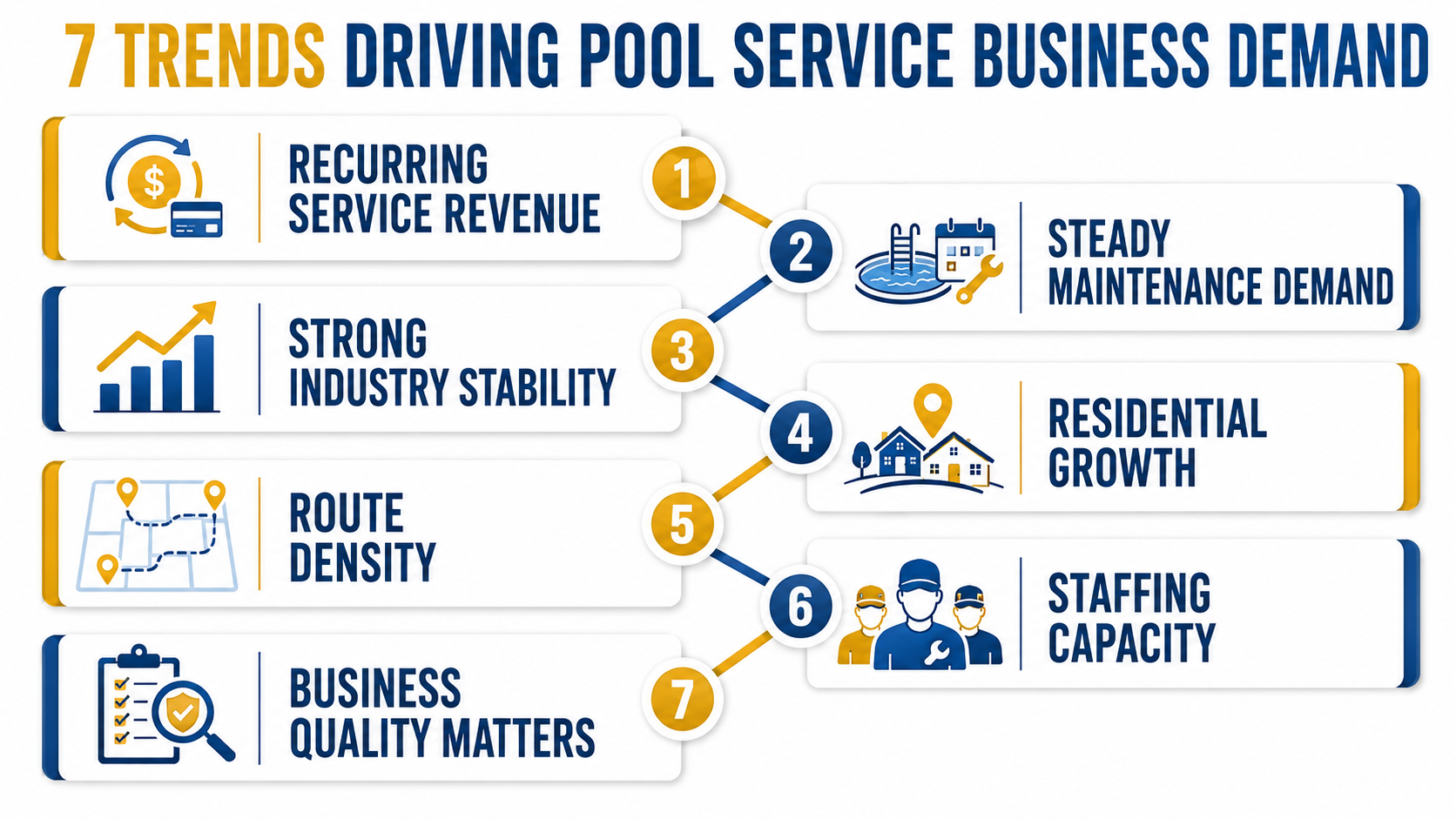
Buyer interest in pool service businesses is supported by recurring maintenance revenue, steady demand from existing pool owners, and opportunities to improve route profitability. Recent industry data also points to continued confidence among pool companies, although buyers still examine the quality of each company’s earnings before deciding what they are willing to pay.

Weekly and monthly maintenance accounts allow buyers to estimate future revenue with greater confidence than one-time repairs or installation projects. They can review customer tenure, cancellation history, pricing, service frequency, and gross profit by route to determine how much revenue is likely to continue after closing.
The recurring model also plays a meaningful role across the broader pool industry. According to the Pool & Hot Tub Alliance’s Q1 2026 Industry Summary, service, repair, and weekly maintenance represented an average of 31.7% of member revenue in 2025, making it the largest reported revenue category. New pool construction accounted for 27.5%.
That revenue mix helps explain why established service routes attract buyers. Maintenance income can continue even when homeowners delay discretionary projects such as new pool installations or major renovations.
For an owner preparing to sell, the number of accounts matters less than the quality of those accounts. Buyers will want to know:
How many customers receive recurring service
How long customers typically remain with the company
Whether pricing has kept pace with labor and chemical costs
How many accounts are seasonal
Whether customer agreements can transfer to a new owner
How frequently customers purchase repairs or replacement equipment
A business with 300 accounts may be less attractive than one with 225 accounts if the larger route has weak margins, frequent cancellations, or customers spread across a wide territory.
Pool service companies generate much of their revenue from assets that have already been installed. Existing pools require cleaning, chemical treatment, equipment inspections, leak detection, repairs, and periodic replacement of pumps, filters, heaters, and automation systems.
This creates several revenue opportunities within the same customer relationship. A weekly cleaning account may later produce repair work, equipment replacement, seasonal services, or renovation referrals. Buyers often examine whether the company captures those opportunities or sends higher-margin work to outside contractors.
The age and condition of the pools within a company’s service area also matter. An older customer base may create more repair and replacement demand, but it can also require technicians with stronger diagnostic skills. Buyers will consider whether the company has the employees, vendor relationships, and operating systems needed to complete that work profitably.
A business that tracks revenue by service category can present a clearer case during valuation. Buyers can separate dependable route revenue from repair income, equipment sales, and project work instead of treating all revenue as equally predictable.
The Pool & Hot Tub Alliance’s Q3 2025 Service and Maintenance Survey found that service companies expected average revenue growth of 5% over the following 12 months. Nearly one-quarter expected growth of at least 10%.
The association’s Q1 2026 summary also reported that 83% of participating industry businesses expected revenue growth during the following year. That result reflects company expectations rather than completed transactions or guaranteed performance, but it provides useful evidence that operators remained confident entering 2026.
Buyers will still compare those industry expectations with the seller’s actual results. A company operating in a growing market may receive limited interest when revenue is flat, margins are shrinking, or customer losses are increasing. Owners should be prepared to explain how their company performed relative to the broader service market.
The latest U.S. Census Bureau Vintage 2025 Estimates provide population data through July 1, 2025. The Census Bureau also estimates that Georgia had approximately 4.73 million housing units as of July 2025 and issued 61,196 residential building permits during 2025.
Those figures do not measure swimming-pool ownership directly. They do show that Georgia’s residential base continues to expand, which can create additional service opportunities in metro Atlanta and surrounding communities.
The practical value of local growth depends on where it occurs. A new subdivision near an established route may allow a company to add customers without adding another vehicle or technician. Growth on the opposite side of the region may increase revenue while reducing route efficiency.
During due diligence, buyers usually map the company's existing service territory before assigning value to future growth opportunities. They want to understand where customers are located, which ZIP codes are producing new accounts, whether technicians have capacity for additional stops, and how much travel time separates route clusters. They also consider whether growth can be supported with existing staff or whether it will require additional vehicles, technicians, or even another service location.
Organic growth within an existing territory is generally easier to manage and often produces stronger margins than expansion into a new market.
Revenue per customer receives considerable attention, but revenue per technician hour often provides a clearer view of route performance. A technician who completes twelve nearby stops may generate more profit than one who completes eight stops spread across several counties. Dense routes can reduce:
Drive time
Fuel expense
Vehicle wear
Overtime
Scheduling gaps
Supervisor travel
Those savings can improve adjusted EBITDA without requiring aggressive price increases. They can also give a buyer room to add customers before hiring another technician.
During due diligence, a buyer may review route maps, stops per day, labor hours, vehicle costs, and customer profitability. Owners who maintain this information can explain why their routes perform well instead of relying on total customer count as the main selling point.
Read More: Increase EBITDA Before Selling Your Business: 7-Step Playbook
A pool service company may have more customer demand than it can serve profitably. Hiring and retaining technicians can restrict growth, particularly when the owner performs difficult repairs, trains every employee, or handles emergency calls personally.
Buyers will want to understand who can perform the work after the seller leaves. They may examine technician tenure, compensation, certifications, productivity, callback rates, and the company’s process for training new hires.
A company with stable technicians and a capable service manager generally presents fewer transition concerns. A company that depends on the owner’s technical knowledge may require a longer transition period, seller consulting agreement, earnout, or other protections.
Favorable industry conditions can bring more buyers into the market, but the strongest interest usually goes to companies with dependable earnings and transferable operations.
Buyers are likely to distinguish between:
| Business Characteristic | Likely Buyer Interpretation |
|---|---|
| Recurring accounts with strong retention | Greater confidence in future revenue |
| Dense, profitable routes | Better labor efficiency and growth capacity |
| Clear revenue by service category | Easier financial analysis |
| Stable technicians and management | Lower transition risk |
| Accurate financial records | Faster due diligence and stronger buyer confidence |
| Heavy owner involvement | Greater risk after closing |
| Revenue growth with declining margins | Possible pricing or cost-control problems |
Owners who expect to sell within the next few years should evaluate their company through the same lens. Industry growth may support buyer interest, but financial quality, route economics, staffing, and owner independence will shape valuation and deal terms.
Strong buyer demand creates opportunities, but it doesn't guarantee a premium valuation or a quick sale. Buyers continue to evaluate each business on its own merits, and the gap between highly desirable businesses and average businesses has become more apparent. Owners who understand how buyers think are in a better position to prepare their business, negotiate favorable terms, and maximize value when they decide to sell.
A favorable market can increase the number of active buyers, but valuation is still driven by the fundamentals of the business. Buyers want to see consistent cash flow, reliable financial records, recurring customers, and operations that can continue after the owner exits.
For example, two pool service businesses may generate similar annual revenue, but the business with stronger margins, better customer retention, and lower owner dependence will often attract more interest. Those factors reduce buyer risk, which can influence both valuation and deal structure.
Read More: What Home Service Businesses Are Worth in 2026: Valuation Multiples and Key Value Drivers
When multiple qualified buyers pursue the same business, owners often have more flexibility during negotiations. The strongest offers aren't always the ones with the highest purchase price. Buyers may also compete by offering a larger cash payment at closing, limiting contingencies, shortening due diligence, or reducing the amount of seller financing required.
These advantages are typically available to businesses that are well prepared before going to market. Buyers are more likely to move quickly when financial information is organized, and operational risks have already been addressed. A structured confidential sale process also helps control how information is shared with prospective buyers while protecting employees, customers, and supplier relationships.
Read Next: How to Manage Multiple Buyer Offers When Selling a Business
Many owners ask whether 2026 is the right year to sell. In practice, the condition of the business usually has a greater impact on the outcome than the calendar.
Improving profitability, documenting operating procedures, strengthening management, and reducing owner dependence can make a business more attractive regardless of broader market conditions. Waiting to make those improvements until after listing the business often limits their impact because buyers evaluate the company's historical performance as well as its future potential.
Owners considering a sale within the next few years should view today's market as an opportunity to prepare rather than a reason to rush. Businesses with predictable earnings, transferable operations, and well-documented financials are generally in the strongest position to attract qualified buyers and negotiate favorable terms.
Buyer demand may be strong in 2026, but buyers still pay more for businesses that demonstrate consistent financial performance, efficient operations, and a smooth ownership transition. Owners who begin preparing well before they plan to sell often have more flexibility, stronger negotiating positions, and fewer surprises during due diligence.

Strengthen your base of recurring customers. Recurring maintenance accounts are often the foundation of a pool service business's value. Buyers look beyond the number of customers and evaluate customer retention, service frequency, pricing, and the consistency of recurring revenue. If recurring accounts have high cancellation rates or pricing hasn't kept pace with labor and chemical costs, buyers may question whether current earnings are sustainable.
Reduce owner dependence. Many pool service businesses rely heavily on the owner's technical knowledge or customer relationships. That creates additional risk for a buyer, particularly if employees aren't prepared to assume those responsibilities after closing. Documented operating procedures, trained technicians, and delegated responsibilities can make the business easier to transfer and reduce transition risk.
Keep financial records organized. Buyers expect financial statements that accurately reflect revenue, expenses, and cash flow, and they'll compare those records against tax returns, bank statements, and other supporting documentation during due diligence. Organized financial reporting helps buyers verify earnings more efficiently and can reduce delays during the transaction process.
Improve route efficiency. Adding new customers increases revenue, but how those customers fit within existing service routes can have an equal impact on profitability. Dense, well-organized routes reduce drive time and operating costs while allowing technicians to complete more service calls each day. Those efficiencies often translate into stronger margins and better use of labor.
Understand your business before buyers do. Many owners wait until they're ready to sell before learning how buyers are likely to value their business. A confidential business valuation completed in advance can identify operational weaknesses, owner dependence, customer concentration, or financial issues while there's still time to address them. That allows owners to prioritize improvements before the business is taken to market.
Read Next: How to Maximize Business Value Before Selling [2026 Guide]
Buyer demand for pool service businesses remains strong in 2026, but demand alone doesn't determine value. Buyers continue to evaluate recurring revenue, cash flow, operational efficiency, and how easily the business can transition to new ownership. Owners who prepare well before going to market are often in a stronger position to attract qualified buyers and negotiate favorable terms.
Key Takeaways
Buyer demand remains strong for well-operated pool service businesses.
Recurring revenue and predictable cash flow continue to drive buyer interest.
Route efficiency, stable employees, and organized financial records reduce buyer risk.
Preparing for due diligence before listing the business can strengthen valuation and improve deal terms.
Operational improvements made today can increase both business value and transferability.
Whether you're planning to sell next year or several years from now, Sunbelt Atlanta's Pool Service Business Brokers work with owners to evaluate business value, position companies for qualified buyers, and manage the sale process confidentially from valuation through closing. Learn more about our specialized brokerage services for pool service companies or request a confidential consultation to discuss your long-term exit goals.
A pool cleaning business can be highly attractive to buyers when it generates recurring maintenance revenue, retains customers over time, and produces consistent cash flow. Buyers also evaluate route efficiency, employee stability, financial performance, and owner involvement. Businesses with transferable operations and organized financial records are generally positioned to achieve stronger valuations than companies that rely heavily on the owner's daily involvement.
Both residential and commercial pool service businesses can attract buyer interest, but each has different strengths. Residential pool companies often benefit from recurring weekly service and a diversified customer base, while commercial pool businesses may generate larger contracts but can also have greater customer concentration. Buyers evaluate the quality of those revenue streams, contract terms, profitability, and the overall risk associated with each customer base.
Many buyers prefer pool service businesses that generate revenue from more than routine pool maintenance. Companies that also provide pool equipment repairs, equipment replacement, automation upgrades, or other service and repair work may have additional opportunities to increase revenue from existing customers. Buyers will evaluate whether those products and services are profitable, repeatable, and supported by trained employees.
Owners should begin preparing well before taking the business to market. Organizing financial records, improving route efficiency, documenting operating procedures, reducing owner dependence, and strengthening recurring customer relationships can all improve buyer confidence. A professional business valuation can also help identify issues that may affect valuation or due diligence before the sale process begins.
Demand for professional pool care is generally supported by the large installed base of residential and commercial swimming pools that require ongoing cleaning, maintenance, repairs, and equipment replacement. While local market conditions vary, buyers continue to seek well-managed pool service businesses that demonstrate recurring revenue, predictable earnings, and opportunities for sustainable growth.
1 min read
Selling a pest control business starts well before it goes to market. Effective exit planning typically begins 12 to 24 months before a sale, giving...
1 min read
Home service business valuation in 2026 depends on more than revenue. Buyers evaluate cash flow, profitability, recurring revenue, customer...
1 min read
Selling a cleaning business successfully requires preparation before the company reaches the market. Buyers examine recurring revenue, profitability,...