


16 min read
Red Flags That Scare Off Buyers — 9 Deal Killers That Can Surface During Business Acquisition
Doreen Morgan
:
Apr 27, 2026 3:00:00 PM
Selling a company means proving that earnings are real, risks are contained, and the business can keep operating after ownership changes. Buyers do not back away because a business is imperfect. They back away when they uncover problems that make the company’s financial health hard to trust, the transfer of operations hard to picture, or the post-sale risk hard to price.
That scrutiny is becoming more consequential. PwC reported that the volume of smaller and mid-sized M&A deals fell by 18% in 2024, even as deals worth more than $1 billion increased by 17%. Buyers are still active, but more selective about which businesses justify time, diligence, and risk. That makes red flags early worth addressing. Once doubt enters the process, a buyer often widens due diligence, lowers valuation, or moves away from the deal entirely.
This guide covers:
- Which red flags reduce buyer confidence before an offer reaches serious negotiations
- What documents do buyers request to verify earnings, risks, and transferability claims
- How different problems affect valuation, deal structure, and closing outcomes
P.S. Deal risk is easier to control before buyers start pulling on every loose thread in your business. At Sunbelt Atlanta, we help owners evaluate sale readiness, business value, confidentiality, and transaction risk through our proven confidential sales process.
Schedule a consultation to identify the issues most likely to weaken buyer confidence, affect valuation, or slow a closing before they surface in diligence.
TL;DR: Buyer Concerns That Matter Most
| Red Flag | Why It Scares Buyers Off |
|---|---|
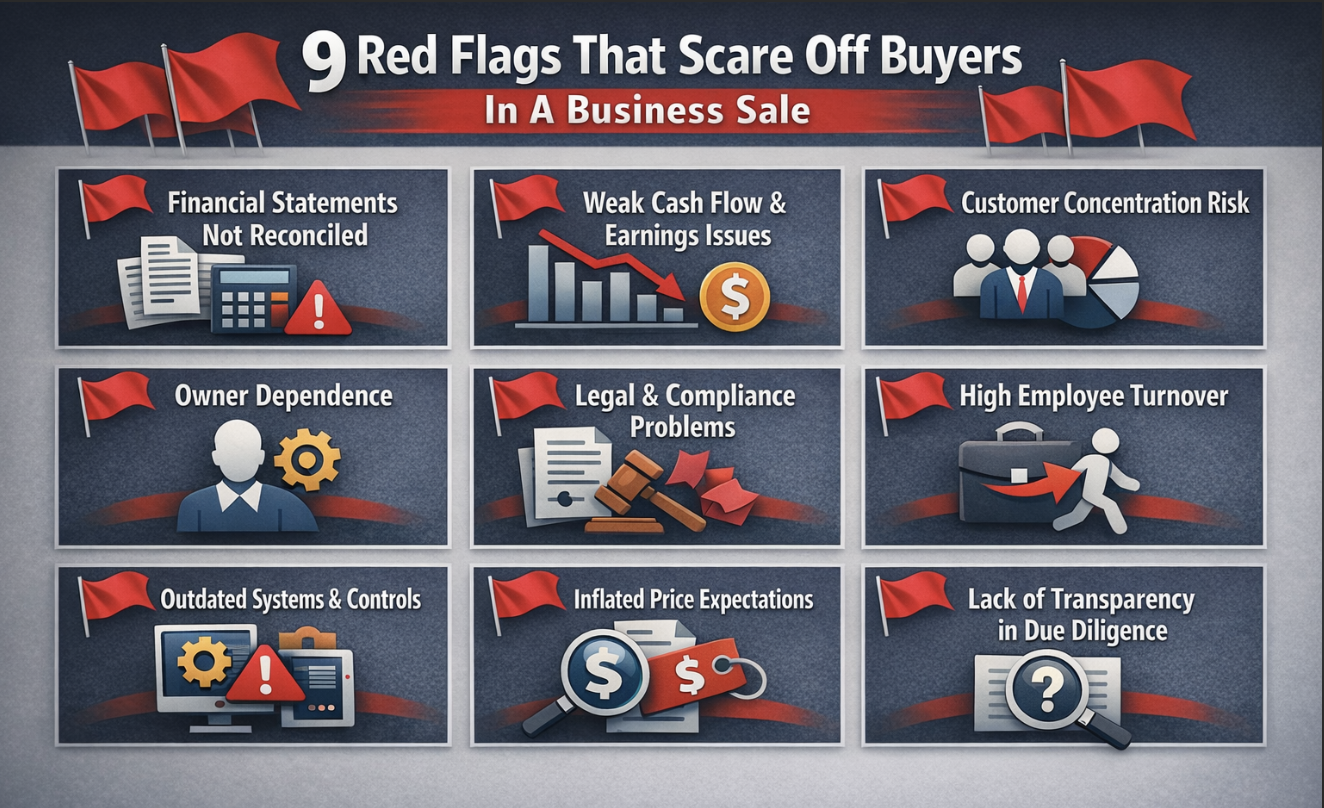
| Financial Statements That Do Not Reconcile | Buyers compare tax returns, monthly P&Ls, balance sheets, bank statements, and debt schedules. If revenue, expenses, or liabilities do not match across those records, they question earnings quality and widens due diligence. |
| Weak Cash Flow And Earnings Quality | Profit on paper is not enough. Buyers test cash conversion, working capital pressure, margin swings, and whether add-backs are supported by receipts, payroll records, or contracts before accepting valuation. |
| Customer Concentration And Revenue Fragility | If too much revenue comes from one customer, one supplier, or a short-term backlog, buyers worry the business can lose earnings quickly after closing. Contracts, renewal terms, and churn history become critical. |
| Owner Dependence And Weak Management Transferability | Buyers want to know whether sales, pricing, licensing, and customer relationships stay with the business or with the seller personally. Heavy owner involvement increases transition risk and often lowers value. |
| Legal Disputes, Unresolved Liability, And Compliance Issues | Lawsuits, tax notices, permit gaps, warranty claims, and regulatory violations create uncertainty that can change deal structure, increase escrow demands, or stop the acquisition entirely. |
| High Employee Turnover And Key Employee Risk | Buyers review turnover trends, tenure, role concentration, and retention risk. If the business depends on a few key employees or struggles to keep staff, post-sale continuity looks weak. |
| Outdated Systems, Poor Controls, And Operational Weaknesses | Manual reporting, weak job costing, undocumented workflows, and unreliable KPI tracking make it harder for buyers to trust that the business can run smoothly after acquisition without the seller. |
| Unsupported Valuation And Inflated Price Expectations | Buyers compare the asking price to adjusted earnings, comparables, risk factors, and transferability. If the seller cannot defend the number with evidence, serious buyers often disengage early. |
| Lack Of Transparency During Due Diligence | Missing documents, delayed answers, and late disclosure of problems damage buyer confidence fast. Even manageable issues can become deal killers when the seller appears evasive or inconsistent. |
9 Red Flags That Scare Off Buyers In A Business Sale
Buyers rarely treat a problem as isolated. If they find one serious issue in the financial records, legal history, or operations, they will review the rest of the business more aggressively to see whether similar problems appear elsewhere. A single red flag can be manageable. Several related problems usually create a pattern, and patterns are what scare buyers off.
When the buyer’s advisor starts seeing discrepancies between reported numbers, weak controls, unresolved liability, or lack of transparency, the process changes fast. Diligence expands, price expectations tighten, and the burden shifts to the seller to prove that the business can thrive after closing.
Each red flag affects a specific transaction decision. Some reduce valuation. Some trigger structure changes. Some require the seller to accept holdbacks, seller financing, or indemnity protections. Some send the buyer away from the deal because the risks look larger than the business’s future upside. That is why identifying and addressing these issues early matters.

#1) Financial Statements That Do Not Reconcile
A buyer cannot make a confident acquisition decision if the company’s financial statements do not line up across the records used in due diligence. This is one of the most common red flags because it undermines the basic question every buyer is trying to answer: what is the business actually earning, and can those earnings be trusted? When financial records conflict, buyers often assume either weak controls or bigger hidden risks.
-
Profit and Loss Mismatch: Monthly and annual profit and loss statements should tie to filed tax returns and general ledger detail. If reported revenue, cost of goods sold, or operating expenses shift between versions without a documented explanation, the buyer will question whether the company’s financial reporting is reliable enough to support valuation.
-
Balance Sheet Inconsistency: Receivables, payables, debt balances, owner distributions, and accrued liabilities should reconcile across internal statements, lender records, and tax filings. A discrepancy in debt or unpaid obligations can signal hidden liabilities that materially change the buyer’s view of financial health.
-
Incomplete Financial Records: Missing monthly close packages, irregular bookkeeping, or gaps in historical reporting make it hard for a buyer to verify trends in profit margins, seasonality, and cash flow. That usually leads to broader due diligence and more skepticism about the company’s financial condition.
-
Weak Support For Add-Backs: If add-backs appear in the valuation discussion but are not supported by payroll records, receipts, invoices, or owner compensation documentation, buyers often remove them. That can reduce earnings, lower valuation, and create disputes between reported and buyer-accepted performance.
Read Next:
-
Want to Sell Your Business at Full Value? Start With Clean Financials
-
Here’s What Buyers Look for in Financials (Disclaimer: It’s Not Just Revenue)
#2) Weak Cash Flow And Earnings Quality Problems
Reported profit does not settle a buyer’s concerns if the cash flow profile looks unstable. Buyers often discover that the income statement tells only part of the story. A company may show acceptable earnings while still struggling to collect receivables, finance working capital, cover payroll comfortably, or absorb seasonal swings. That becomes a financial risk because the buyer is not purchasing accounting profit alone. The buyer is purchasing a business that must operate without constant cash pressure after closing.
Earnings quality becomes a major red flag when the business depends on adjustments that do not survive thorough due diligence. That includes aggressive add-backs, unusual one-time revenue treated like recurring revenue, margin swings with no explanation, or personal expenses mixed into business operations without a clean trail. Buyers want assurance that normalized earnings reflect how the business actually performs, not how the seller wants the business to look in a sale process.
Working capital strain can create similar concern. If payables are stretched, receivables are aging, inventory turns poorly, or off-balance-sheet obligations exist outside the normal reporting package, the buyer could conclude that the company’s financial health is weaker than advertised. Even if the deal survives, the buyer may request additional protections or reduce the price to account for that strain.
#3) Customer Concentration And Revenue Fragility
A business acquisition becomes less attractive when too much revenue comes from a small number of customers, a few suppliers, or short-term contracts that can disappear after closing. Buyers often accept some concentration. What raises concerns is the concentration that has not been explained, mitigated, or supported by stable agreements. If one customer represents an outsized share of revenue, the buyer has to ask whether the business can thrive if that relationship changes post-sale.
This issue goes beyond a simple percentage threshold. Buyers review the terms inside customer contracts, renewal dates, cancellation rights, pricing history, gross margin by account, and the extent to which the seller personally owns the relationship. They also look at supplier concentration because overdependence on one vendor can weaken margins, inventory continuity, or service reliability. A company that relies on one major supplier and one major customer may look profitable on paper while still carrying significant hidden risks.
Revenue fragility also shows up in one-time projects, insurance work spikes, seasonality, backlog quality, or products or services that lack consistent demand. If reported growth depends on unusual periods that cannot be repeated, the buyer may view those gains as temporary rather than as part of the business’s future. That weakens buyer confidence and usually lowers valuation.
#4) Owner Dependence And Weak Management Transferability
Buyers want assurance that the business can operate without the seller acting as the operating system. Owner dependence is a major red flag because it threatens transferability. If the company’s financial performance depends on one person holding the customer relationships, quoting the work, overseeing production, making daily operational decisions, and resolving every problem, the business may not hold together the same way after closing.
-
Seller-Controlled Revenue: If the owner personally closes most sales, handles the largest accounts, or serves as the face of the business to customers and suppliers, the buyer has to estimate how much revenue could disappear once that role changes hands.
-
License or Credential Dependence: Some businesses rely on the seller’s license, certification, or compliance role to legally operate. Buyers will verify whether that authority transfers, whether another employee can hold it, and what happens if it does not.
-
Weak Management Depth: A shallow management bench signals that the business relies too heavily on one person’s judgment. Buyers look for documented responsibilities, reporting lines, and evidence that managers can run the business post-acquisition.
-
Undocumented Process Knowledge: If quoting, purchasing, scheduling, production, or service delivery exists mostly in the seller’s head, the buyer sees a transfer problem, not just a training issue. That raises transition risk and can weaken the business post-acquisition.
-
Fragile Customer Continuity: When customers stay because of the owner rather than the brand, systems, or broader team, buyer confidence drops. The business may still sell, but the buyer often pushes for a more cautious structure to reduce exposure.
#5) Legal Disputes, Unresolved Liability, And Compliance Issues
Legal and regulatory problems force buyers to think defensively. A business with unresolved legal exposure may still receive interest, but the burden of proof gets heavier, and the buyer’s tone changes. The concern is not limited to the visible dispute. It is the possibility that the dispute reveals broader control failures, compliance issues, or hidden liabilities that remain after closing.
| Issue | What Should Be Verified And Why It Matters |
|---|---|
| Active Lawsuit Or Threatened Lawsuit | Buyers review pleadings, settlement posture, insurance coverage, damages exposure, and outside counsel assessments because a lawsuit can create direct liability or trigger escrow and indemnity demands. |
| Unresolved Disputes With Customers And Suppliers | Buyers check contract terms, disputed invoices, service failures, warranty claims, or payment disagreements to determine whether the issue reflects an isolated dispute or a pattern that could damage revenue stability. |
| Regulatory Violations Or Licensing Gaps | Buyers verify permit status, renewal dates, citations, inspection history, and operating authority because unresolved compliance issues can stop operations, delay closing, or require post-sale remediation. |
| Intellectual Property Disputes | Buyers review registrations, assignment agreements, ownership records, contractor agreements, and infringement claims because intellectual property rights that are unclear can reduce value or expose the buyer to post-acquisition conflict. |
| Hidden Liabilities And Off-Balance-Sheet Obligations | Buyers request tax notices, debt schedules, guarantee documents, pending claims, and contingent liability disclosures because obligations that sit outside standard reporting can materially change the economics of the deal. |
#6) High Employee Turnover And Key Employee Risk
High employee turnover is a major red flag because buyers want continuity. If the business depends on technicians, account managers, estimators, supervisors, or salespeople who are difficult to replace, turnover becomes a direct threat to post-sale performance. That is especially true when those employees hold customer trust, process knowledge, or operational authority that is not documented elsewhere.
Buyers look at turnover patterns over time, not just a current headcount snapshot. They want to know who left, why they left, how quickly replacements were hired, how long the ramp-up takes, and whether service or production quality declined during the transition. If the business has repeated churn in key roles, the buyer may read that as a sign of compensation problems, culture issues, weak supervision, or an unstable labor model.
This issue gets more serious when the business relies on a few key employees without retention plans, contracts, incentives, or a real management layer beneath them. In that case, buyers often widen diligence to understand how exposed the company would be if those people left during or after closing. That can reduce valuation or trigger structure changes built around retention and transition.
Read Next: The Critical Role of Employee Retention in Business Valuation
#7) Outdated Systems, Poor Controls, And Operational Weaknesses
Operational weaknesses do not always show up in the first conversation. They often emerge when buyers try to understand how the business actually runs. A company can report decent earnings and still scare buyers off if its control environment is weak, its systems are outdated, or the day-to-day workflow depends on manual workarounds that will be hard to inherit. Buyers want proof that operations are repeatable, trackable, and manageable after acquisition.
-
Manual Reporting and Bookkeeping: If management reporting depends on spreadsheets patched together after month-end, the buyer may doubt the consistency of the numbers and the strength of internal controls.
-
Weak Inventory or Job Costing Discipline: Buyers often test whether inventory counts are current, shrinkage is controlled, and project margins can be measured accurately. Weak job costing can hide unprofitable work and distort valuation.
-
Undocumented Workflows: Quoting, purchasing, scheduling, billing, routing, and fulfillment should not depend on tribal knowledge alone. When processes are undocumented, training risk rises, and operational continuity looks weaker.
-
Poor KPI Visibility: Buyers often request backlog reports, margin reporting, customer profitability data, route density, utilization metrics, or service response metrics. If management cannot produce them, it raises concerns about operational maturity and decision discipline.
-
Inconsistent Execution: Rework, scheduling breakdowns, billing delays, quality issues, and uneven service delivery signal that the business may struggle post-sale, even if current revenue looks acceptable.
#8) Unsupported Valuation And Inflated Price Expectations
Buyers expect some negotiation. They do not expect a seller to anchor valuation to revenue alone, personal sacrifice, years of effort, or a number heard from another business owner without comparable context. Inflated price expectations often reduce buyer engagement before the process reaches serious momentum because they suggest the seller may not respond realistically once diligence begins.
Unsupported valuation usually shows up in a few predictable ways. The seller uses reported earnings without cleaning up add-backs. The seller ignores customer concentration, turnover, compliance issues, or owner dependence. The seller assumes the business deserves a premium multiple without showing why the business can support it. Or the seller treats temporary growth as permanent cash flow. Each of those problems creates an inconsistency between what the buyer sees and what the seller expects.
Buyers recalculate valuation based on adjusted earnings, risk, transferability, growth durability, and the cost of fixing what is weak. If those inputs point well below the asking price, the buyer often steps back rather than spend time pursuing a deal built on unrealistic assumptions. That is why accurate valuation is not just a pricing exercise. It is part of buyer confidence.
Read Next: Business Valuation Trends for 2026: Get Ahead of What Buyers Want
#9) Lack Of Transparency During Due Diligence
Lack of transparency turns manageable concerns into deal killers faster than almost any other issue. Buyers expect to find some rough edges. They do not expect to be misled, delayed, or forced to uncover basic facts through contradiction. Once that happens, every later answer gets filtered through doubt. The buyer starts asking not only what the issue is, but what else has not been disclosed.
This problem usually shows up through missing files, delayed responses, evasive explanations, or late disclosures tied to unresolved legal matters, customer losses, tax issues, liability exposure, or inconsistencies in financial records. It also appears when the seller changes the story after new documents are shared. Even when the underlying issue is fixable, the lack of transparency itself damages buyer confidence because it suggests poor controls or poor faith.
That change in trust affects the whole process. Buyers widen due diligence, ask for more third-party review, request additional protections, lower price, or move away from the deal entirely. In mergers and acquisitions, credibility is part of value. Once credibility drops, the transaction becomes harder to defend.
Read Next: Common Pitfalls to Avoid in Mergers and Acquisitions
How Buyers React When They Find Red Flags
Not every problem affects a deal the same way. Some issues are understandable and measurable. Some introduce uncertainty that changes how the buyer structures risk. Some indicate that the business is not what it appeared to be in the first place. That is why sellers should think beyond the question of whether a red flag exists and focus on what that issue is likely to trigger once uncovered.
Buyers do not make these judgments emotionally. They use them to protect returns, financing, transition stability, and post-acquisition performance. The same issue can lead to a price adjustment in one deal and a collapsed process in another, depending on size, timing, documentation quality, and whether the seller disclosed the issue early.
Problems That Lower Price But Do Not Kill The Deal
Some weaknesses are survivable because they can be measured and priced. Buyers may still pursue the acquisition, but they reduce valuation to reflect the cost, risk, or transition effort involved.
| Issue | Typical Buyer Response |
|---|---|
| Moderate Customer Concentration | Buyers often lower valuation if concentration is visible but contract-backed and historically stable. The issue becomes a pricing adjustment rather than a walk-away event. |
| Margin Inconsistency With Clear Explanation | If margin swings are tied to labor shortages, one-time project mix, or temporary input costs, and the support is credible, buyers often price the volatility rather than abandon the process. |
| Aging Equipment Or Deferred Maintenance | Buyers usually estimate replacement cost and reduce the offer or working capital assumptions to reflect near-term capital needs. |
| Outdated Systems | Weak systems may not kill the deal if reporting is still usable and workflows are understandable, but buyers typically factor in operational cleanup costs. |
| Manageable Turnover | If turnover affects lower-level roles more than key employees and the business still performs consistently, buyers often treat it as a risk factor that lowers value rather than a fatal flaw. |
Problems That Trigger Structure Changes And Additional Protections
Some red flags do not push buyers away immediately. They push buyers into risk-transfer mode. That means the deal may continue, but the economics and protections change. Instead of paying full value at closing, buyers use a structure to protect themselves against uncertain outcomes.
Common examples include unresolved disputes, customer concentration, weak working capital, pending claims, inconsistent cash flow, or dependence on key employees. In those situations, a buyer may request an escrow, indemnity coverage, earnout, seller financing, holdback, or a tighter working capital peg. The logic is straightforward. If the risk cannot be priced with confidence, the buyer wants the seller to share that risk after closing.
This is an important distinction for sellers. A deal that continues is not necessarily a good deal. Structure changes can reduce certainty, delay proceeds, and create post-sale friction. Sometimes the seller focuses too heavily on preserving headline valuation and misses the fact that the buyer has shifted substantial risk back onto the seller through terms.
Read Next: Seller Financing in Mergers and Acquisitions: A Strategic Tool for Buyers and Sellers
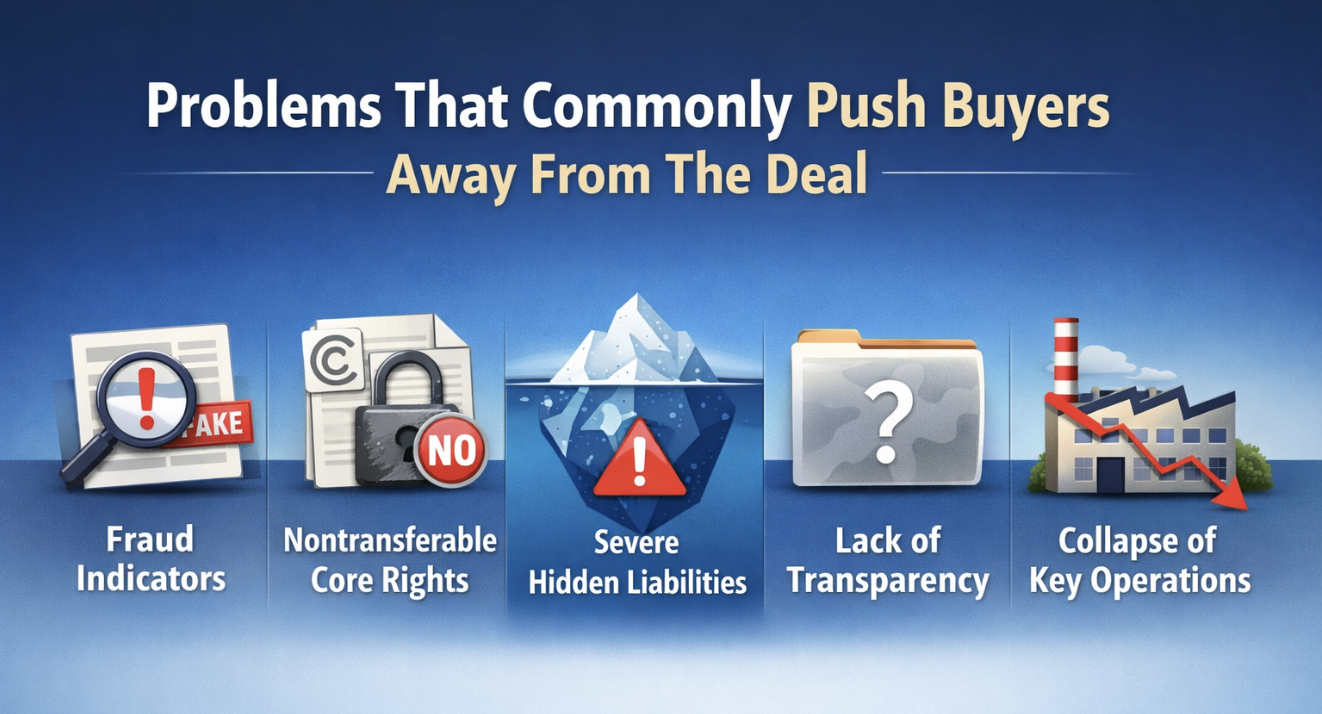
Problems That Commonly Push Buyers Away From The Deal
Some issues cause buyers to question the foundation of the business rather than the terms of the acquisition. When that happens, the process often stalls or ends.

-
Fraud Indicators: Material discrepancies between reported results and underlying records, intentional omission of liabilities, or manipulated financial statements usually end a process quickly because the buyer cannot trust anything else presented.
-
Nontransferable Core Rights: If a license, key contract, lease, or intellectual property right central to revenue cannot transfer, the business may not support the same economics post-sale. That is often a deal killer.
-
Severe Hidden Liabilities: Undisclosed tax exposure, major warranty liabilities, large unresolved legal disputes, or off-balance-sheet obligations can push buyers away when the downside is hard to cap.
-
Deep Lack Of Transparency: Missing documents and late disclosure do more than slow diligence. They make the buyer suspect a pattern of concealment. That often drives the buyer away from the deal even before all facts are known.
-
Collapse of Key Operations: If the business relies on one or two people, one customer, one supplier, or one fragile workflow in a way that cannot be stabilized, the buyer may decide the business’s future is too uncertain to underwrite.
Why Late Disclosure Damages Buyer Confidence Faster Than Early Disclosure
Early disclosure does not eliminate risk, but it gives the buyer a chance to judge the issue in context. Late disclosure does the opposite. It suggests the seller either did not know the business well enough to identify risks or chose not to disclose them until forced to. Both interpretations are damaging. Buyers want assurance that the seller understands the business at a level consistent with the valuation being asked.
Once a red flag surfaces late, the buyer’s advisor often widens the diligence scope and becomes more aggressive in document requests. Lenders may also take a harder look at the company’s financial health, liability exposure, or post-acquisition resilience. That can delay closing, increase transaction cost, and create new negotiation pressure. Even if the buyer stays engaged, trust has usually dropped, and trust is hard to rebuild under a deadline.
Read Next: Legal Agreements in a Business Sale: What Every Entrepreneur Must Know Before Signing
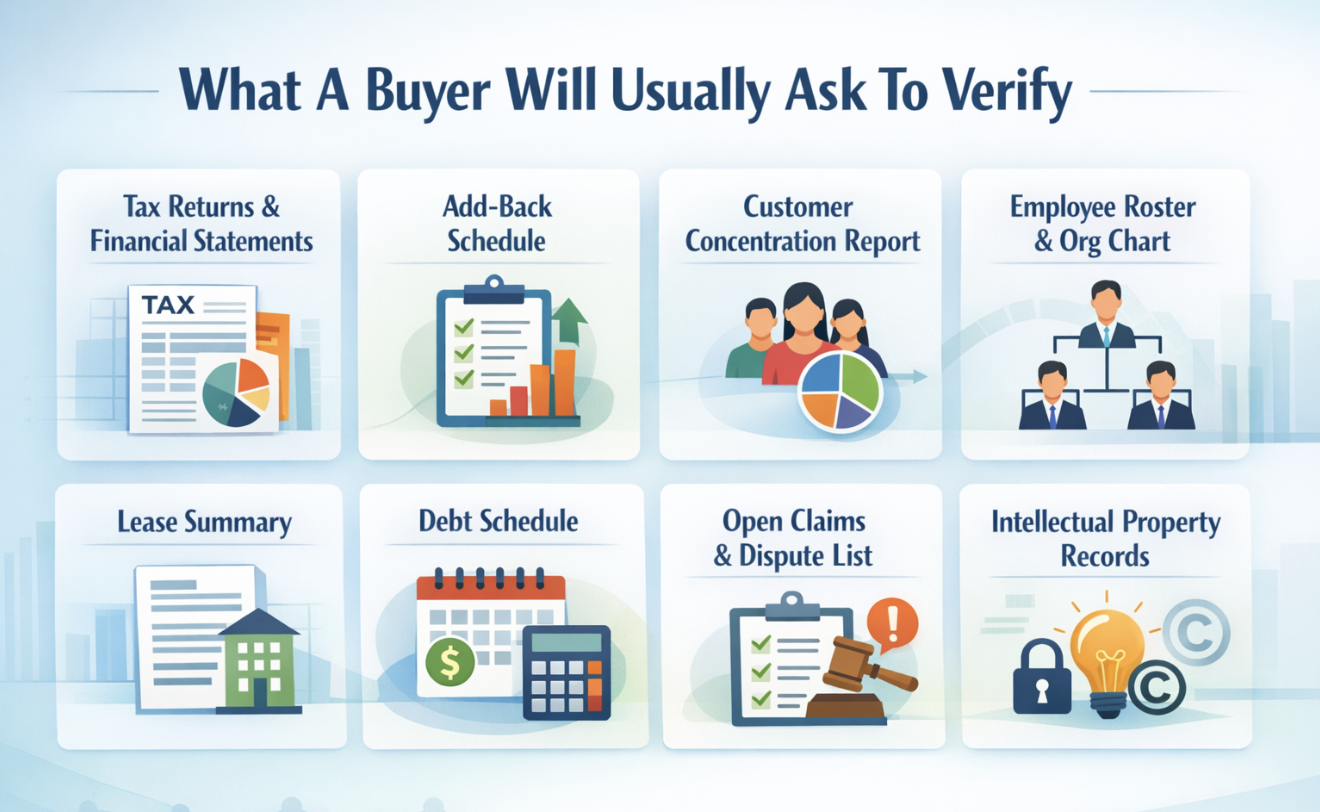
What A Buyer Will Usually Ask To Verify
Buyers verify the seller’s claims through documents that reveal what is stable, what is inconsistent, and what has been omitted. That is why due diligence often feels less like a conversation and more like a test of whether the business can support scrutiny from multiple angles at once. The documents requested are not random. Each one is tied to a specific risk the buyer is trying to identify.
The stronger the proof trail, the easier it is for the buyer to verify earnings, uncover liability, and assess whether the business can thrive post-sale. Weak documentation does not automatically kill a deal, but it often creates the kind of delay and doubt that makes buyers more defensive.

| Document Or Artifact | What Buyers Verify Inside It |
|---|---|
| Tax Returns And Monthly Financial Statements | Buyers compare reported revenue, expenses, and profit trends across tax filings, internal reporting, and bank support to test consistency and spot discrepancy patterns. |
| Add-Back Schedule | Buyers verify whether each add-back is owner-specific, one-time, and supported by receipts, payroll detail, invoices, or contracts rather than by unsupported explanation. |
| Customer Concentration Report | Buyers review top accounts, revenue share, margin by customer, contract terms, renewal dates, and churn history to understand revenue fragility and overdependence. |
| Employee Roster And Org Chart | Buyers assess headcount by role, compensation structure, tenure, turnover, supervisor depth, and whether key employees hold fragile knowledge or relationships. |
| Lease Summary | Buyers check assignment rights, term remaining, renewal options, rent escalations, landlord consent requirements, and whether the location can transfer without disruption. |
| Debt Schedule | Buyers verify lender, balance, maturity, covenants, collateral, guarantees, and payoff terms to measure liability and cash flow strain. |
| Open Claims Or Dispute List | Buyers review unresolved disputes, lawsuit status, tax notices, insurance claims, and settlement exposure to understand what may survive closing. |
| Intellectual Property Records | Buyers verify ownership, registrations, assignment language, contractor IP provisions, trademark or copyright status, and dispute history affecting core products or services. |
Read Next: How to Write a Confidential Information Memorandum (CIM): A Detailed Guide
A More Defensible Sale Starts With Better Proof
A business does not need to be perfect to attract credible buyers. It does need to be explainable. Buyers can work through risk when the numbers reconcile, the issues are disclosed clearly, and the operational story holds together under due diligence. They step back when inconsistency, hidden risk, and unsupported claims force them to guess. The practical question is not whether a red flag exists. The practical question is whether it can be documented, contained, and priced without undermining the business’s future.
-
Priority One: Reconcile financial statements, add-backs, and cash flow support before discussions on valuation begin, so buyer confidence is built on evidence rather than explanation.
-
Priority Two: Identify legal, compliance, customer concentration, and key employee risks early enough to disclose them cleanly and control how they enter the process.
-
Priority Three: Prepare a buyer-ready proof trail with contracts, schedules, rosters, and operating records that reduce friction during due diligence and help preserve leverage.
At Sunbelt Atlanta, we help business owners understand what a buyer is likely to challenge, which risks are manageable, and where preparation can protect buyer confidence before a potential deal starts to slip.
Schedule a consultation to clarify value, reduce surprise diligence problems, and move toward a cleaner, more defensible sale process.
Frequently Asked Questions
What are the biggest red flags in a business?
The biggest red flags in a business usually involve weak financial statements, unstable cash flow, high employee turnover, legal disputes, compliance issues, customer concentration, and owner dependence. Buyers focus on these areas because they affect valuation, transferability, and long-term success after acquisition. A single red flag may be manageable, but several related issues often signal broader operational weaknesses or hidden risks.
What makes a buyer walk away from a business deal?
A buyer usually walks away when the business no longer looks trustworthy, transferable, or financeable. That can happen because of fraud indicators, unresolved legal matters, major discrepancies in financial records, nontransferable licenses or contracts, severe hidden liabilities, or a deep lack of transparency during due diligence. Buyers will tolerate some risk, but they rarely tolerate uncertainty they cannot measure or contain.
What do buyers look for during due diligence?
During due diligence, buyers review financial statements, tax returns, cash flow, customer concentration, contracts, debt schedules, lease terms, employee rosters, legal exposures, compliance history, and intellectual property records. The goal is to verify the company’s financial health, identify risks, and confirm that the business can operate as expected post-sale. Buyers are not only checking whether the documents exist. They are checking whether the documents support the seller’s claims.
How does customer concentration affect business valuation?
Customer concentration affects valuation by increasing the risk that revenue could drop materially if one major account leaves after closing. Buyers look at the percentage of revenue tied to top customers, contract renewal terms, margin by account, cancellation rights, and how dependent the relationship is on the seller personally. Higher concentration often lowers multiples, changes structure, or leads buyers to request additional protections.
Can a business still sell with legal issues?
A business can still sell with legal issues, but the type, size, and documentation of the issue matter. Minor, disclosed, and well-documented disputes may lead to a price adjustment or escrow rather than kill the deal. Larger unresolved legal exposures, unclear liability, or late disclosure can derail the process because buyers and lenders may view the risk as too open-ended. Early disclosure with clear documentation usually creates better outcomes than surprise discovery later.
Why do buyers care about employee turnover?
Buyers care about employee turnover because turnover affects continuity, service quality, training costs, customer retention, and post-acquisition stability. High turnover can signal deeper problems with compensation, culture, supervision, or process discipline. It becomes more serious when the business relies on key employees who hold customer relationships or specialized knowledge that is hard to replace after the sale.