


1 min read
What Home Service Businesses Are Worth in 2026: Valuation Multiples and Key Value Drivers
Home service business valuation in 2026 depends on more than revenue. Buyers evaluate cash flow, profitability, recurring revenue, customer...
10 min read
Doreen Morgan is the owner and managing broker of Sunbelt Business Brokers – Atlanta, where she has spent two decades guiding Main Street and lower-middle-market business owners through successful sales valued from $750K to $75M. A proven dealmaker, Doreen has personally closed 300-plus transactions since 2005 across B2B services, heavy construction, healthcare, franchising, manufacturing, specialty distribution, and technology. Before acquiring Sunbelt Atlanta in 2015, she sharpened her M&A...
Doreen Morgan
June 29, 2026
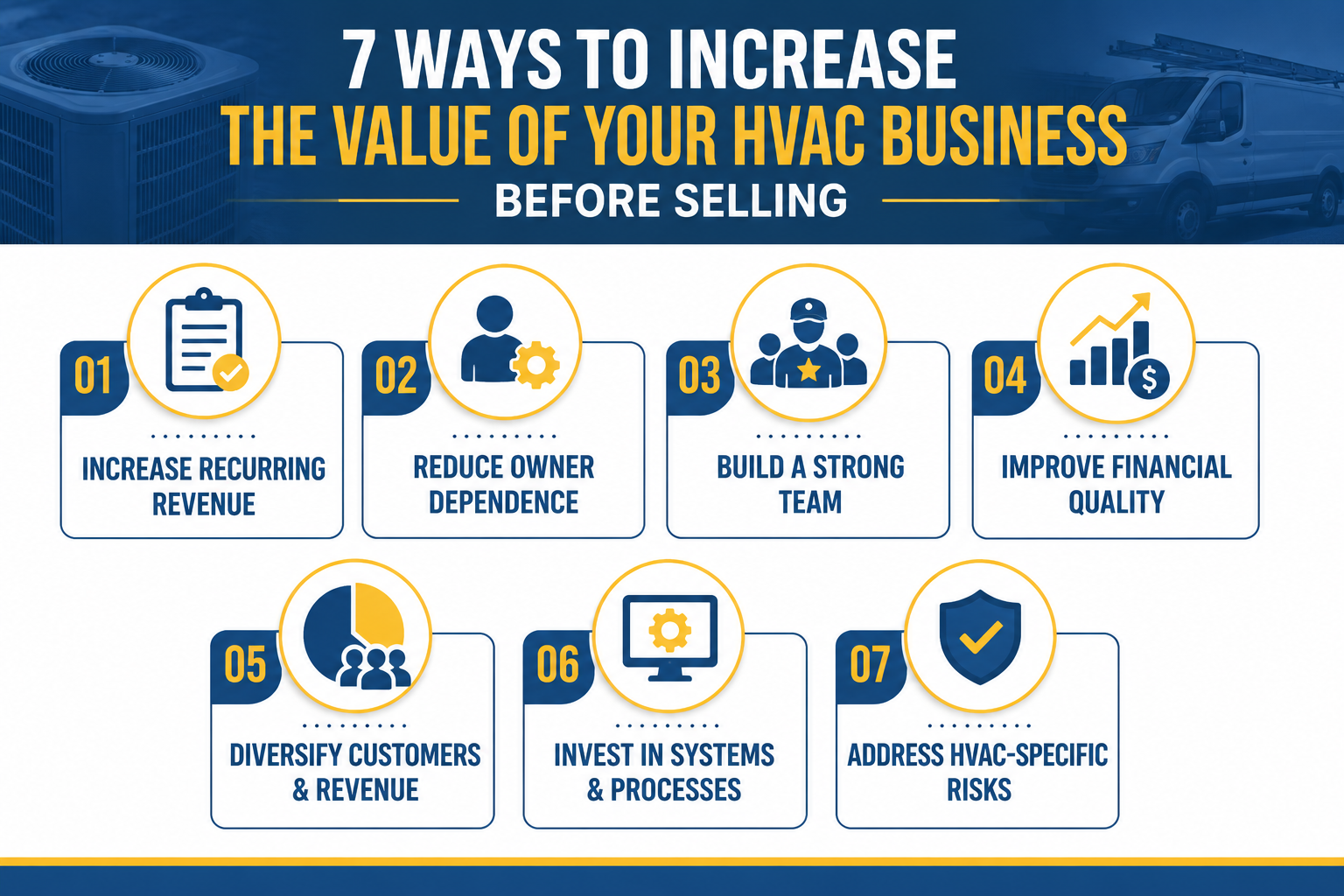
Increasing the value of your HVAC business before a sale starts with understanding how buyers evaluate risk, cash flow, and transferability. Recurring maintenance revenue, clean financials, technician retention, documented systems, and reduced owner dependence all influence what buyers are willing to pay.
Most buyers are not trying to determine what your business has done historically. They are assessing whether the company can continue generating reliable profits after the ownership transition. HVAC companies with predictable earnings and established operating systems often receive stronger offers than businesses that depend heavily on the owner.
This guide explains the value drivers buyers focus on most and the practical steps HVAC owners can take to improve valuation before going to market.
Core Challenge: Buyers determine HVAC business value based on future cash flow, transferability, and risk. Recurring maintenance agreements, technician stability, financial quality, and owner independence all influence valuation.
Business Impact: HVAC companies with predictable earnings, documented systems, and diversified customer relationships often attract stronger buyer interest, better deal terms, and a smoother sale process.
Common Mistake: Many HVAC owners wait until they are ready to sell before addressing owner dependence, weak financial reporting, customer concentration, or employee retention issues. Those problems often surface during due diligence and can reduce buyer confidence.
What Buyers Evaluate: Recurring revenue, adjusted EBITDA or SDE, technician retention, management depth, customer concentration, maintenance agreement performance, dispatch and CRM systems, and the company's ability to operate without the owner.
Biggest Value Drivers: Maintenance agreements, clean financial statements, documented operating procedures, stable technicians, diversified revenue sources, and a management team capable of running the business after the transition.
Highest-Risk Areas: Heavy owner involvement, customer concentration, weak documentation, inconsistent financial reporting, high employee turnover, and limited recurring revenue.
Recommended Next Step: Start preparing 12–24 months before a sale by improving recurring revenue, reducing owner dependence, strengthening financial reporting, and documenting key processes. The earlier these improvements are made, the easier they are for buyers to verify and value.
When buyers evaluate an HVAC business, they are trying to determine how reliably the company can generate cash flow after the ownership transition. Strong revenue alone rarely drives valuation. Buyers want evidence that the business can retain customers, keep technicians productive, maintain margins, and operate without heavy owner involvement.
This is one reason HVAC companies continue to attract buyer interest. Heating and cooling services remain essential for residential and commercial property owners, and recurring maintenance programs can create predictable revenue streams that extend beyond one-time installation projects. Businesses that combine recurring revenue with strong operations are often viewed as lower-risk acquisition opportunities.
For smaller owner-operated companies, valuation is frequently based on Seller's Discretionary Earnings (SDE). Larger HVAC companies with established management teams are more likely to be evaluated using EBITDA or adjusted EBITDA. Regardless of the valuation method used, buyers tend to focus on the same underlying question: how sustainable is the company's future cash flow?
For owners seeking a more accurate understanding of value, Sunbelt Atlanta provides HVAC Business Valuation Services that evaluate financial performance, recurring revenue, transferability, customer concentration, and other factors buyers consider during an acquisition.
Read Next: 11 Valuation Tips Every Service Business Owner Needs to Know
| Value Driver | Why Buyers Care | Impact on Value |
|---|---|---|
| Recurring Maintenance Agreements | Creates predictable revenue and improves customer retention | Often supports stronger valuation and buyer demand |
| Clean Financial Reporting | Allows buyers to verify earnings and cash flow | Reduces diligence risk and protects valuation |
| Technician Retention | Preserves service capacity and customer relationships | Improves transition confidence |
| Low Owner Dependence | Makes the business easier to transfer | Supports stronger deal terms |
| Customer Diversification | Reduces reliance on a small number of accounts | Lowers perceived risk |
| Documented Systems and Processes | Helps the business operate consistently after closing | Increases buyer confidence |
| Management Depth | Reduces dependence on a single individual | Improves scalability and transferability |
The strongest HVAC valuations are typically achieved when these value drivers work together. A business with recurring maintenance revenue, experienced technicians, reliable financial reporting, and documented operating procedures presents fewer risks to a buyer than a company where critical knowledge, customer relationships, and decision-making remain concentrated with the owner.

Recurring revenue is one of the strongest drivers of HVAC business value because it makes future cash flow easier to predict. Buyers place a premium on maintenance agreements because they generate recurring income, improve customer retention, and create opportunities for future repair, replacement, and system upgrade work.
Most buyers evaluate maintenance revenue differently from installation revenue. Installation projects can be highly profitable, but they are often influenced by seasonality, weather patterns, and replacement cycles. Maintenance agreements provide visibility into future revenue and reduce uncertainty after the ownership transition.
Maintenance agreements also tell buyers something important about customer behavior. A homeowner or commercial customer who renews a service agreement year after year is typically more valuable than a customer who calls only when equipment fails. Long-term customer relationships often translate into higher customer lifetime value and more predictable revenue.
When reviewing an HVAC business, buyers typically focus on:
The number of active maintenance agreements
Renewal and cancellation rates
Revenue generated from agreements
Gross margins on maintenance work
The percentage of total revenue tied to recurring customers
The process used to renew and manage agreements
A common mistake is treating repeat customers as recurring revenue. Buyers generally place more value on documented maintenance agreements because they provide verifiable evidence of future cash flow and customer retention.
Before going to market, prepare a maintenance agreement report that clearly outlines active contracts, renewal history, customer retention trends, and revenue generated by those agreements. Well-organized reporting makes it easier for buyers to validate recurring revenue during due diligence.
Two HVAC companies may generate similar annual revenue, but the company with a larger, well-documented maintenance agreement base will often attract stronger buyer interest. Recurring revenue reduces perceived risk, improves forecasting, and gives buyers greater confidence that the business can continue performing after the ownership transition.
Read Next: Improve Customer Retention: A Guide to Increasing Your Business Value
Owner dependence is one of the most common factors that limit HVAC business value. When the owner serves as the lead estimator, primary salesperson, operations manager, dispatcher, and key customer contact, buyers see a business that may be difficult to transfer.
The concern is simple: if revenue, customer relationships, and operational knowledge are tied to one person, performance after closing becomes less predictable. That uncertainty can affect both valuation and deal structure.
In many HVAC businesses, owner dependence appears in everyday operations. The owner approves estimates, manages key accounts, negotiates with suppliers, resolves technician issues, and makes pricing decisions. While that involvement may have helped build the company, it can become a challenge during a sale.
| Owner-Dependent Area | Buyer Concern | Practical Fix |
|---|---|---|
| Owner Handles Estimates | Sales may decline after closing | Train a sales manager or lead estimator |
| The Owner Manages Key Customer Relationships | Relationships may not transfer | Introduce account managers and document relationships |
| The Owner Controls Scheduling and Dispatch | Operations may become less consistent | Implement documented scheduling procedures |
| Owner Approves All Pricing Decisions | Margins depend on the owner's judgment | Develop pricing guidelines and approval processes |
| The Owner Manages Vendor Relationships | Supplier relationships may be difficult to maintain | Document vendor contacts and key agreements |
Reducing owner dependence does not require the owner to step away from the business. Buyers simply want evidence that the company can operate successfully without constant owner involvement. The strongest HVAC businesses have documented systems, trained employees, and clearly defined responsibilities that support a smooth ownership transition.
Businesses that rely heavily on the owner often face greater scrutiny during due diligence and less favorable deal terms. Building management depth and delegating key responsibilities before going to market can improve transferability, reduce buyer concerns, and strengthen valuation.
Read Next: How to Maximize Business Value Before Selling
A strong technician and management team can significantly increase the value of an HVAC business. Buyers know that future revenue depends on the company's ability to service customers, complete installations, and maintain operational consistency after the ownership transition.
Workforce stability is particularly important in the HVAC industry, where recruiting and training qualified technicians takes time. High turnover, limited management depth, or heavy reliance on a few key employees can create concerns about the company's ability to maintain performance after closing.
When evaluating an HVAC business, buyers often look for the following indicators:
| Area | Strong Signal | Weak Signal |
|---|---|---|
| Technician Retention | Stable team with documented tenure | Frequent turnover |
| Training | Structured onboarding and ongoing development | Informal, inconsistent training |
| Management Depth | Service manager, dispatcher, and lead technicians in place | The owner manages most functions |
| Compensation | Clear pay structure and incentives | Inconsistent or undocumented compensation |
| Role Clarity | Written job descriptions and responsibilities | Reliance on verbal instructions |
Management depth is often just as important as technician retention. Buyers gain confidence when responsibilities are distributed across supervisors, dispatchers, service managers, and lead technicians rather than concentrated with the owner.
Before going to market, HVAC owners should identify key employees, document responsibilities, and develop a plan for retaining critical team members through the transition. These steps help demonstrate that the business can continue operating successfully under new ownership.
A stable workforce reduces transition risk, strengthens transferability, and supports operational continuity. That confidence can have a meaningful impact on valuation, financing, and deal terms.
Read Next: The Critical Role of Employee Retention in Business Valuation
Clean financial reporting helps buyers trust the earnings they are being asked to pay for. When financial records are inconsistent or difficult to verify, valuation discussions often become more challenging.
For smaller HVAC businesses, valuation is often based on Seller's Discretionary Earnings (SDE). Larger companies are more commonly evaluated using adjusted EBITDA. In either case, buyers want to know whether earnings are accurate, repeatable, and supported by documentation.
Organize revenue by service line, including maintenance agreements, repair work, replacement installs, new construction, commercial HVAC, and residential service. This helps buyers evaluate recurring revenue, profitability, and customer concentration.
Common issues include mixing personal and business expenses, overstating add-backs, failing to reconcile tax returns with internal financials, and not tracking profitability by service category.
Before going to market, make sure your financial statements are accurate, consistent, and easy to verify. Clean financials reduce diligence issues and help support valuation throughout the sale process.
Read Next: Here’s What Buyers Look for in Financials
Customer concentration can have a significant impact on HVAC business value. If a single commercial customer, property management group, builder, or general contractor represents a large percentage of revenue, buyers will evaluate the risk of losing that relationship after closing.
Buyers generally place a higher value on businesses with diversified customers and revenue streams because future cash flow is less dependent on any one account, service line, or market segment. This becomes even more important when the owner personally manages the largest customer relationships.
| Revenue Issue | Buyer Concern | Potential Impact |
|---|---|---|
| One Large Commercial Customer | Revenue may decline if the account leaves. | Lower valuation or additional deal protections. |
| Heavy New Construction Exposure | Revenue may be cyclical and harder to forecast | More conservative valuation |
| Weak Maintenance Agreement Base | Last recurring revenue | Reduced buyer confidence |
| Few Documented Customer Contracts | Relationships may not transfer smoothly | Increased due diligence scrutiny |
| Owner-Managed Accounts | Customer loyalty may remain with the seller | Longer transition requirement |
Before going to market, focus on reducing customer concentration, expanding maintenance agreements, balancing revenue sources, and documenting key customer relationships. These steps can reduce perceived risk and help support valuation during the sale process.
Systems make an HVAC business easier to transfer because they reduce reliance on the owner's knowledge and create consistency across the organization. Buyers want to understand how work is scheduled, how customers are managed, how jobs are priced, how maintenance agreements are tracked, and how performance is measured after the transition.
Well-documented systems also make due diligence easier. Dispatch software, CRM platforms, job-costing tools, inventory records, and fleet management systems help buyers verify how the business operates and assess its ability to perform under new ownership.
A strong Google Business Profile and positive customer reviews can further support buyer confidence, particularly for residential HVAC companies. Buyers do not necessarily care how sophisticated a system is. They care that it is consistently used, well-documented, and capable of supporting the business after the ownership transition.
Read Next: How Buyers Assess Risk During Due Diligence
Every HVAC business has risks, but unresolved issues can become obstacles during due diligence. Buyers do not expect a perfect business. They expect accurate records, reasonable explanations, and evidence that potential risks are being managed.
The most common HVAC-specific issues buyers review include:
| Risk | Buyer Concern | Owner Action |
|---|---|---|
| Licensing Gaps | Businesses may not operate legally after the sale | Confirm licenses and transfer requirements |
| Permit Issues | Past work may create liability | Organize permit and inspection records |
| Vehicle Condition | Fleet replacement may require additional capital | Maintain fleet records and maintenance logs |
| Warranty Exposure | Future claims may affect cash flow | Document warranty obligations and claims history |
| Technician Classification | Labor compliance risk | Review employment and contractor classifications |
| Customer Complaints | Reputation and retention concerns | Address recurring service and review issues |
| Equipment Documentation | Asset value may be difficult to verify | Prepare an accurate FF&E inventory |
Many of these issues become more problematic when they are discovered late in the sale process. Buyers are often willing to work through manageable risks when they are disclosed early and supported by documentation. Unexpected issues, however, can create delays, trigger additional diligence requests, or lead buyers to renegotiate terms.
Buyers often expand due diligence when documentation is missing or answers are inconsistent. Addressing these issues before going to market can reduce delays, limit negotiation friction, and help support valuation throughout the transaction process.
HVAC owners should ideally begin preparing for a sale 12 to 24 months before going to market. That timeline provides enough time to improve recurring revenue, clean up financial reporting, reduce owner dependence, strengthen management depth, and address potential due diligence concerns before buyers begin their review.
Some improvements affect valuation faster than others. Financial cleanup and documentation can often be completed relatively quickly, while growing maintenance agreements, diversifying customers, and developing management depth typically require more time to influence business performance and buyer perception.
| Timeline | Primary Focus |
|---|---|
| 12-24 Months Before a Sale | Reduce owner dependence, strengthen management depth, improve technician retention, and grow maintenance agreement revenue |
| 6-12 Months Before a Sale | Clean up financial reporting, document systems and processes, and address customer concentration issues |
| 3-6 Months Before a Sale | Organize due diligence materials, review contracts, and confirm licenses, permits, and compliance records |
| Final Months Before Going to Market | Resolve outstanding issues, confirm valuation expectations, and prepare sale documentation |
Owners who prepare early generally have more control over timing, negotiations, and deal structure. Waiting until buyers identify issues during due diligence often leads to delays, additional scrutiny, and pressure to address concerns on the buyer's timeline rather than your own.
Most HVAC owners focus on revenue growth when thinking about value. Buyers focus on something different: whether the business can continue producing reliable cash flow after the ownership transition. The easier it is for a buyer to understand, verify, and operate the business, the easier it becomes to justify a stronger valuation.
Many of the factors that increase HVAC business value, such as recurring maintenance revenue, clean financial reporting, management depth, documented systems, and customer diversification, also make the business easier to run. Owners who address these areas before going to market often enter the sale process with greater flexibility and fewer obstacles during due diligence.
Key Takeaways
Recurring maintenance agreements can increase value by improving revenue predictability and customer retention.
Reducing owner dependence improves transferability and lowers transition risk.
Technician retention and management depth help buyers feel confident that the business can perform after closing.
Clean financial reporting makes earnings easier to verify and defend during due diligence.
Documented systems, diversified customers, and organized records can strengthen buyer confidence and support valuation.
Many of the factors that increase HVAC business value, such as recurring maintenance revenue, clean financial reporting, management depth, documented systems, and customer diversification, also make the business easier to run.
Owners who address these areas before going to market often enter the sale process with greater flexibility and fewer obstacles during due diligence. For owners evaluating a future exit, a Confidential Business Valuation from Sunbelt Atlanta can provide a clearer understanding of current value, key risk areas, and opportunities to strengthen valuation before approaching buyers.
An HVAC business valuation typically starts with SDE or EBITDA, depending on the size of the company. Buyers then evaluate recurring revenue, customer concentration, owner dependence, technician retention, and management depth to determine fair market value. Two HVAC companies with similar revenue can receive very different valuations if one is more transferable and generates more predictable cash flow.
Multiples for HVAC companies vary based on profitability, recurring maintenance revenue, growth potential, and risk. There is no single valuation multiple that applies to every business. A professional HVAC valuation considers both financial performance and the factors that influence buyer demand.
The strongest value drivers in the HVAC industry include recurring maintenance agreements, clean financial reporting, technician retention, management depth, documented systems, and diversified customers. Buyers value HVAC companies that can continue operating successfully after the ownership transition.
Most HVAC business owners should begin preparing 12 to 24 months before going to market. This gives owners time to improve recurring revenue, reduce owner dependence, organize financial records, and address potential due diligence concerns before buyers begin their review.
Yes. A professional business valuation can help you understand the value of your HVAC business, identify opportunities to increase value, and establish realistic expectations before entering the sale process. It can also highlight issues that may affect buyer interest or valuation.
1 min read
Home service business valuation in 2026 depends on more than revenue. Buyers evaluate cash flow, profitability, recurring revenue, customer...
1 min read
Service business valuation depends first on three buyer questions: is cash flow predictable, does risk transfer cleanly with ownership, and can the...
1 min read
Selling a business typically takes six to twelve months, although some transactions close faster and others take longer. Recent market data shows why...