


14 min read

How Buyers Evaluate Utility Construction Companies During Due Diligence

Written by Updated August 5, 2026
Picture of Doreen Morgan
Doreen Morgan

Doreen Morgan is the owner and managing broker of Sunbelt Business Brokers – Atlanta, where she has spent two decades guiding Main Street and lower-middle-market business owners through successful sales valued from $750K to $75M. A proven dealmaker, Doreen has personally closed 300-plus transactions since 2005 across B2B services, heavy construction, healthcare, franchising, manufacturing, specialty distribution, and technology. Before acquiring Sunbelt Atlanta in 2015, she sharpened her M&A...

How Buyers Evaluate Utility Construction Companies During Due Diligence

Selling a utility construction company involves more than negotiating a purchase price. Due diligence is the process buyers use to verify financial performance, evaluate operational risks, and determine whether the business can continue performing successfully after closing.

This is often where transactions change. Buyers may enter the process with confidence based on revenue, profitability, customer relationships, and growth potential, but due diligence is where those assumptions are tested. For utility construction companies, buyers review customer contracts, backlog, project profitability, equipment, workforce stability, safety performance, regulatory compliance, and the management team.

Reduce Uncertainty.

The more confidence buyers have in the business's quality and transferability, the more likely they are to maintain the valuation and move forward under the original terms. This guide explains how buyers evaluate utility construction companies during due diligence, the issues that most often influence valuation and deal certainty, and the practical steps owners can take to prepare before taking their business to market.

💡 TL;DR: What Buyers Want to See During Due Diligence

  • Due diligence determines whether a buyer's initial confidence holds up under closer review. Buyers verify financial performance, operational stability, and potential risks before deciding whether to move forward under the original terms.

  • Strong financial results alone rarely tell the whole story. Buyers also evaluate contract quality, backlog, customer relationships, equipment, workforce stability, safety performance, and management depth to understand how the business is likely to perform after closing.

  • Well-prepared businesses are often in a stronger negotiating position. Organized financial records, documented processes, and fewer operational surprises help reduce uncertainty during diligence and can improve deal certainty.

  • Many issues that surface during due diligence can be addressed before a business goes to market. Identifying gaps early gives owners time to strengthen financial reporting, improve documentation, resolve compliance issues, and reduce owner dependence.

  • Preparing for due diligence should begin well before a sale process starts. Owners who understand how buyers evaluate utility construction companies are typically better positioned to protect valuation and navigate the transaction with fewer surprises.


Why Due Diligence Matters

Many business owners assume that once a Letter of Intent (LOI) is signed, the difficult part of the transaction is behind them. In reality, due diligence is often the most detailed and consequential stage of the sale process.

During this phase, buyers test the assumptions that shaped their initial offer. They review financial records, contracts, operations, and legal documentation to determine whether the business performs as represented and whether the risks are consistent with the agreed valuation. If their findings align with expectations, the transaction typically continues on its original path. If significant issues emerge, buyers may renegotiate the purchase price, request additional protections, or reconsider the acquisition altogether.

Read More: How Buyers Evaluate Risk and What It Means for Your Valuation

For utility construction companies, this review extends across every part of the business. Buyers evaluate financial performance, customer relationships, project execution, workforce stability, safety, and regulatory compliance to determine whether the business can continue operating successfully after the ownership transition.

The questions below shape nearly every due diligence process and influence both valuation and deal certainty.

Buyer Question Why It Matters
Are the financial statements accurate and consistent? Buyers need confidence that reported revenue, margins, and cash flow reflect the company's actual performance.
Are earnings sustainable? Buyers assess whether profitability is supported by recurring operations or driven by temporary factors that may not continue after closing.
Is the project backlog profitable and achievable? Backlog quality, contract terms, and project margins help buyers estimate future revenue and execution risk.
Will customers remain after the sale? Long-standing customer relationships and diversified revenue reduce the risk of lost business after the ownership transition.
Can the business operate without the current owner? Management depth, documented processes, and experienced field personnel improve transferability and reduce transition risk.
Are there legal, regulatory, or safety issues that could create future liabilities? Unresolved disputes, compliance issues, or poor safety performance can affect valuation, financing, and deal structure.

The answers to these questions influence far more than the purchase price. They help determine financing, transition planning, post-closing obligations, and whether the transaction ultimately closes successfully.

Read Next: M&A Deal Structures Explained — Understanding Deal Structure in Mergers and Acquisitions

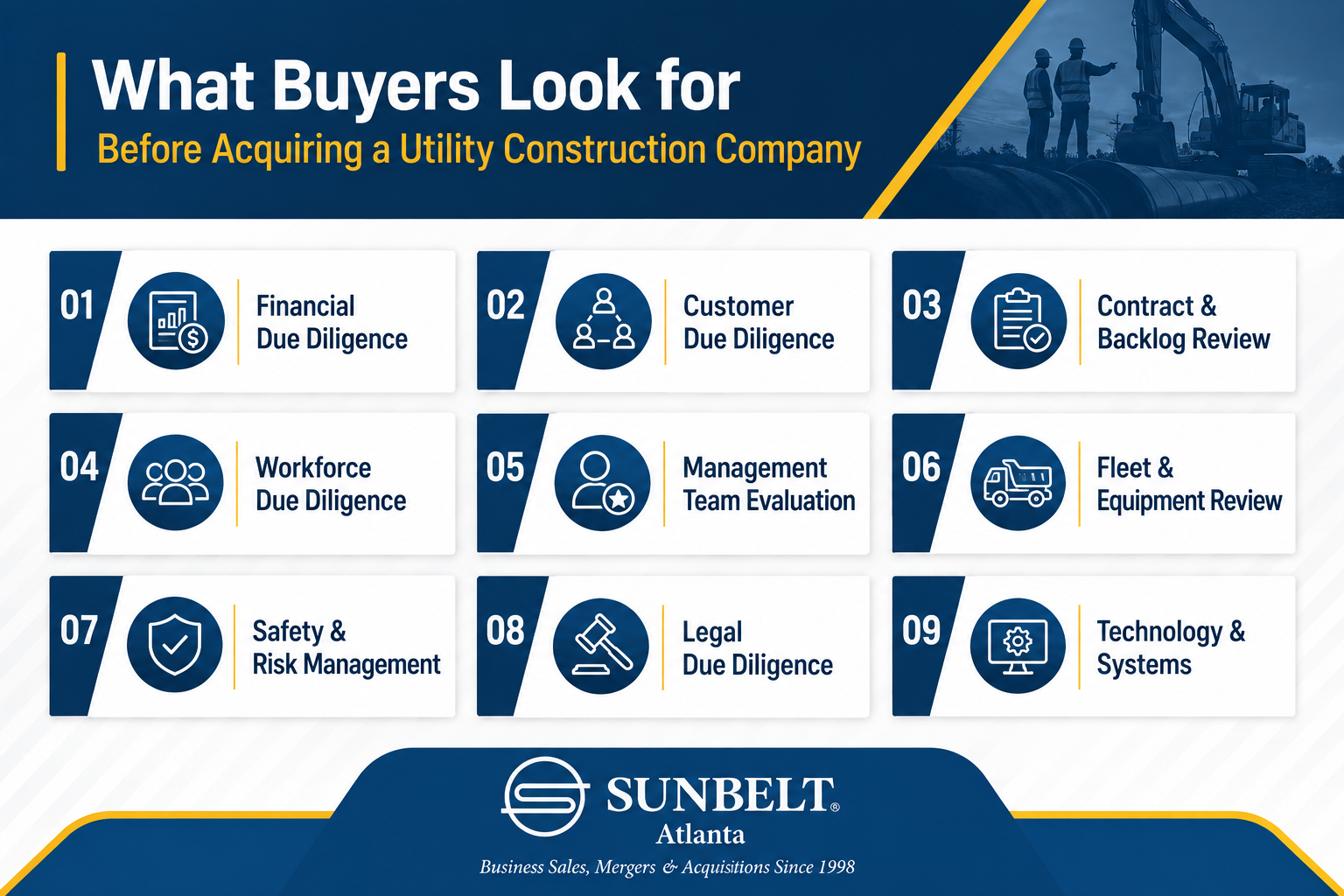
What Buyers Look for Before Acquiring a Utility Construction Company

No buyer evaluates a utility construction business based on a single factor. While financial performance often shapes the initial valuation, buyers also assess the company's operations, customer relationships, workforce, equipment, and long-term ability to generate consistent cash flow after the ownership transition.

The goal of due diligence is to build a complete picture of the business. Strong performance in one area can be offset by risks in another, which is why buyers evaluate the company from multiple perspectives before finalizing the transaction. The following sections explain the factors that typically receive the closest scrutiny and how each one can influence valuation, deal structure, and closing certainty.

1. Financial Due Diligence

Financial due diligence is usually the first area buyers examine because it provides the foundation for every other part of the transaction. Before evaluating contracts, equipment, or operations, buyers want confidence that the company's financial performance accurately reflects its earning potential.

For utility construction companies, this review extends beyond revenue and profitability. Buyers analyze how the business generates cash flow, whether margins remain consistent across projects, how working capital supports day-to-day operations, and whether financial reporting accurately reflects the company's performance. They also want to understand whether recent results are sustainable or driven by temporary factors such as unusually large projects, delayed equipment purchases, or one-time customer demand.

Companies with organized financial records, consistent reporting, and reliable job costing typically move through due diligence with fewer questions. When buyers can clearly understand how the business earns money and where profits come from, they are generally able to evaluate the opportunity with greater confidence.

During financial due diligence, buyers typically review:

Financial Area Why Buyers Review It
Historical Financial Statements To evaluate revenue trends, profitability, and overall financial performance over time.
Monthly Financial Reporting To understand seasonality, monitor performance throughout the year, and identify unusual fluctuations.
Cash Flow and Working Capital To determine whether the business generates sufficient cash to support ongoing operations and future growth.
Job Costing Reports To verify project-level profitability and understand how labor, materials, equipment, and subcontractor costs are managed.
Customer and Project Profitability To identify which customers, contract types, or service lines generate the strongest returns and whether margins are sustainable.
Capital Expenditure Requirements To estimate future investments in fleet, equipment, and other assets that may affect cash flow after closing.

Read More: Here’s What Buyers Look for in Financials (Disclaimer: It’s Not Just Revenue)

As transactions become larger or more complex, buyers may also commission a Quality of Earnings (QoE) review. Unlike standard financial statements, a QoE review focuses on the sustainability of earnings by examining revenue recognition, non-recurring income or expenses, owner-related adjustments, margin consistency, and working capital requirements. The objective is to determine whether the company's reported earnings accurately reflect its ongoing earning power.

For business owners, strong financial reporting does more than support valuation. It reduces uncertainty during due diligence and allows buyers to spend more time evaluating the opportunity instead of reconciling the numbers. Owners who want to understand how earnings quality, customer concentration, backlog, and future capital requirements may affect market value can begin with a Confidential Business Valuation before entering the sale process.

Read Next: Want to Sell Your Business at Full Value? Start With Clean Financials

How Would Buyers View Your
Utility Construction Company?


2. Customer Due Diligence

Customer relationships are often one of the most valuable assets in a utility construction business. Buyers want to understand where revenue comes from, how stable those relationships are, and whether they are likely to continue after the ownership transition.

Customer concentration is usually one of the first areas buyers evaluate. A contractor that generates a significant share of its revenue from a single utility, municipality, telecommunications provider, or general contractor may receive additional scrutiny because the loss of that customer could materially affect future cash flow.

Concentration alone isn't necessarily a concern, but buyers will want to understand the strength of the relationship, the contract structure, and the likelihood of future work. For Telecom Infrastructure Contractors, buyers may also examine dependence on a small number of carriers, prime contractors, or regional broadband programs and whether those relationships extend beyond the current owner.

Buyers also assess whether customer relationships depend primarily on the owner or are supported by project managers, account managers, and long-term contracts. Businesses with diversified revenue, repeat customers, and relationships that extend beyond the owner's personal involvement generally provide buyers with greater confidence during due diligence.

3. Contract and Backlog Review

For utility construction companies, backlog is often viewed as an indicator of future revenue. However, buyers look beyond the total value of contracted work. They want to understand whether the backlog is profitable, executable, and likely to generate the earnings reflected in the valuation.

During due diligence, buyers review contract terms, remaining project value, expected margins, project duration, change order history, and whether contracts can be assigned after a change in ownership. They also assess customers' financial strength and the likelihood that projects will proceed as planned.

For Fiber Construction Companies, buyers may distinguish between fully funded work, awarded projects awaiting notice to proceed, and pipeline opportunities tied to future broadband deployment or public funding.

Buyer Focus Why It Matters
Total Backlog Value Buyers want to understand how much contracted work is likely to convert into profitable revenue.
Project Diversification A balanced mix of projects and customers helps reduce concentration risk and improves revenue stability.
Contract Status Fully executed and funded contracts generally provide greater confidence than projects still awaiting approvals or funding.
Expected Project Margins Strong backlog should also produce healthy margins, not just future revenue.
Project Timelines Buyers assess whether labor availability, equipment capacity, and scheduling support successful project execution.

A large backlog can strengthen a company's value, but only if the work can be completed profitably and with manageable risk. In many cases, a smaller backlog of well-managed, higher-margin projects provides buyers with greater confidence than a larger pipeline carrying uncertain margins or execution challenges.

4. Workforce Due Diligence

For many utility construction companies, the workforce is one of the business's most valuable assets. Experienced operators, foremen, project managers, and field crews are difficult to replace, particularly in a competitive labor market. Buyers want confidence that the team responsible for delivering projects will remain in place after the acquisition.

During due diligence, buyers evaluate the stability and depth of the workforce. They review employee tenure, turnover trends, training programs, certifications, compensation structures, and the roles of key personnel. They also want to understand whether the business has a reliable approach to recruiting, developing, and retaining skilled employees.

Beyond headcount, buyers assess how knowledge is distributed across the organization. A company where project execution depends on a small number of individuals may present greater transition risk than one with documented processes, experienced supervisors, and a team capable of operating independently.

Ultimately, buyers are asking whether the workforce can continue delivering quality work after the ownership transition. Companies with experienced employees, strong retention, and limited reliance on any one individual often inspire greater confidence during due diligence.

Read More: The Critical Role of Employee Retention in Business Valuation

5. Management Team Evaluation

A strong management team can significantly reduce buyer risk. Buyers want to understand whether the business can continue operating successfully if the owner steps away after the sale. The answer often influences valuation, deal structure, and the length of the transition period.

During due diligence, buyers evaluate who is responsible for estimating, project management, field operations, business development, and other critical functions. They also assess whether responsibilities are clearly defined or concentrated in the owner's day-to-day involvement.

Businesses with experienced managers, documented processes, and clear decision-making structures are generally easier to transition to new ownership. When leadership responsibilities are shared across a capable team rather than centered on one individual, buyers often have greater confidence in the company's long-term stability.

Buyer Perspective: A business doesn't need a large management team to be attractive. Buyers are primarily looking for continuity. They want confidence that key decisions, customer relationships, and daily operations can continue without significant disruption after closing.

6. Fleet and Equipment Review

Fleet and equipment are among the largest capital investments for many utility construction companies. Buyers evaluate these assets not only to understand their current condition, but also to estimate future capital expenditures and determine whether the existing fleet can support ongoing operations after the acquisition.

During due diligence, buyers review maintenance records, equipment age, utilization rates, ownership structures, and replacement schedules. They also assess whether the fleet aligns with the company's service offerings and backlog. For example, HDD Companies may rely on specialized drill rigs, locating systems, mud-mixing equipment, and experienced operators that would be costly and time-consuming for a buyer to replace.

Equipment Consideration Why It Matters
Condition and Maintenance History Well-maintained equipment generally reduces operational risk and unexpected repair costs.
Age and Remaining Useful Life Buyers estimate when major assets may require replacement and how those investments could affect future cash flow.
Ownership vs Leased Equipment Ownership structures influence ongoing costs, financing obligations, and capital requirements.
Fleet Utilization Consistent utilization may indicate efficient asset management, while underused equipment can represent unnecessary capital tied up in the business.
Specialized Equipment Assets used for directional drilling, underground utility installation, or other specialized work can strengthen competitive positioning if they are well maintained and aligned with market demand.

A newer fleet does not automatically make a business more valuable, just as older equipment does not necessarily reduce value. Buyers are primarily looking for equipment that is reliable, properly maintained, and capable of supporting future work without requiring significant near-term investment.

7. Safety and Risk Management

Safety performance can affect insurance costs, workforce stability, project eligibility, and the liabilities a buyer may inherit after closing. Buyers therefore review a utility contractor’s safety record as an indicator of both operational risk and management discipline.

This scrutiny is especially important for companies performing excavation and underground utility work. In June 2025, OSHA reported that 11 trench-related fatalities had already occurred that year and urged contractors to follow established protections for trenching and excavation work.

During due diligence, buyers typically examine OSHA citations, incident logs, workers’ compensation claims, Experience Modification Rate (EMR), insurance coverage, safety manuals, and employee training records. They also look at how the company investigates incidents, documents corrective action, and ensures that field supervisors consistently enforce safety protocols.

A weak safety record may lead to higher insurance expenses, limited access to certain projects, added indemnity protections, or a lower valuation. A documented safety program with consistent training and clear accountability gives buyers greater confidence that the company can continue operating without preventable disruptions after the sale.

For Underground Utility Contractors, trench safety, excavation controls, permitting, and incident documentation can materially affect insurance costs, project eligibility, and buyer risk assessments.

8. Legal Due Diligence

Legal due diligence helps buyers identify liabilities that could affect the business's value or create complications after closing. Even relatively small legal issues can lead to additional negotiations if they introduce uncertainty or require future remediation.

For utility construction companies, buyers typically review contracts, licensing, permits, pending litigation, employment matters, regulatory compliance, and environmental obligations. They also confirm that customer agreements, equipment leases, and other key contracts can be assigned or transferred to a new owner without disrupting operations.

Legal Area What Buyers Want to Confirm
Contracts and Agreements Customer, vendor, subcontractor, and lease agreements are current, enforceable, and transferable where required.
Licenses and Permits Required licenses, registrations, and permits are active and in good standing.
Litigation and Disputes Outstanding legal matters are disclosed, understood, and unlikely to create material post-closing liabilities.
Regulatory and Environmental Compliance The company has complied with applicable regulations and addressed any known compliance issues.

Most legal issues do not prevent a business from being sold. However, resolving documentation gaps, expired permits, or outstanding disputes before entering the market can help reduce delays, strengthen buyer confidence, and keep negotiations focused on the value of the business rather than avoidable risks.

9. Technology and Systems

Technology alone rarely increases the value of a utility construction business. What matters is whether the company's systems help manage projects efficiently, improve financial visibility, and support consistent operations.

During due diligence, buyers review the software and processes used to estimate jobs, track project costs, manage schedules, maintain equipment, and produce financial reports. Well-organized systems make it easier to understand business performance, monitor project profitability, and transition day-to-day operations after closing.

For utility contractors, buyers often pay close attention to project management, job costing, and equipment management systems because they provide insight into how the business controls costs and executes work in the field. Companies that rely on spreadsheets or undocumented processes may require additional diligence to verify financial and operational information.

Ultimately, buyers are looking for systems that support informed decision-making rather than create dependency on a single individual. Technology should make the business easier to understand, easier to manage, and easier to transition to new ownership.

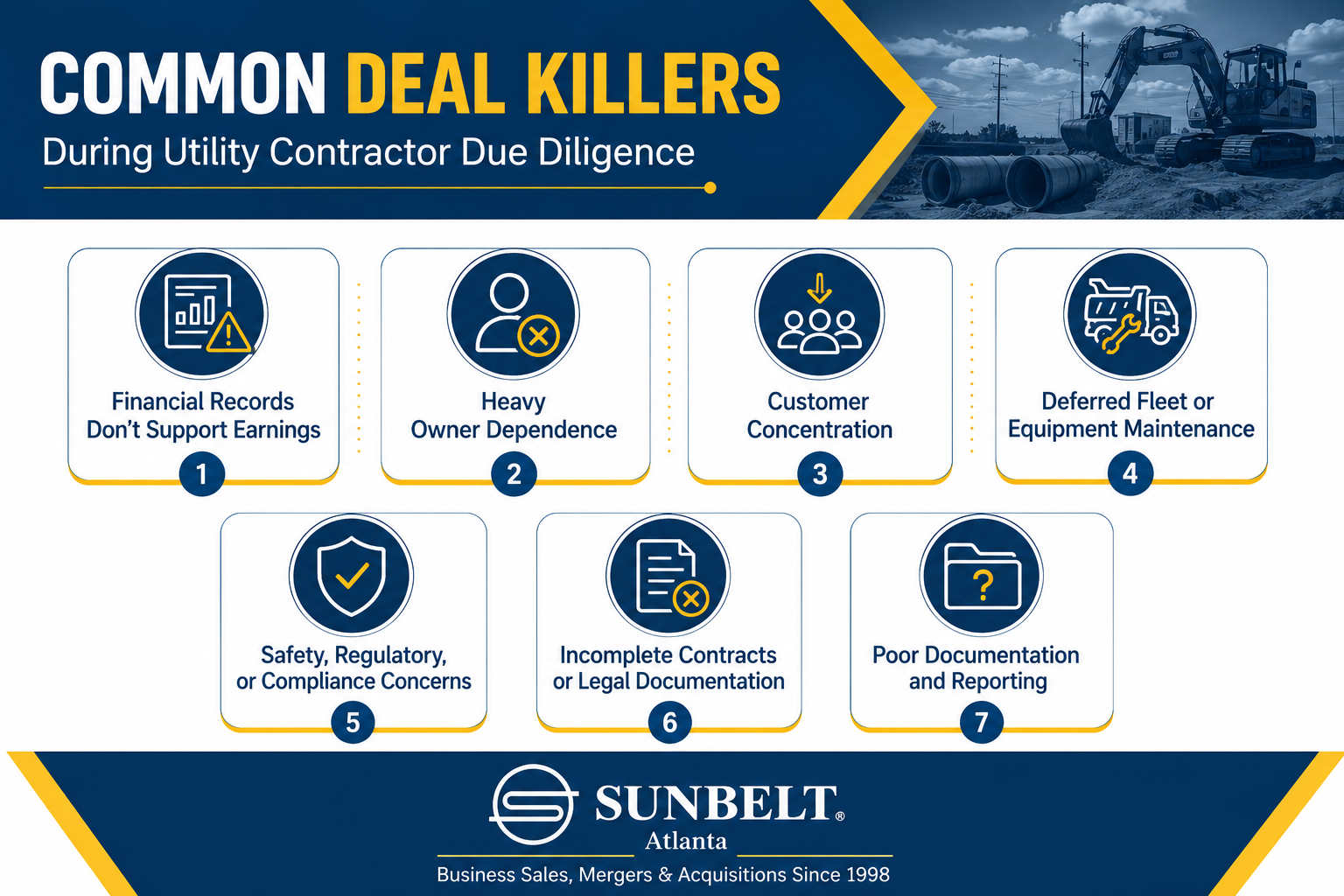
Common Deal Killers During Utility Contractor Due Diligence

Not every issue uncovered during due diligence ends a transaction. Buyers expect to ask questions and request additional documentation as they evaluate the business. Problems arise when significant risks surface unexpectedly or when sellers cannot provide clear answers to support the company's financial or operational performance.

Many of the issues below can be addressed before taking a business to market. Identifying them early helps reduce uncertainty, strengthen buyer confidence, and keep negotiations moving forward.

  • Financial records that don't support reported earnings: Inconsistent financial statements, incomplete records, or unexplained adjustments often lead buyers to question the company's reported performance. This can result in additional diligence, revised valuation, or delayed negotiations.

  • Heavy owner dependence: Buyers become more cautious when customer relationships, estimating, project oversight, or day-to-day decision-making rely heavily on the owner. A capable management team and documented processes help reduce transition risk.

  • Customer concentration: Heavy reliance on one or two customers isn't necessarily a deal breaker, but buyers will want evidence that those relationships are stable and likely to continue after the ownership transition.

  • Deferred fleet or equipment maintenance: Aging equipment, inconsistent maintenance records, or significant upcoming replacement costs may lead buyers to adjust their valuation to account for future capital expenditures.

  • Safety, regulatory, or compliance concerns: OSHA violations, recurring workers' compensation claims, licensing issues, or unresolved compliance matters can increase perceived risk and affect deal terms.

  • Incomplete contracts or legal documentation: Missing agreements, expired permits, unresolved disputes, or contracts that cannot be assigned may require additional legal review before closing.

  • Poor documentation and reporting: Buyers expect organized financial records, project documentation, and operational information. Missing or inconsistent documentation often extends due diligence and makes it more difficult to validate the business.

Most transactions encounter questions during due diligence. The difference is whether the seller is prepared to answer them. Businesses with organized records, documented processes, and a clear understanding of potential risks are generally better positioned to maintain buyer confidence throughout the sale process.

Read More: Red Flags That Scare Off Buyers — 9 Deal Killers That Can Surface During Business Acquisition

Preparing for Due Diligence Before You Go to Market

The best time to prepare for due diligence is before your business is listed for sale. Buyers expect organized documentation, reliable financial reporting, and clear operational processes. Addressing potential issues early can reduce delays, strengthen buyer confidence, and keep negotiations focused on the value of the business rather than avoidable risks.

Use the checklist below to evaluate your readiness before beginning the sale process.

Preparation Area Questions to Consider
Financial Readiness Are your financial statements current and supported by accurate job costing and documentation? Can you clearly explain any owner add-backs or unusual financial results?
Operational Readiness Are equipment records, maintenance logs, and project documentation complete? Are key operating procedures documented and consistently followed?
Customer & Contract Readiness Are customer contracts and backlog reports organized? Can you explain customer concentration and the profitability of current work?
Workforce & Management Readiness Have you reduced owner dependence? Are key employees identified, and can the business continue operating without your daily involvement?
Legal & Compliance Readiness Are licenses, permits, insurance policies, safety records, and legal documents current and readily available? Have outstanding issues been addressed where possible?

No business enters due diligence without questions from buyers. The objective is to be prepared to answer those questions with accurate information, organized documentation, and a clear understanding of how the business operates. That preparation helps build buyer confidence and keeps the transaction moving forward.

Read Next: How to Maximize Business Value Before Selling [2026 Guide]

Preparation Makes Due Diligence More Predictable

Due diligence is designed to reduce uncertainty for buyers. The more organized and transparent a utility construction business is before going to market, the easier it becomes to answer questions, support valuation, and keep the transaction moving forward.

Preparing early also allows owners to address potential concerns before they become negotiating points. Whether that involves improving financial reporting, documenting operating procedures, strengthening management, or resolving compliance issues, those efforts can increase buyer confidence and contribute to a smoother sale process.

Read Next: Increase EBITDA Before Selling Your Business: 7-Step Playbook

If you're considering selling a utility construction company, Sunbelt Atlanta's Utility Construction Business Brokers can help you evaluate your company's market readiness, identify opportunities to strengthen value, and prepare for a successful transaction. Contact our team to schedule a confidential consultation and discuss your long-term exit goals.

Planning a Future Sale of
Your Utility Construction Company?


Frequently Asked Questions

How long does due diligence typically take when selling a utility construction company?

The timeline depends on the size and complexity of the business, the quality of its records, and the structure of the transaction. For many lower middle-market utility construction companies, due diligence lasts anywhere from several weeks to a few months. Businesses with organized financial records, documented operating procedures, and complete legal documentation generally move through the process more efficiently than companies that need to gather information after the sale process has already begun.

What documents should utility contractors prepare before due diligence begins?

Buyers typically request historical financial statements, tax returns, customer contracts, backlog reports, equipment records, employee information, insurance policies, licenses, permits, and corporate documents. They may also request project-level financial analysis, safety records, and documentation supporting regulatory compliance. Preparing these materials in advance helps buyers verify the business more efficiently and reduces delays during the transaction.

How do buyers evaluate regulatory compliance for utility construction companies?

Regulatory compliance is an important part of business due diligence because utility contractors often operate within a complex framework of licensing, permitting, safety standards, and environmental regulations. Buyers review these areas to identify potential liabilities and ensure compliance with applicable federal, state, and local requirements. They also want to confirm that the business has maintained required licenses, environmental permits, and documentation needed to continue operating after closing.

Does customer concentration automatically reduce the value of a utility construction business?

Not necessarily. Many successful utility contractors perform a significant amount of work for a limited number of municipalities, utility providers, or telecommunications companies. Buyers are generally more interested in the stability of those relationships, the quality of the contracts, and whether future work is likely to continue after the ownership transition. Diversified revenue can reduce risk, but long-term customer relationships with a strong performance history can also support buyer confidence.

When should owners begin preparing for due diligence?

Ideally, preparation should begin well before the business is taken to market. Many owners start reviewing financial reporting, operational processes, management responsibilities, and documentation three to five years before a planned exit. This provides time to improve financial performance, strengthen transferability, reduce owner dependence, and address potential issues before buyers begin their review.