



20 min read
How to Evaluate a Plumbing Business in Georgia Before You Buy
Doreen Morgan is the owner and managing broker of Sunbelt Business Brokers – Atlanta, where she has spent two decades guiding Main Street and lower-middle-market business owners through successful sales valued from $750K to $75M. A proven dealmaker, Doreen has personally closed 300-plus transactions since 2005 across B2B services, heavy construction, healthcare, franchising, manufacturing, specialty distribution, and technology. Before acquiring Sunbelt Atlanta in 2015, she sharpened her M&A...
Doreen Morgan
Updated on September 8, 2026
Buying a plumbing business in Georgia starts with verifying three things: whether the company can legally operate after closing, whether its earnings are sustainable, and whether the operation can transfer without disrupting customers or technicians. Buyers should review licensing, normalized SDE or EBITDA, service mix, customer concentration, workforce depth, fleet condition, working capital, and owner dependence before agreeing to a purchase price.
Licensing should be addressed early. Under current Georgia law, a partnership, LLC, or corporation may engage in the plumbing business when a licensed Class I or Class II Master Plumber is regularly connected with the entity and actively engaged in the business on a full-time basis. If the seller currently fills that role, the buyer needs to determine who will provide the required licensed capability after closing and what that arrangement will cost.
Workforce depth deserves the same scrutiny. The U.S. Bureau of Labor Statistics projects about 44,000 openings for plumbers, pipefitters, and steamfitters each year from 2024 through 2034, with many openings resulting from workers changing occupations or leaving the labor force. For a buyer, retaining experienced plumbers and capable managers can directly affect service capacity, customer continuity, cash flow, and transition risk.
💡 TL;DR: What Buyers Should Know Before Buying a Plumbing Business in Georgia
-
Licensing can determine whether operations continue smoothly after closing. Buyers should confirm which Class I or Class II Master Plumber supports the company, whether the license covers the work that generates revenue, and who will provide the required licensed capability after the seller exits.
-
Reported earnings need to hold up under buyer scrutiny. Tax returns, P&Ls, bank statements, payroll, add-backs, and working capital should support the seller’s stated SDE or adjusted EBITDA and show sustainable cash flow.
-
The workforce is a major part of what the buyer is acquiring. Experienced plumbers, service managers, dispatchers, and other key employees affect service capacity, customer retention, and how easily the company can operate under new ownership.
-
Revenue quality affects both valuation and deal structure. Buyers should separate recurring and repeat service revenue from project work, review customer concentration, and understand how much revenue depends on the seller’s relationships or a small number of accounts.
-
Test transferability before closing. Owner dependence, fleet condition, operating systems, documentation, licensing continuity, and transition requirements can influence purchase price, seller support, holdbacks, working-capital terms, and the likelihood of closing.
1. Assess Georgia Plumbing Licensing and Operating Continuity
Licensing should be one of the first issues a buyer reviews when evaluating a plumbing business in Georgia. A profitable company can still be difficult to acquire if the licensed capability required to perform its work depends on a seller who plans to leave immediately after closing.
Current Georgia law distinguishes between ownership of the business entity and the licensed person responsible for its plumbing activity. A partnership, LLC, or corporation may engage in plumbing when a Class I or Class II Master Plumber is regularly connected with the entity and actively engaged in the business on a full-time basis.
For an acquisition, the practical question is therefore whether the company will continue satisfying Georgia's licensing requirements after ownership changes.

Confirm Which Master Plumber the Business Depends On
During preliminary diligence, identify the Master Plumbers and Journeyman Plumbers working in the company and verify the licenses that matter to the operation. Determine:
-
Who currently serves as the Master Plumber supporting the business
-
Whether that person is the seller or an employee
-
Whether the license holder plans to remain after closing
-
What responsibilities that person performs beyond licensing
-
Whether the license is active and in good standing
-
Whether employment or retention arrangements are needed before closing
This issue becomes especially important in an owner-operated plumbing company. The seller may provide the Master Plumber credential while also supervising technicians, estimating larger jobs, resolving technical issues, and managing important customer relationships.
Replacing that person may therefore require more than hiring another license holder. A short consulting arrangement should not automatically be treated as a licensing solution. Buyers should confirm any proposed post-closing arrangement with qualified Georgia legal or licensing counsel before relying on it in the acquisition structure.
Match the License Class to the Work That Produces Revenue
Georgia recognizes Journeyman Plumber, Master Plumber Class I, and Master Plumber Class II licenses. Buyers should compare the target company's actual service mix with the authority supporting its work.
| License Type | What It Means for the Acquisition | What the Buyer Should Verify |
|---|---|---|
| Journeyman Plumber | Performs qualifying plumbing work but does not serve as the plumbing contractor responsible for the business. | License status, experience, role, retention, and dependence on individual journeymen. |
| Master Plumber Class I | Covers qualifying residential work and commercial buildings within the current Class I statutory limits. | Whether the company's residential and commercial work fits within Class I authority and whether the license holder will remain after closing. |
| Master Plumber Class II | Provides unrestricted Master Plumber authority under Georgia's licensing framework. | Active license status, the holder's post-closing role, and how much revenue depends on that individual's continued employment. |
Georgia expanded the Class I scope effective July 1, 2026. Buyers evaluating a transaction now should therefore verify the current statutory limits rather than relying on older licensing descriptions.
Compare Licensing With the Company's Revenue Mix
The licensing review should connect directly to revenue. Review:
-
Residential versus commercial revenue
-
Typical project size
-
Larger commercial jobs
-
Current backlog
-
Active permits
-
Customer contracts
-
The Master Plumber associated with relevant work
-
Renewal and continuing-education status
Suppose a company earns most of its revenue from residential repair but also performs meaningful commercial work. The buyer should determine whether the license supporting the company covers those commercial jobs and whether that capability remains in place after closing.
The issue affects more than compliance. If a meaningful portion of revenue depends on one licensed individual, that person directly affects transferability.
Do Not Assume the Buyer Can Obtain a Master License Immediately
A buyer who intends to qualify personally after the acquisition should review Georgia's current experience, application, and examination requirements before structuring the deal around that assumption.
Licensure requires qualifying plumbing experience. A buyer without the necessary background may therefore need a properly licensed Master Plumber to remain with or join the company after closing. That requirement should be resolved before the buyer relies on historical earnings.
Translate Licensing Dependence Into the Economics of the Deal
Licensing risk affects value when maintaining compliant operations creates a cost that is not fully reflected in the seller's historical financials.
If the seller currently serves as the Master Plumber and manages technicians, the buyer may need to hire or retain someone to perform those responsibilities after closing. That compensation belongs in the normalized earnings analysis. The practical questions are:
-
Which Master Plumber supports the work the company currently performs?
-
Will that person remain after closing?
-
What will maintaining that licensed capability cost under new ownership?
If those answers remain unclear, the buyer does not yet have a reliable view of transferable cash flow.
2. Verify the Earnings and Transferable Cash Flow
A plumbing company can show healthy revenue and still produce weak cash flow after a buyer takes over. The financial review should determine what the business actually earns after normalizing owner compensation, one-time expenses, and costs the buyer will inherit.
For smaller owner-operated plumbing businesses, buyers often focus on seller’s discretionary earnings (SDE). Larger companies with a management team in place are more likely to be evaluated using adjusted EBITDA. In either case, the buyer should work from earnings that can be supported by the company’s records rather than the seller’s preferred calculation.
Reconcile the Financials Before Accepting the Earnings Story
Start with at least three years of tax returns, profit and loss statements, balance sheets, and monthly financials. The goal is to see whether reported revenue and profit are consistent across the records and whether recent performance reflects a durable trend.
Plumbing businesses can have meaningful swings in profitability from labor costs, material pricing, large projects, emergency work, seasonality, or changes in service mix. A buyer should understand what caused those movements before treating the latest year as a reliable run rate.
Bank statements, payroll records, accounts receivable aging, and job-level reporting can help confirm whether the financial statements match how the business actually operates.
Treat Add-Backs Conservatively
Seller add-backs can materially change the apparent earnings of an owner-operated plumbing business. Common adjustments may include owner-specific compensation, personal vehicle expenses, family payroll, or genuinely nonrecurring professional fees. Each adjustment should have documentation and a clear reason it will disappear after closing.
A seller may also add back most of their compensation because the business is being presented on an SDE basis. That does not mean the buyer can remove the seller without replacing the work. If the owner currently estimates jobs, manages technicians, oversees licensing, or handles major accounts, the buyer should include the cost of replacing those responsibilities when estimating post-closing cash flow.
If the seller performs work that will require a paid replacement after closing, the buyer should include that cost when estimating transferable earnings. Otherwise, historical SDE or adjusted EBITDA may overstate the cash flow available under new ownership.
Look Beyond Revenue Growth
Revenue growth has more value when the underlying margins and cash flow improve with it. A plumbing business can grow quickly by taking on lower-margin installation projects, relying heavily on subcontractors, or adding technicians faster than it can keep them productive. The buyer should compare revenue growth with gross margin, labor efficiency, operating expenses, and cash flow over the same period.
Job costing is particularly useful here. If the company tracks profitability by service line, buyers can see whether residential service, commercial work, drain cleaning, repiping, new construction, or maintenance agreements are actually contributing to earnings.
Weak job costing makes that analysis harder and increases the risk that apparently strong revenue is masking unprofitable work.
Understand the Cash Needed After Closing
Reported SDE or EBITDA does not show how much cash the buyer must keep in the business. Plumbing companies may need working capital to cover payroll, fuel, materials, inventory, insurance, and vendor payments before customer invoices are collected. Commercial work can create larger receivable balances and longer collection cycles than residential service work.
The buyer should review normal accounts receivable, accounts payable, inventory, customer deposits, and seasonal cash requirements before agreeing to a working-capital target. A company with strong earnings but chronically stretched receivables may require more cash at closing than its income statement suggests.
Build the Valuation Around Transferable Earnings
The earnings used for valuation should represent what the business is expected to produce under new ownership after realistic replacement costs and normal operating expenses. That means separating historical profit from transferable profit.
If normalized earnings fall during diligence because add-backs are unsupported, owner responsibilities were understated, or working-capital needs were overlooked, the buyer may reduce the valuation or revisit the deal terms. When the parties need an outside reference point for normalized earnings and market value, Sunbelt Atlanta’s Business Valuation Services can help establish a more defensible basis for the pricing discussion.
Read Next: Here’s What Buyers Look for in Financials (Disclaimer: It’s Not Just Revenue)
3. Evaluate the Service Mix and Revenue Quality
Two plumbing businesses with similar revenue can carry very different levels of risk. Buyers should understand where the revenue comes from, how predictable it is, and how much of it is likely to continue after ownership changes.
A company built around recurring service calls and established customer relationships will usually present a different risk profile from one that depends heavily on large projects, new construction, or a few commercial accounts.
Break Revenue Down by Service Line
Start by separating revenue into meaningful categories such as:
-
Residential service and repair
-
Commercial service
-
New construction
-
Repiping and larger replacement work
-
Drain and sewer services
-
Emergency calls
-
Maintenance agreements
-
Other recurring or contract-based work
The goal is to identify which services generate the strongest margins and which require the most labor, equipment, and working capital.
A company may generate significant revenue from new construction while producing thinner margins and slower collections than its residential service work. Another may rely heavily on emergency calls that carry attractive pricing but require enough technicians to cover nights and weekends.
Buyers should compare revenue by service line with gross margin and labor requirements rather than treating every dollar of sales as equally valuable.
Separate Repeat Business From One-Time Work
Revenue becomes easier to underwrite when the buyer can see where future work is likely to come from. Maintenance agreements, repeat residential customers, property managers, commercial service contracts, and long-standing referral relationships can provide a more dependable base of demand. One-time installations and project work may still be profitable, but the buyer has to rebuild that pipeline after closing.
The distinction matters when estimating future cash flow. If the seller describes the business as having recurring revenue, the buyer should verify what actually renews, how often customers return, and whether those relationships belong to the company or to the owner personally.
Field-service platforms such as ServiceTitan, CRM records, invoice histories, and customer reports can help establish repeat service patterns when the company maintains reliable data.
Review Customer and Referral Concentration
Customer concentration is usually more obvious in commercial plumbing companies, but residential businesses can carry concentration risk as well. A buyer should review revenue by customer and by referral source. Dependence on one property manager, general contractor, homebuilder, warranty company, or lead-generation channel can create exposure even when the company serves hundreds of individual end customers.
For example, a plumbing contractor may appear highly diversified because it completes hundreds of jobs each year. If 30% of those jobs come through one property-management relationship, losing that account after closing could create an immediate revenue gap.
The same issue applies to marketing channels. A business that depends heavily on one paid lead source may need materially higher marketing spending if that channel becomes more expensive or stops producing.
Connect Revenue Quality to Valuation and Deal Terms
Buyers place greater confidence in revenue they can trace, understand, and reasonably expect to continue. Strong repeat business, diversified customers, stable margins, and documented service agreements reduce uncertainty around future cash flow. Heavy concentration, project dependence, weak customer records, or revenue tied closely to the seller increase the risk that historical performance will not transfer.
That risk can show up in the purchase price or in the terms of the transaction. A buyer may value uncertain revenue more conservatively, require additional diligence around major accounts, or structure part of the consideration around customer retention. Before relying on the seller’s historical growth rate, the buyer should know which revenue streams are profitable, repeatable, and likely to remain with the business after closing.
Buyers comparing plumbing with other trade-based acquisitions can also review Sunbelt Atlanta’s guidance for Home Services Businesses, where workforce depth, recurring demand, owner dependence, and transferability often drive similar transaction decisions.
Read More: Improve Customer Retention: A Guide to Increasing Your Business Value
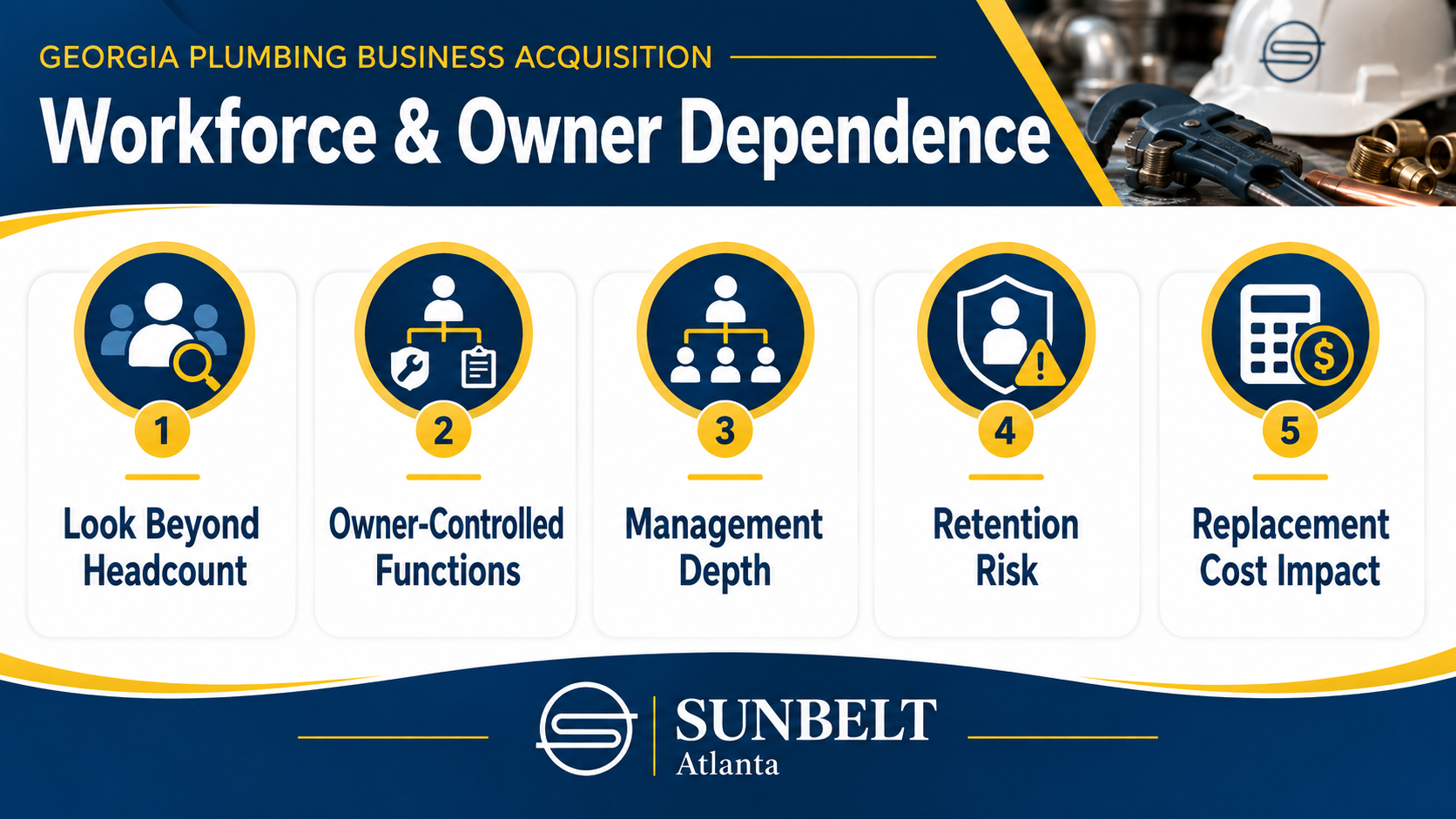
4. Examine Workforce Depth, Management, and Owner Dependence
A plumbing business can have strong demand and still be difficult to transfer if too much of its service capacity, technical knowledge, or decision-making depends on a few people. Buyers should understand who performs the work, who manages the operation, and which responsibilities will need to be replaced when the seller leaves.

Look Beyond Employee Headcount
Total employee count does not tell a buyer enough about workforce strength. A better review looks at the experience, licensing, tenure, productivity, compensation, and retention history of the people who actually keep jobs moving.
A company with ten technicians can still carry significant risk if two senior plumbers perform most of the complex work, handle difficult customer situations, or train newer employees. Overtime and subcontractor usage can reveal similar pressure. If the company regularly depends on outside labor or excessive overtime to meet demand, the buyer should determine whether the problem is temporary or reflects a deeper staffing shortage.
The buyer should also identify which employees would be difficult to replace. Losing a highly experienced plumber may affect more than field capacity if that employee also holds customer relationships, technical knowledge, or licensing responsibilities.
Determine What the Owner Still Controls
Owner dependence often becomes clearer when the buyer looks at how decisions are made rather than at the organizational chart.
In a smaller plumbing company, the owner may still price large jobs, supervise technicians, handle commercial accounts, approve hiring, manage vendor relationships, resolve customer complaints, and provide technical oversight. If several of those responsibilities sit with the seller, the buyer may be acquiring a profitable company that still lacks independent operating capacity.
For example, a seller who personally prices every major commercial job may be protecting margins through experience that has never been documented or transferred to another employee. If no estimator or service manager can reproduce that process, the buyer faces both a staffing cost and a risk that job profitability changes after closing.
Review Management Depth
Buyers should determine who can run the business when the owner is unavailable.
A more transferable plumbing company may already have a service manager, dispatcher, office manager, estimator, or operations leader with clearly defined authority. Those employees do not need to replace the owner completely, but they should be able to keep scheduling, field operations, customer service, and routine decisions moving without constant seller involvement.
If nearly every important decision still routes through the owner, the buyer should expect a more demanding transition and potentially additional management payroll after closing.
Evaluate Employee Retention Risk
Employee retention matters because experienced plumbing personnel can be difficult to replace quickly. The loss of a senior plumber, dispatcher, estimator, or service manager shortly after closing can reduce capacity while the buyer is already managing an ownership transition.
Buyers should review employee tenure, compensation, recent turnover, and whether important employees are likely to remain. Where one or two people carry substantial operational responsibility, the buyer may need to discuss retention incentives, employment arrangements, or transition planning before closing.
The purpose is not to eliminate employee risk. It is to understand which people have a material effect on revenue and whether the company can absorb a departure without disrupting service.
Factor Replacement Costs Into Transferable Earnings
Owner and employee dependence ultimately affect valuation when they create expenses the historical financials do not reflect.
If the seller performs work that will require a paid replacement, the buyer may need to add the cost of a service manager, estimator, operations leader, salesperson, or licensed Master Plumber to the post-closing operating model. That can reduce normalized SDE or adjusted EBITDA even though the expense does not appear in the seller's historical P&L.
Before closing, the buyer should know which responsibilities will remain with existing employees, which the buyer intends to assume personally, and which will require an additional hire. That distinction helps determine how much of the company's historical cash flow is actually transferable.
Read Next: The Critical Role of Employee Retention in Business Valuation
5. Understand Working Capital, Fleet, and Near-Term Capital Needs
A plumbing company can report healthy SDE or EBITDA and still consume a meaningful amount of cash in day-to-day operations. Buyers should determine how much working capital the business normally needs to cover payroll, materials, fuel, inventory, and vendor payments before customer invoices are collected.
Review the Cash Conversion Cycle
Residential service work often produces faster collections, while commercial and project-based plumbing can create larger accounts receivable balances and longer payment cycles. Buyers should review:
-
Accounts receivable aging
-
Accounts payable
-
Inventory levels
-
Customer deposits
-
Payroll timing
-
Seasonal cash needs
A business with strong reported earnings but slow collections may require more cash at closing than the income statement suggests.
Set a Realistic Working Capital Target
Working capital is often negotiated as part of the transaction. The buyer should distinguish between the working capital the company needs to operate and the working capital that will actually transfer at closing. Those amounts depend on the transaction structure and should be defined clearly in the LOI and purchase agreement.
That target should reflect the company’s historical needs rather than an arbitrary number. If receivables are unusually high, payables have been stretched, or inventory has been reduced before closing, the buyer may need an adjustment to avoid funding a shortfall immediately after taking ownership.
Connect Working Capital to the Purchase Economics
Working capital affects the buyer’s total cash requirement even when it does not change the headline purchase price.
A buyer should model the acquisition based on both the amount paid for the business and the cash required to operate it afterward. That provides a more accurate view of the capital needed to complete the acquisition and maintain service levels from day one.
Include Fleet and Equipment Spending in the Capital Model
Service vehicles and equipment can create another cash requirement that is not obvious from SDE or EBITDA. Buyers should review:
-
Vehicle age and mileage
-
Maintenance history
-
Outstanding liens
-
Specialty equipment
-
Replacement schedules
-
Deferred repairs
-
Equipment required for planned growth
A plumbing company may report attractive earnings while operating a fleet that will require substantial replacement spending during the first few years after closing.
The buyer should therefore evaluate the purchase price, working capital requirement, and near-term capital expenditures together. That provides a more realistic estimate of the total capital required to acquire the company and maintain its current service capacity.
6. Structure the LOI Around the Risks Already Visible
Before submitting a letter of intent, the buyer should understand enough about the company’s earnings, licensing, service mix, workforce, customer concentration, and obvious capital needs to frame the basic economics of the offer. Full due diligence usually follows the LOI and may uncover additional issues that require the buyer to confirm or revise those economics.
The LOI should therefore reflect what the buyer already knows without pretending that every risk has been resolved. Price matters, but so do the assumptions behind the price, the assets being acquired, the working-capital treatment, the seller’s transition obligations, and the conditions that must be satisfied before closing.
Decide What the Buyer Is Actually Acquiring
Many privately held business transactions are structured as asset sales, while others involve the purchase of equity. The structure affects what transfers to the buyer, which liabilities remain with the seller, and which contracts, leases, permits, or other arrangements may require additional action.
For a plumbing business, the buyer should understand how vehicles, tools, equipment, inventory, trade names, phone numbers, websites, customer records, software, leases, and other operating assets will be treated. Receivables, customer deposits, debt, and outstanding obligations also need clear treatment because they can materially change the cash required at closing.
The LOI does not need to resolve every legal detail, but it should establish enough of the transaction structure that both sides are negotiating from the same economic assumptions.
Address Known Risks Before They Become Closing Disputes
Material issues already identified during preliminary review should be reflected in the LOI rather than postponed unnecessarily.
If the seller is the Master Plumber the company depends on, the buyer should define a compliant post-closing licensing arrangement before relying on that person's continued involvement. If one commercial account represents a significant share of earnings, the buyer may want additional diligence around that relationship. If several service vehicles require replacement, the purchase economics should account for that near-term capital requirement.
The same principle applies to working capital. If the buyer expects a normal level of receivables, inventory, or other operating assets to remain in the company, the basic methodology should be addressed before the parties spend substantial time and money on full diligence. Resolving these assumptions early reduces the risk that the buyer and seller reach the purchase-agreement stage with fundamentally different views of the deal.
Look Beyond the Headline Purchase Price
Two offers with the same stated purchase price can expose the buyer to very different levels of risk. The buyer should consider how much cash is due at closing, whether any consideration is deferred or contingent, what working capital will transfer, what seller financing is involved, and how much additional capital the business will need shortly after the acquisition.
Transition support also has economic value. A seller who must remain involved because of licensing, estimating, customer relationships, or management responsibilities may require a different transition arrangement from an owner whose responsibilities have already been delegated.
The LOI should give both parties a clear framework for the transaction while leaving the buyer enough room to validate the assumptions through due diligence.
Read Next: M&A Deal Structures Explained — Understanding Deal Structure in Mergers and Acquisitions
7. Use Due Diligence to Validate the Acquisition
Due diligence should confirm that the business described during negotiations matches the company the buyer will actually own. For a plumbing acquisition, that means testing the financials alongside licensing, employees, customer relationships, assets, contracts, and operating liabilities.
Verify the Records Behind the Seller’s Claims
Buyers should reconcile the information used to support valuation with source documents. That typically includes tax returns, monthly financial statements, payroll records, bank statements, accounts receivable, customer reports, vehicle schedules, and major contracts.
Operational diligence should also confirm that licenses are current, vehicles and equipment are owned as represented, and important customer or vendor relationships are likely to continue after closing. The goal is to identify discrepancies before they become post-closing expenses.
Focus on Issues That Could Change Cash Flow
Not every diligence finding deserves the same weight. Buyers should concentrate on issues that could materially affect earnings or continuity. Examples include:
-
Unsupported add-backs
-
A major customer with declining revenue
-
A key plumber planning to leave
-
Deferred fleet replacement
-
Unrecorded liabilities
-
Licensing dependence on the seller
-
Receivables that are unlikely to be collected
A problem discovered during diligence does not automatically end the transaction. It should change the buyer’s analysis when it affects the economics of the deal.
Reflect Material Findings in the Deal Terms
When diligence uncovers additional risk, buyers may respond through price, working capital adjustments, seller financing, holdbacks, transition requirements, or other terms in the purchase agreement.
For example, if a major commercial account represents a meaningful share of earnings and its future relationship is uncertain, a buyer may be less comfortable paying the entire purchase price at closing. If several vehicles need immediate replacement, the buyer may adjust the price to reflect that near-term capital requirement.
Due diligence is complete when the buyer can explain where the company’s cash flow comes from, what could disrupt it, and whether the agreed purchase price and terms adequately reflect those risks.
Read Next: How Buyers Evaluate Risk and What It Means for Your Valuation
Need a Second Opinion on the Business
You’re Evaluating?
8. Plan the Transition Before You Close
A plumbing acquisition is more likely to hold its value when the buyer knows how customers, employees, licensing, and day-to-day decisions will transfer after closing. The transition plan should reflect the actual dependencies uncovered during diligence.
Define the Seller’s Role After Closing
The seller may need to remain involved for customer relationships, estimating, employee supervision, or other transition responsibilities. If the buyer also intends to rely on the seller's Master Plumber license after closing, the proposed arrangement should separately satisfy Georgia's licensing requirements. Buyers should define:
-
How long the seller will stay
-
Which responsibilities the seller will handle
-
Which customer and vendor introductions are required
-
When operating authority transfers to the buyer or management team
A vague promise to “help with the transition” is difficult to rely on once the deal closes.
Protect Customer and Employee Continuity
The buyer should identify which relationships need a deliberate handoff. For larger commercial accounts, property managers, referral partners, and key vendors, a planned introduction can reduce uncertainty. The same applies to employees who are central to service delivery or management.
Timing matters because confidentiality should usually be maintained until the transaction reaches the appropriate stage. Once disclosure is necessary, the buyer and seller should have a clear communication plan rather than improvising.
Match the Transition Period to the Risk
A small residential plumbing company with a strong service manager and limited owner involvement may require only a short handoff. An owner-operated company where the seller controls licensing, estimating, and major accounts may need a longer transition.
The transition period should therefore be based on what the buyer is actually inheriting, not a standard number of weeks or months. A well-defined handoff reduces the chance that revenue, employees, or operational knowledge leave with the seller and gives the buyer a more realistic path to maintaining cash flow after closing.
Read Next: How to Lead a Successful Post-Merger Integration: Key Steps & Tips
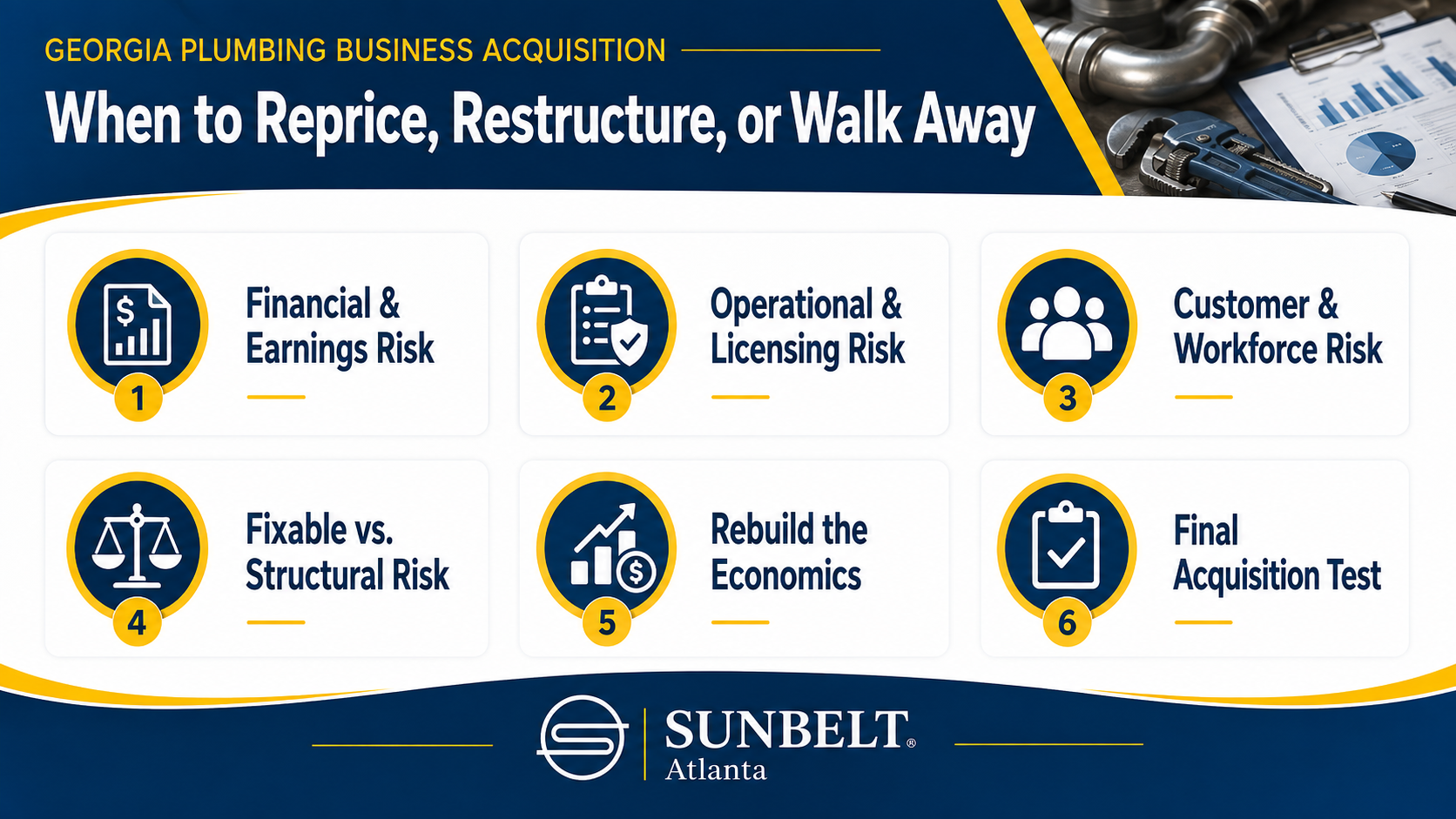
9. Know When to Reprice, Restructure, or Walk Away
By the end of due diligence, the buyer should understand which problems are manageable and which could materially change the economics of the acquisition. The question is whether those risks can be quantified, corrected, or addressed through price and deal structure.

Financial and Earnings Risk
Financial statements that do not reconcile, unsupported add-backs, unexplained margin changes, and weak cash conversion can undermine the earnings used to support valuation. If diligence reduces normalized SDE or adjusted EBITDA, the buyer should rebuild the acquisition model using the earnings that are likely to remain after closing.
This is especially important when historical earnings do not reflect replacement payroll, recurring expenses previously treated as add-backs, or working-capital requirements the buyer will have to fund.
Operational and Licensing Risk
Operational concerns become more significant when several responsibilities depend on the same person. A seller who provides the Master Plumber capability, estimates important jobs, supervises technicians, and manages major customer relationships represents several transition risks concentrated in one individual.
Other concerns may include weak job costing, undocumented procedures, outdated systems, deferred fleet replacement, or limited management depth. Some of these problems can be corrected with additional investment. Others may require a longer seller transition, new management hires, retention arrangements, or changes to the purchase price.
Customer and Workforce Risk
Revenue concentration and employee concentration deserve similar scrutiny. A company may serve hundreds of customers while still depending heavily on one property manager, general contractor, homebuilder, referral partner, or marketing channel. Losing that source after closing can create an immediate revenue gap.
The same principle applies to employees. If a small number of plumbers, managers, or dispatchers carry most of the technical knowledge or customer relationships, the buyer should consider what happens if one leaves. Risk becomes more significant when customer concentration, employee dependence, and seller dependence overlap.
Separate Fixable Problems From Structural Risk
Some issues have straightforward solutions. A vehicle can be replaced, an outdated system can be upgraded, and a temporary staffing vacancy can be filled.
Other problems are harder to correct quickly. Heavy customer concentration, persistent technician turnover, weak earnings quality, dependence on the seller for critical relationships, or unresolved licensing continuity may continue affecting the business well after closing.
The buyer should determine whether those risks can realistically be managed or whether they require a different valuation, transaction structure, or decision.
Rebuild the Economics With What You Learned
The acquisition model should reflect the company as it will operate under new ownership. That may mean reducing SDE or adjusted EBITDA for replacement management, adding the cost of maintaining required licensed capability, increasing expected fleet spending, funding additional working capital, or accounting for employee-retention costs.
If those changes materially reduce expected cash flow or increase the capital required after closing, the original valuation may no longer be supportable.
Use a Final Acquisition Test
Before moving toward closing, the buyer should be able to answer five questions clearly.
| Question | What a Strong Answer Looks Like |
|---|---|
| Where does the cash flow come from? | Earnings are supported by clean financials and profitable service lines. |
| Who keeps the operation running? | Licensed plumbers, managers, and technicians can continue without excessive seller involvement. |
| What could reduce earnings after closing? | Major risks have been identified and quantified. |
| How much additional capital is required? | Working capital, fleet, equipment, and hiring needs are included in the acquisition model. |
| Does the price reflect the risk? | Valuation and deal terms account for the material issues uncovered during diligence. |
If those answers remain unclear, the buyer needs additional diligence before moving forward. If they are supported by the financial and operational evidence, the buyer has a stronger basis for deciding whether the plumbing business is worth acquiring.
Read Next: Red Flags That Scare Off Buyers — 9 Deal Killers That Can Surface During Business Acquisition
What a Strong Plumbing Acquisition Looks Like
A strong plumbing acquisition gives the buyer a clear path to maintaining the company’s cash flow after ownership changes. The financials support the earnings, the required licensed capability remains in place, experienced employees can continue serving customers, and the business does not depend excessively on the seller to operate.
The purchase price should reflect the business as it will operate under new ownership. That means accounting for replacement management, licensing costs, working capital, fleet investment, employee retention, and other expenses that may not be obvious from historical SDE or adjusted EBITDA.
For buyers evaluating a plumbing business in Georgia, the final decision comes down to whether the company can continue operating legally, profitably, and reliably after closing. When the financial and operational evidence supports that conclusion, the buyer has a stronger basis for moving forward with confidence in both the valuation and the transaction structure.
Buyers still comparing opportunities can review Sunbelt Atlanta’s current Businesses for Sale. If you are evaluating a plumbing business in Georgia and want an experienced perspective on valuation, deal structure, or transaction risk, talk with a Sunbelt Atlanta advisor before committing to the acquisition.
Evaluating Your Next Business Acquisition
in Georgia?
Frequently Asked Questions
Do I need a Georgia plumber license to buy or start a plumbing business?
A buyer does not necessarily need to hold the plumber license personally, but the Georgia business must have the required licensed plumbing capability after closing. If the seller is the Master Plumber the company depends on, the buyer should resolve that arrangement before completing the acquisition. The same licensing issue matters when starting a plumbing business in Georgia.
What license type does a Georgia plumbing business need?
Georgia has Journeyman Plumber, Master Plumber Class I, and Master Plumber Class II licenses. Class II is the non-restricted Master Plumber license, while Class I has limits on the plumbing work it covers. Buyers should confirm that the license type supporting the company matches its actual service mix and remains in place after closing.
What experience requirements and exam details should a buyer know about Georgia plumbing licenses?
Georgia's experience requirements differ by license type, and the rules changed effective July 1, 2026. Buyers who plan to qualify personally as a Master Plumber should review the current experience requirements, journeyman licensing requirements, application process, and exam details with the Georgia Division of Master Plumbers and Journeyman Plumbers before structuring an acquisition around that plan.
Does the seller's plumber license transfer with the business?
No. An individual plumber license should not be treated as an asset that automatically transfers with the company. Buyers should verify the post-closing licensing arrangement under Georgia's plumbing rules and applicable O.C.G.A. requirements before relying on the seller's license.
How should buyers value a small plumbing business in Georgia?
A small plumbing business is often analyzed using SDE, while a larger company with management in place may be evaluated using adjusted EBITDA. Market benchmarks can provide context, but buyers should also account for owner dependence, licensed plumbing personnel, customer concentration, working capital, fleet needs, and replacement payroll before settling on a value.