
How Long Does It Take to Sell a Business in 2026?
 Doreen Morgan : Jun 9, 2026, 1:00:00 PM
Learn how long it takes to sell a business in 2026, what factors affect the timeline, and what sellers can do to improve their chances of a...

Are you thinking it’s time to sell your insurance agency, or simply curious about how to value an insurance entity before making any major moves? This in-depth guide covers everything from the initial evaluation process to identifying your potential buyers.
According to the 2025 IBBA and M&A Source Market Pulse Report, seller preparedness, financial quality, and realistic pricing continue to shape lower middle market deal outcomes, which is especially relevant when selling an insurance agency with recurring revenue and retention-based value.
Whether you’re an agency owner or just exploring your options, we’ll walk you through how to determine the value of your agency so you can make the best possible decision. Learn how to maximize the value of your insurance agency and position it to attract the right buyer at the most favorable sale price.
This guide covers:
How valuation, buyer fit, and deal structure affect your final selling price
What buyers review during due diligence before acquiring an insurance agency
How to prepare your agency for sale without disrupting staff or clients
P.S. Early preparation usually produces a cleaner process, stronger buyer confidence, and fewer surprises once diligence starts. Sunbelt Atlanta supports insurance agency owners through business valuation, a proven sale process, and confidential business sales designed to protect operations while you evaluate options.
Selling an insurance agency is a structured process that demands careful preparation and disciplined execution. Owners who achieve the strongest outcomes follow a defined series of actions that protect value, maintain confidentiality, and support a smooth transition. Below is a practical roadmap:
| Step | Full Description |
|---|---|
| Pre-Sale Preparation | Update financials, organize client and carrier agreements, and address outstanding compliance issues. Clear, accurate records increase buyer confidence and reduce friction during due diligence. |
| Assemble Your Advisory Team | Engage a broker, accountant, and attorney who specialize in agency transactions. Their guidance helps you navigate valuation, tax implications, and deal structure with precision. Sunbelt Atlanta brokers bring over 90 years of collective experience. |
| Confidential Marketing | Position the agency to qualified buyers through controlled outreach. Maintaining discretion preserves employee stability and client trust while creating a competitive buyer environment. |
| Negotiation and Offers | Review letters of intent, analyze payment structures, and negotiate terms that align with your financial and strategic goals. Understanding goodwill, including your agency’s reputation and client retention, can help support value during negotiation. |
| Closing and Transition | Finalize contracts, transfer assets, and oversee a managed handoff to the buyer. A well-orchestrated transition retains client relationships and safeguards the agency’s reputation. |
This framework provides a clear, actionable view of the sale journey and complements the deeper dives into valuation, timing, and buyer types throughout the rest of this guide.
Every business in the insurance industry has unique features, from the lines of insurance products you offer to the client relationships you’ve built over time. For agency owners, particularly those running an independent insurance agency, understanding the agency’s true value is crucial. You might be selling soon or simply want an accurate valuation for strategic planning. Either way, calculating your agency’s true value goes well beyond guesswork. It means looking at annual revenue, profitability, and the strength of client loyalty. It’s not unlike consulting a Kelley Blue Book for cars, except the “mileage” here is your reputation and intangible goodwill.
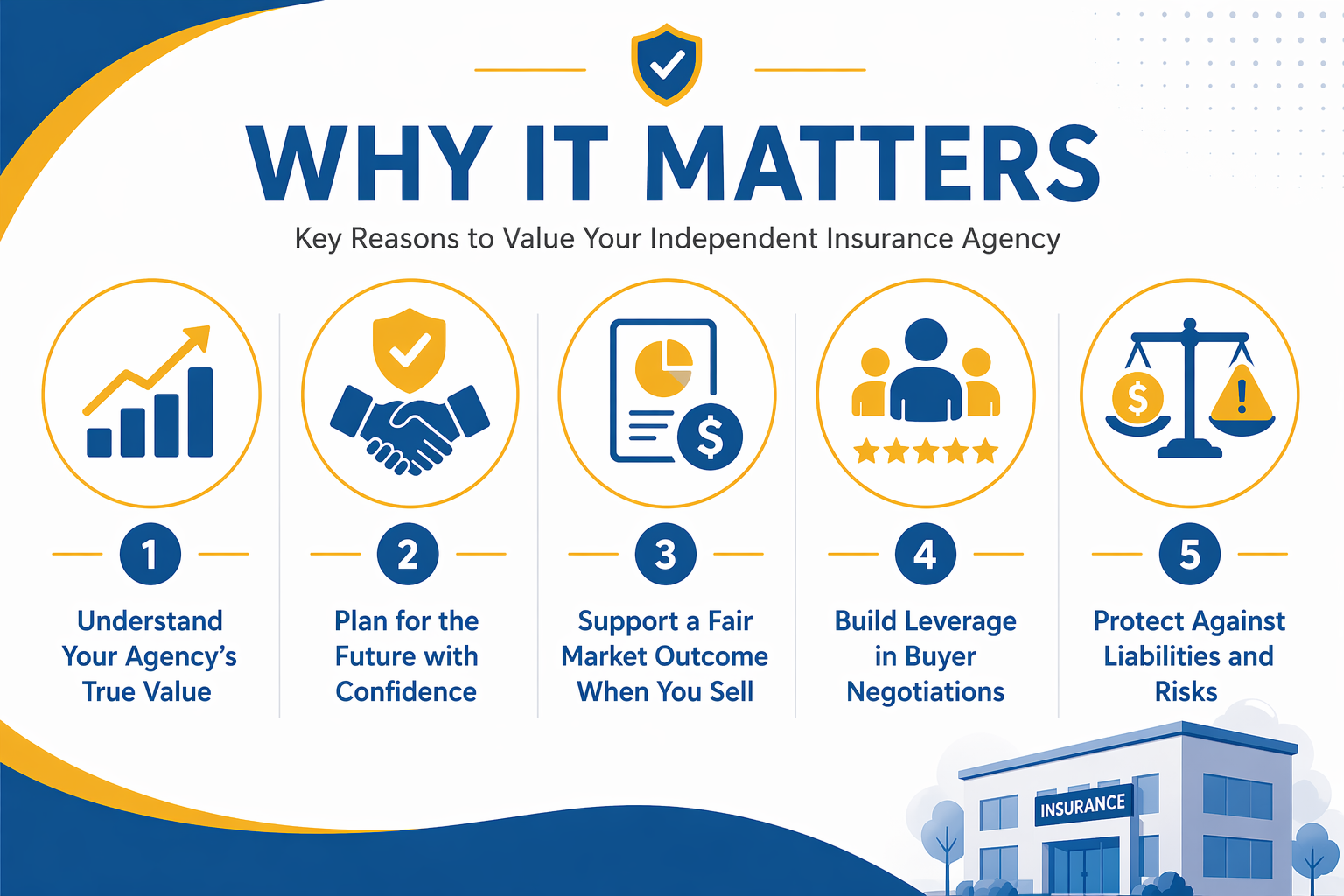
Moreover, knowing how to value an insurance agency helps protect you from unforeseen liability issues and supports a fair market outcome if you decide to sell the entire business down the road. For owners focused on future success, an accurate market value report serves as a roadmap, highlighting both tangible and intangible assets as well as potential liabilities. This clarity is indispensable if you want to sell your agency in the future or shift partial ownership. The stronger and better supported the valuation, the more leverage you will have when negotiating with potential buyers.
Owners preparing your agency for sale should also understand that buyers do not price insurance agencies on revenue alone. They look closely at recurring commission income, policy retention, carrier concentration, producer dependence, and the stability of service staff who support renewals and cross-sell opportunities. Two agencies with similar topline revenue can produce very different outcomes if one has cleaner earnings, stronger retention, and less owner dependence. A formal business valuation helps surface those differences early and gives you a more defensible starting point before going to market.
For many agency owners, pinpointing the right time to sell an insurance agency can feel overwhelming. According to the Bureau of Labor Statistics, the insurance sector remains relatively stable, which can be both beneficial and challenging. On one hand, stability can support a consistent client base. On the other hand, competition in established markets can be fierce. A key indicator that it might be time to sell is when you’ve reached a plateau in annual revenue, or you’re ready to retire and pass the torch. If you sense that you’ve taken the business as far as it can go under your leadership, it may signal that you’re ready to sell.
Another essential consideration is whether your agency still has opportunities for expansion or diversification. If you’re facing stagnant growth, escalating operating costs, or a dip in client satisfaction, it may be a sign that timing matters. Savvy agency owners understand that selling when financials are robust often leads to a stronger valuation and better buyer interest than waiting until performance softens.
According to the BizBuySell Insight Report, small business transaction activity and buyer demand have remained resilient in recent years, reinforcing the importance of entering the market while performance is strong. Ultimately, the best time to sell an insurance agency is when the business is performing well enough to attract a buyer willing to pay a premium.
Preparing to sell often starts 12 to 24 months before the agency sale, not when you first speak to a buyer. That runway gives you time to clean up financial statements, reconcile carrier reports to internal numbers, document owner add-backs, and reduce avoidable dependency on one insurance agent, one carrier relationship, or one large account. If you wait until a buyer enters the picture, you lose time and negotiating leverage. Owners who begin preparing to sell while performance is still solid usually have more control over timing, buyer selection, and purchase price expectations.
Read next: Deal Structure Guide for Business Owners: How Sellers Maximize Profit in M&A
Before you even list your agency, you need to determine the value you bring to prospective buyers. This begins with a careful review of your financials, including EBITDA, or earnings before interest, taxes, depreciation, and amortization. By scrutinizing these figures, you’ll understand the profitability of your operations and identify areas that could use improvement. It is similar to standard business valuation calculations, but with a focus on the distinct characteristics of insurance agencies, such as policy renewal rates and the mix of insurance products offered.
To get a realistic view of your agency’s value, you also have to consider less tangible factors. Are your clients loyal, and do you have strong relationships with reputable insurance carriers? Another key question is your growth trajectory. Have annual revenue numbers been rising consistently, or have they plateaued? Sometimes a third-party appraisal, conducted by a broker or an agency merger-and-acquisition consultant, can deliver an accurate valuation that takes into account both quantifiable data and intangible goodwill. This comprehensive approach helps you arrive at a realistic market value that reflects the worth of your insurance business.
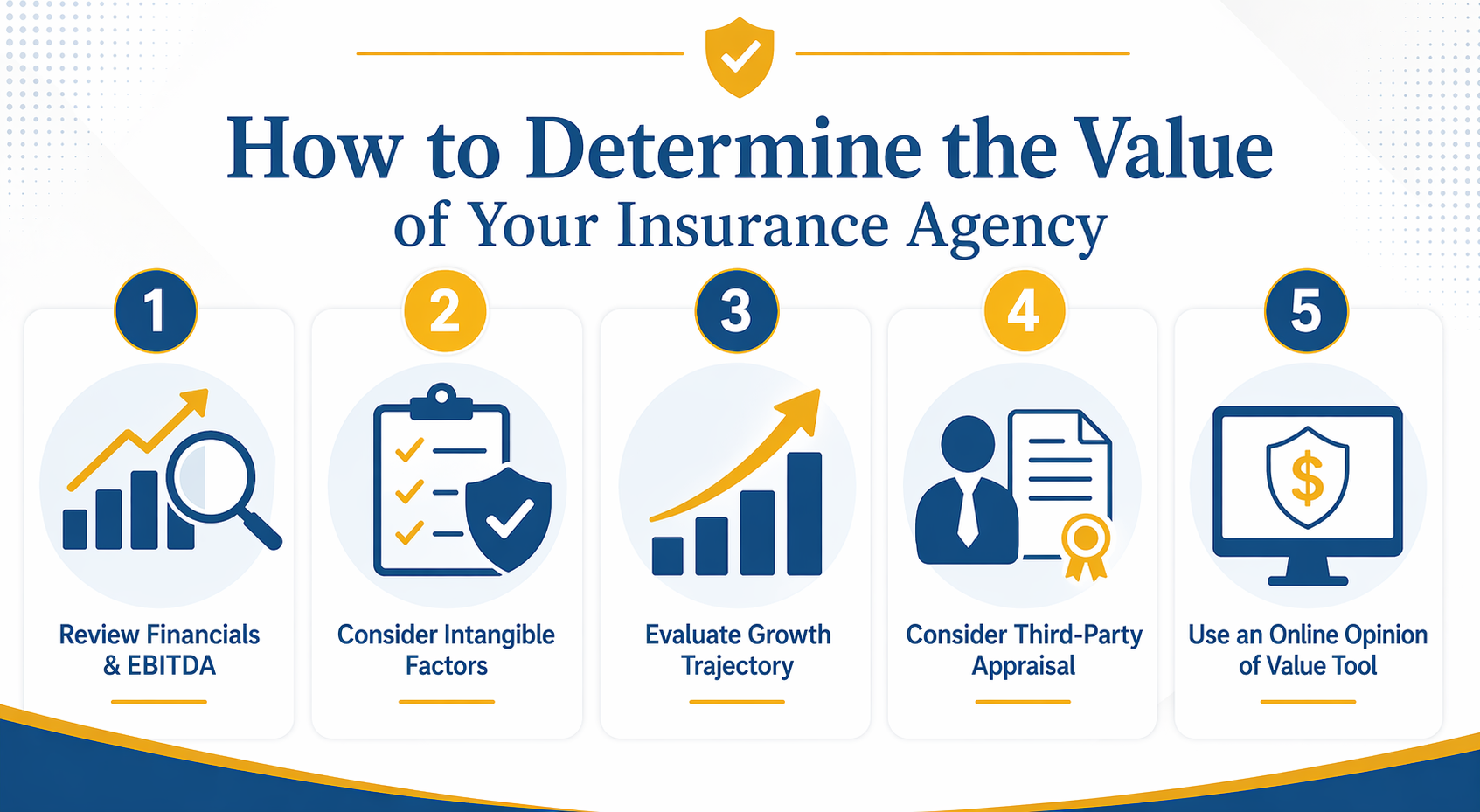
To streamline the value assessment process, consider using Sunbelt Atlanta’s Confidential Estimator. This convenient tool provides an initial estimate of your agency’s value, helping you make informed decisions early in the selling process.
For insurance agencies, due diligence starts with whether the reported earnings can be verified and whether the book of business will hold after closing. Buyers usually want trailing twelve-month financials, business tax returns, commission reports by carrier, retention data by line of business, top-account concentration, payroll detail, and a clear explanation of any non-operating or owner-specific expenses added back to earnings.
If those records do not reconcile, buyers will question both the valuation and the reliability of the purchase price they are being asked to support. Owners who want a clearer benchmark can start with Sunbelt Atlanta’s business valuation form before formally marketing the agency.
When selling your insurance agency, determining the right payment structure is a critical decision that can significantly impact your financial future. There are three primary methods to consider: lump sum, over time, and earn-out.
The lump sum method offers simplicity and immediate access to funds, allowing you to receive the entire payment upfront. This approach is straightforward but may lead to lower offers because the buyer assumes the full purchase price at once. Conversely, the over time method enables you to receive payments in installments over a set period. This can provide more predictable cash flow and may support a higher total payout if buyers are more comfortable spreading risk over time. The earn-out method combines an upfront portion of the sale price with additional payments based on the agency's future performance. This approach can produce the highest total earnings if the agency continues to grow, but it also carries more risk because future payments depend on performance after closing.
Choosing the right payment method depends on your financial goals and your comfort with the associated risks. Consulting with a business broker can provide valuable insight and help you determine the best option for your specific situation.
The payment method also affects taxes when selling an insurance agency, cash flow certainty, and your exposure after closing. A lump-sum structure may simplify your exit, but installment payments, seller notes, and earn-outs can change how much of the proceeds are treated as capital gain versus ordinary income, depending on the allocation and deal terms. Because tax consequences vary by entity structure and transaction design, owners should involve a tax advisor or tax professional early rather than treating tax planning as a final-step exercise. Strong coordination between your broker, attorney, and tax advisor helps you compare the headline selling price against the actual after-tax proceeds.
Read more: Seller Financing in Mergers and Acquisitions: A Strategic Tool for Buyers and Sellers
When it comes to agency valuation, there’s no universal formula. Some insurance agencies may use an asset-based valuation, accounting for tangible assets like the physical agency building and equipment. Others prioritize a cash-flow analysis centered on EBITDA and projected earnings. Another method involves examining comparable sales, much like real estate comps, except here you would research publicly traded agency transactions or privately held agencies of similar size. Each method offers a different vantage point, and many professionals use a combination of these strategies for a more complete market value determination.
To truly know how to value an independent insurance agency, you must consider your particular business model and potential for growth. If your primary selling point is a strong book of business, recurring revenue multiples may provide a more relevant assessment than an asset-based figure. Each appraisal method comes with pros and cons, and one may better highlight your strengths than another. In practice, combining multiple valuation approaches often produces a number that more accurately reflects both current stability and future outlook.
For many independent insurance agents and independent agencies, the most useful valuation work combines earnings analysis with a close review of transferability. Buyers want to know whether commissions are recurring, whether client retention is stable by policy type, whether agency licenses and producer licenses are current, and whether key carrier contracts can be assigned or replaced without disrupting revenue. Smaller agencies typically sell on a different basis than a larger agency with management depth, stronger EBITDA, and less day-to-day owner dependence. That is why a generic industry multiple rarely tells the full story.
Read more: Business Valuation Trends for 2026: Get Ahead of What Buyers Want
Identifying potential buyers can be one of the most important parts of listing your insurance agency for sale. Often, larger insurance companies look to grow by purchasing smaller, well-established agencies. In other cases, an insurance broker serves as a middleman, linking agencies with a buyer who has both the funds and strategic interest to scale the operation. You might also attract private equity groups or agency owners hoping to expand, especially if your client relationships are strong or you specialize in a promising market segment.
If you plan to sell your insurance business, you could also consider an internal transition by selling to a key employee or co-owner who already understands the day-to-day business. Alternatively, you might sell outright to a local competitor looking to strengthen its position in your market. The question is which buyer type best aligns with your goals and can offer the strongest financial and strategic fit. Different categories of buyers will evaluate your agency differently, so be sure to showcase what sets you apart, whether that is customer loyalty, a broad service portfolio, or consistent cash flow.

The market and potential buyers for insurance agencies vary widely, and buyer fit influences both deal structure and post-close risk. Strategic buyers may pay more for carrier relationships, geographic density, or a book that fills a line-of-business gap. Individual buyers may focus more heavily on cash flow support, seller transition help, and financing terms. Private investors and groups pursuing agency acquisitions typically spend more time on retention history, management continuity, and how quickly the agency can be integrated after closing. Positioning matters because the same agency can attract different purchase agreement terms depending on whether the buyer wants to buy agencies for immediate consolidation or preserve the entire agency as a standalone platform.
Navigating the sale of your insurance agency can be a complex process. Partnering with a knowledgeable business broker who understands the insurance industry can make a major difference, providing support and transaction experience to help move the deal forward. Here’s how a business broker can assist you:
One of the most crucial aspects of selling your agency is maintaining confidentiality. Keeping the sale under wraps helps prevent employee anxiety, reduces the risk of customer uncertainty, and protects business operations during the transition. A skilled broker ensures that sensitive information is shared only with vetted buyers who have signed nondisclosure agreements, helping safeguard your agency’s reputation and stability throughout the process.
Business brokers have access to serious, financially capable buyers that you may not reach on your own. By leveraging those connections, brokers like Sunbelt Atlanta can connect you with buyers who are genuinely interested and able to proceed. This saves time and allows you to focus on running your agency while the broker handles outreach and early negotiations.
From valuing your business to negotiating terms and coordinating paperwork, business brokers help streamline the sale process. They bring expertise in pricing your agency appropriately to attract the right buyers and protect value. They also manage communication between you and buyers, helping negotiations proceed more smoothly and making sure legal and financial steps are properly addressed.
Sunbelt Atlanta offers experience and personalized guidance to help owners pursue the best possible outcome. They provide tools like an online assessment estimator, which gives you an initial estimate of your agency’s value, and work closely with you to navigate the complexities of the sale process. Their team manages the transaction with professionalism and care, helping make the sale of your insurance agency more efficient and controlled.
In practice, a broker’s value often shows up in the details that owners do not see at first. That includes screening whether a buyer can actually finance the purchase price, controlling when sensitive carrier and client information is released, and pushing the process forward when due diligence requests start to expand. An experienced intermediary also helps separate serious buyers from casual interest, which matters when confidentiality, employee retention, and timing all affect value.
Read more: Choosing the Right Business Broker to Help Sell Your Business: Tips, Traps, and Smart Steps
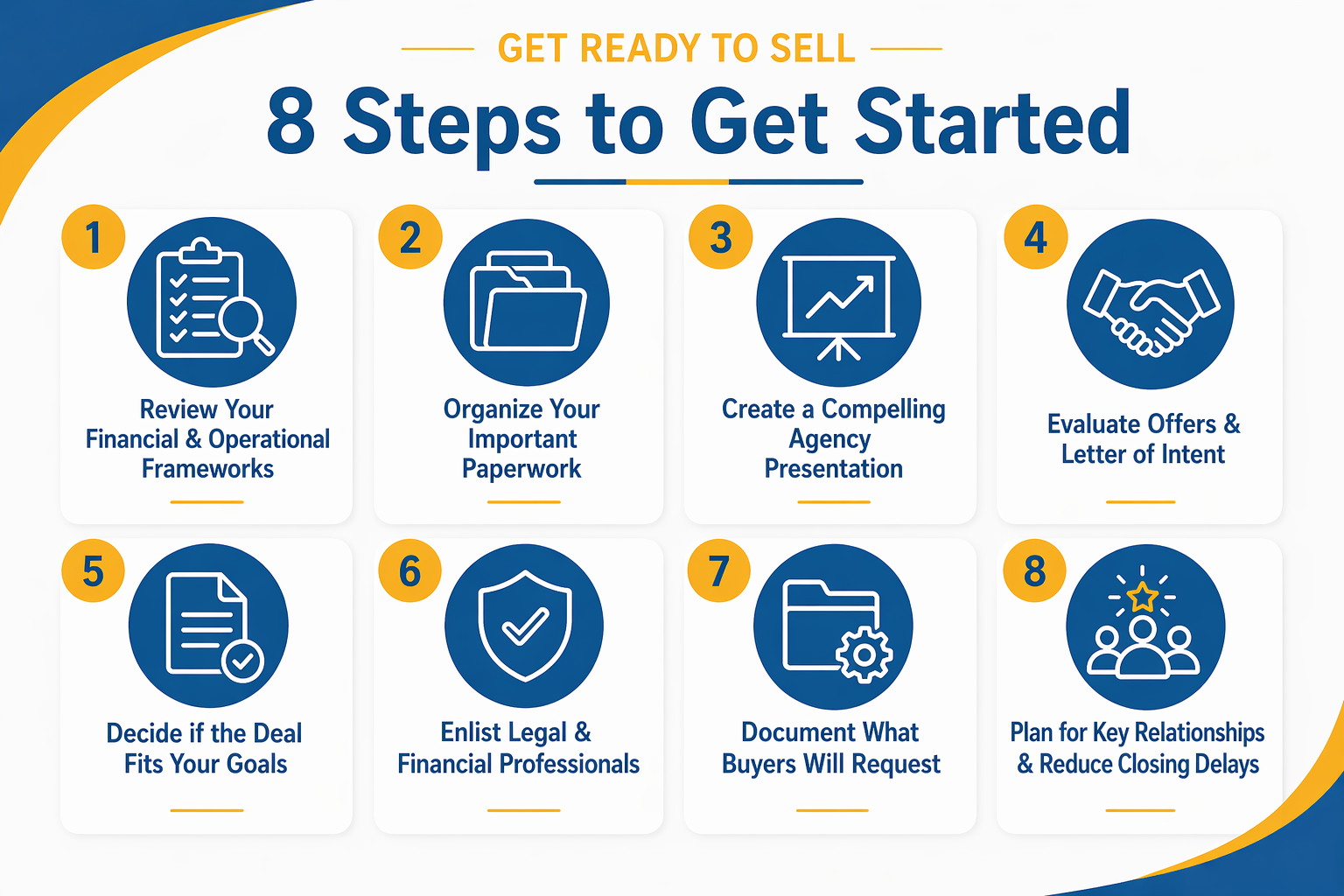
If you’re not sure where to start, the idea of launching an agency sale can be intimidating. First, conduct a full review of your financial and operational frameworks. This is where business brokers or a seasoned broker can help you maximize your agency’s worth by highlighting strengths and identifying weaknesses.
Then, make sure your paperwork is organized, from client contracts to financial statements, so you’re fully prepared when potential buyers come calling. Equally important is creating a compelling presentation that underscores why your agency is a sound investment, focusing on client retention and future growth opportunities.
Once negotiations move forward, you may receive a letter of intent from an interested party outlining the proposed deal. At this stage, you must decide whether the arrangement fits your goals or whether you should hold out for a better proposition. If you do agree to sell, enlist legal and financial professionals to finalize specifics. Preparation is key to securing the best possible outcome.
Preparing your agency for sale also means documenting the exact items buyers will request instead of relying on broad summaries. That usually includes three years of business tax returns, monthly profit and loss statements, balance sheets, commission statements by carrier, client retention reports, employee and producer compensation detail, lease terms, E&O coverage, and any agreements affecting agency licenses or transfer rights.
If independent contractors or key producers control major accounts, buyers will want to see how those relationships are structured and what happens if they leave. Owners can reduce closing delays by building that package before buyer conversations start.
Read next: Thinking of Selling in 2026? A Step-by-Step Guide to Prepare Your Business for Sale
Keeping the sale of your insurance agency confidential is crucial for several reasons. It helps prevent employee anxiety that can arise if staff become uncertain about job security or the future direction of the company. That uncertainty can affect morale and performance. It also helps avoid customer concern about continuity of service and quality of care, which could push clients to consider other options. By keeping the process discreet, you protect the agency's reputation and client trust. A business broker plays an important role by ensuring that sensitive information is shared only with vetted buyers who have signed nondisclosure agreements. This helps preserve the agency's stability throughout the sale process.
A smooth transition period is also essential for retaining clients and maintaining business stability. This period often lasts from two to four weeks, but it can be adjusted based on the complexity of the agency's operations and the needs of the new owner. During this time, the outgoing owner works closely with the incoming owner to transfer knowledge about operations, client relationships, and ongoing projects. This handoff helps maintain trust and reassures clients that their needs will continue to be met without disruption. If needed, extended support can be negotiated as part of the sale agreement.
Controlled information flow matters most when a buyer starts requesting deeper access. A buyer may first receive anonymous summary information, then a tighter view of financials, and then client and carrier details only after stronger screening and a signed NDA. That progression protects the agency while still supporting due diligence. It also gives you time to evaluate whether the buyer is serious, financially qualified, and operationally credible.
Read next: The Importance of Confidentiality Agreements in Business Transactions
A crucial asset for any insurance agency is its book of business. This usually refers to the assortment of policies and clients that generate repeat revenue. The value of an insurance agency often hinges on how stable and loyal its client base is. A well-managed book of business can significantly elevate your agency’s appeal, especially if you’ve cultivated long-term client trust. Keep in mind, though, that transferring these relationships could involve liability considerations, such as unresolved claims or renewals in progress.
Additionally, your insurance book of business reveals the breadth of your offerings and the depth of your client loyalty. The larger and more stable your client pool, the more profitable your agency is perceived to be by a buyer. This is where agency size and years in operation factor in. A long-established firm with multiple insurance products typically presents less risk and higher upside. Therefore, if you want to sell your agency, recordkeeping and transparent communication are vital. Showcasing achievements, such as your track record in client satisfaction, can strengthen your negotiating position.
Buyers will usually look beyond the headline size of the book and test how the revenue is distributed. They want to know whether the agency is concentrated in personal lines, commercial lines, life insurance, or specialty risks, how retention performs by segment, and whether a small number of accounts represent too much of the renewal base. A book with stable recurring commissions, diversified account size, and strong renewal history is easier to finance and defend during negotiations. A book dependent on one producer, one niche, or a few large clients may still sell, but the purchase agreement may include more holdbacks, performance conditions, or seller support obligations.
Many agency owners have several frequently asked questions when approaching the valuation phase. How long will the process take? Which financial documents will a buyer request? Is it necessary to hire experts specializing in insurance agency valuations, or can your regular accountant handle everything? The reality is that the timeline and complexity vary, but valuations conducted by professionals familiar with insurance can speed up the process and improve precision.
One critical FAQ is about boosting your insurance agency’s value. Owners frequently wonder if cost-cutting or aggressive revenue growth is more advantageous. In most scenarios, a balanced strategy that eliminates inefficiencies while still investing in marketing works best. Demonstrating dependable growth and stable operations gives interested buyers a clearer view of future potential. Well-maintained financial records also speed up due diligence and often support a stronger sale price.
When ironing out the terms of the sale, you have to consider more than just the final dollar figure. Some deals require the agency owner to remain for a transition period to facilitate client retention and smooth operations. Others may include non-compete clauses preventing you from launching a rival agency in the same region. Whatever the conditions, ensure all stakeholders understand them completely and seek specialized legal counsel if needed.
Keep in mind that the sale price can also fluctuate based on external shifts, such as changes in the insurance market or variations in your agency’s performance between offer and closing. A broker experienced in insurance-specific transactions can help you navigate these nuances and secure an agreement that feels fair to both sides. Whether you’re offered a lump-sum payout or a structured deal over several years, clarity and thoroughness in the terms of the sale support a smoother transition.
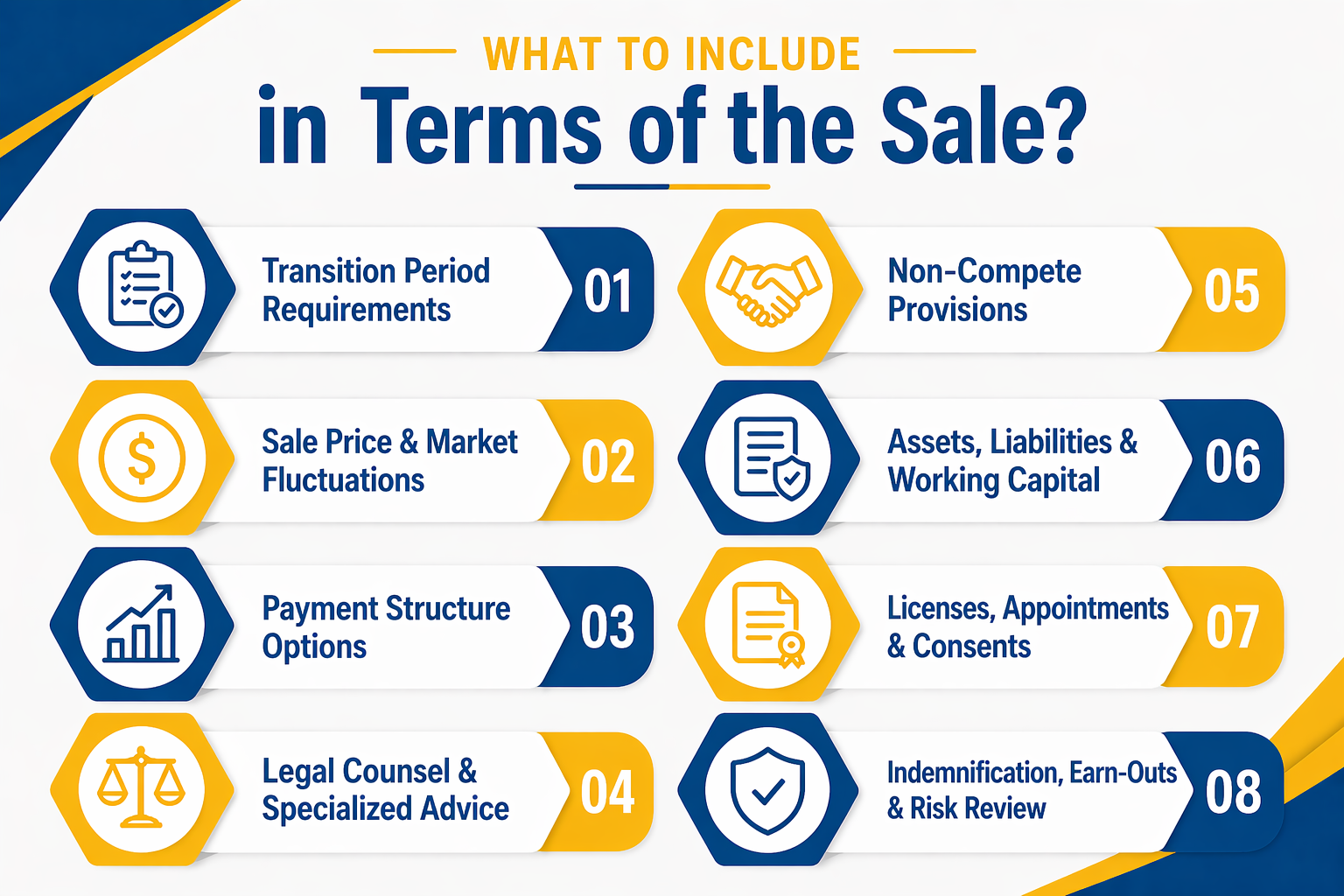
Involved in selling the agency are several legal and tax issues that can materially change the deal you thought you had. The purchase agreement should clearly address what assets transfer, what liabilities stay behind, how working capital is treated, whether agency licenses or carrier appointments require consent, and what happens if revenue drops during the transition. Non-compete agreement terms, seller consulting periods, indemnification limits, and any earn-out calculations should be specific enough to avoid post-close disputes. Owners should treat this stage as a business risk review, not just a documentation exercise, and get legal or tax advice tailored to the transaction.
Read more: Legal Agreements in a Business Sale: What Every Entrepreneur Must Know Before Signing
Gain valuable insights from Laura Chapman, a seasoned business broker at Sunbelt Business Brokers, as she delves into the complexities of selling an insurance agency on Atlanta's "Ask the Experts" radio show. In this interview, Laura shares strategies for maximizing your agency’s value, identifying the right buyers, and navigating the sale process with confidence. Whether you're ready to sell or simply exploring your options, this discussion provides practical guidance to help you make informed decisions.
Watch the Full Interview Below
Selling an insurance agency usually requires more than buyer outreach. Owners need a process that can support valuation, maintain confidentiality, filter buyer quality, and keep the transaction moving when diligence becomes more detailed.
Valuation Support: Sunbelt Atlanta helps owners establish a defensible starting point through its business valuation process, which is useful when you are comparing timing, testing market readiness, or responding to inbound buyer interest.
Confidential Sale Execution: Sunbelt Atlanta uses a confidential business sales approach that limits unnecessary exposure while qualified buyers are screened and information is released in stages.
End-to-End Process Management: Sunbelt Atlanta’s proven process is built to guide owners from preparation through negotiation and closing, which is especially important when due diligence, licensing questions, and transition planning affect deal certainty.
Deciding to sell your agency is a pivotal step, one that shouldn’t be taken lightly. Gather all the data you can, like financial statements, client demographics, and growth metrics, and perhaps consult professionals who specialize in agency valuation. Whether you opt to value an insurance enterprise on your own or bring in experts, preparation is paramount. The more organized you are, the easier it becomes to convince a buyer that your agency is worth the number you’ve set.
In the end, you don’t just sell your insurance agency; you hand over years of effort, relationships, and goodwill. To truly value the agency, you need a clear understanding of both your tangible assets and intangible attributes. From analyzing EBITDA to calculating your community goodwill, every factor contributes to your ultimate valuation. If you remain uncertain, talking to an agency merger-and-acquisition consultant or a seasoned financial advisor can provide clarity. Ultimately, once you’re ready to finalize the deal, thorough due diligence ensures you’ll be satisfied with the result.
Request a Confidential Consultation to evaluate your agency’s value, identify likely buyer concerns, and move toward a more controlled sale process with fewer surprises in diligence.
Most buyers ask for at least three years of tax returns, monthly profit and loss statements, balance sheets, carrier commission reports, retention data, payroll records, and a clear add-back schedule. They use these documents to confirm earnings quality, test client concentration, and verify whether the reported selling price is supportable.
Agency licenses and producer licenses can directly affect transferability. Buyers and their advisors usually check renewal status, compliance history, designated licensed personnel, and whether any carrier or state approvals are required before closing. If the owner holds critical licenses personally, that can create added transition risk.
Yes. Smaller agencies typically sell with greater emphasis on owner involvement, book stability, and transition support, while larger agencies are often evaluated more heavily on management depth, EBITDA, and the transferability of operations without the founder. That difference can affect valuation multiples, financing, and earn-out expectations.
A purchase agreement should clearly define the assets being transferred, any excluded liabilities, payment terms, transition obligations, non-compete agreement language, indemnification limits, and how post-close adjustments will be handled. The more specific the agreement is, the less room there is for disputes after closing.
Yes. Tax planning should begin well before signing a letter of intent. A tax advisor can help you understand how the deal structure may affect capital gain treatment, ordinary income exposure, installment reporting, and other federal income tax purposes that change your net proceeds.
 Doreen Morgan : Jun 9, 2026, 1:00:00 PM
Learn how long it takes to sell a business in 2026, what factors affect the timeline, and what sellers can do to improve their chances of a...
 Doreen Morgan : Apr 7, 2026, 10:15:00 AM
Confidentiality is crucial when you sell your business. Learn how a business broker helps the seller maintain confidentiality during the sale process...
 Doreen Morgan : Jul 17, 2026, 11:00:00 AM
Learn how to sell your cleaning business by avoiding 10 mistakes that reduce valuation, weaken buyer confidence, and delay a successful sale.