12 min read

How to Maximize Business Value Before Selling [2026 Guide]

According to Pepperdine Private Capital Markets' Report, 31% of business sale engagements ended without a transaction in 2025. The top reasons were a valuation gap (26%), unreasonable seller/buyer demands (14%), and no market for the business (12%).

Despite these challenges, the market remains active. In Q1 2025 alone, more than 2,300 small businesses were sold in the U.S., representing nearly $2 billion in total transaction value—a 9% increase in deal value year over year.

Buyers are still transacting, but they’re being far more selective about which businesses make it to closing. So if you’re selling within the next year, the goal isn’t just “get ready” but to fix what causes buyers to hesitate, discount, or walk.

This guide covers:

  • How to identify and prioritize value-building actions for your business
  • The exact steps to clean and recast your financials before listing
  • What to fix in operations, compliance, and documentation for buyer appeal
  • How to prepare for buyer due diligence and avoid costly surprises

P.S. Sunbelt Atlanta has spent over 25 years helping business owners sell quickly and confidentially. Our team of seasoned professionals, with more than 1,200 closed sell-side transactions, supports owners who are ready to exit or are exploring their options.

If you want to maximize your business’s value and ensure a smooth, confidential sale, request a pre-sale audit from Sunbelt Atlanta to get started with a clear, actionable roadmap.

TL;DR – Your Value-Building Roadmap at a Glance

Section

Actionable Takeaway

Step 1: Financial Clean-Up

Reconcile P&Ls, remove personal expenses, document add-backs, and prepare 3 years of statements.

Step 2: Operational Improvements

Standardize processes, document SOPs, and reduce owner dependence for easier transfer.

Step 3: Customer/Revenue Quality

Diversify customer base, reduce churn, and document contracts for recurring revenue.

Step 4: Legal/Compliance

Update contracts, resolve disputes, and ensure all licenses and permits are current.

Step 5: Team/Retention

Secure key employees with agreements and retention plans; reduce single-point-of-failure risk.

Step 6: Market Positioning

Prepare a compelling business story and highlight growth opportunities in your CIM.

Step 7: Technology/Systems

Upgrade outdated systems, ensure cybersecurity, and document digital assets.

Step 8: Real Estate/Assets

Appraise, maintain, and document all physical assets; resolve liens or title issues.


Why Value-Building Matters Before Listing

The period before you list your business is not just a countdown to a sale; it’s your last, best chance to shape the outcome. Buyers today are more sophisticated, often backed by advisors, private equity, or strategic acquirers who know exactly what to look for and what to avoid.

They’re not just buying your past performance; they’re investing in the future cash flow, stability, and growth potential of your company. If you enter the market with unresolved issues, outdated systems, or a business that’s too dependent on you, you’ll face lower offers, longer negotiations, and a higher risk of deals falling apart.

Value-building is essential because it directly impacts three things:

  1. Sale Price: Businesses that proactively address weaknesses and highlight strengths consistently command higher multiples.

  2. Deal Certainty: Well-prepared companies are less likely to face re-trades, last-minute price cuts, or failed closings.

  3. Buyer Competition: The more “buyer ready” your business is, the more buyers you’ll attract—and competition drives up value.

A focused approach to value-building means you’re not just hoping for a good outcome; you’re engineering it. By investing in the right improvements, you can transform your exit from a stressful, uncertain process into a strategic, rewarding event.

What Buyers Actually Pay For: Defining Key Value Drivers

It’s a common misconception that buyers simply pay a multiple of your revenue or profit. In reality, buyers are looking for a combination of tangible and intangible factors that reduce their risk and increase their confidence in future returns. These “value drivers” are what separate premium deals from average ones.

Value Driver

What It Means in Practice

Why Buyers Care

Clean, Verifiable Financials

Accurate, reconciled, and CPA-reviewed statements

Reduces risk of surprises, supports financing

Transferable Operations

Documented SOPs, cross-trained staff, and low owner dependence

Ensures business can run post-sale

Recurring/Contracted Revenue

Multi-year contracts, subscriptions, or service agreements

Predictable cash flow, less volatility

Customer Diversification

No single customer >10–15% of revenue

Lowers risk of revenue loss

Stable, Committed Team

Key employees are secured with agreements and retention plans

Maintains continuity and expertise

Legal & Compliance Readiness

Up-to-date contracts, licenses, and risk mitigation

Avoids deal delays and legal exposure

Growth Opportunities

Clear, documented paths for expansion

Increases upside for buyers


Understanding what buyers value allows you to focus your pre-sale efforts on the improvements that will have the biggest impact on your sale price and deal certainty.

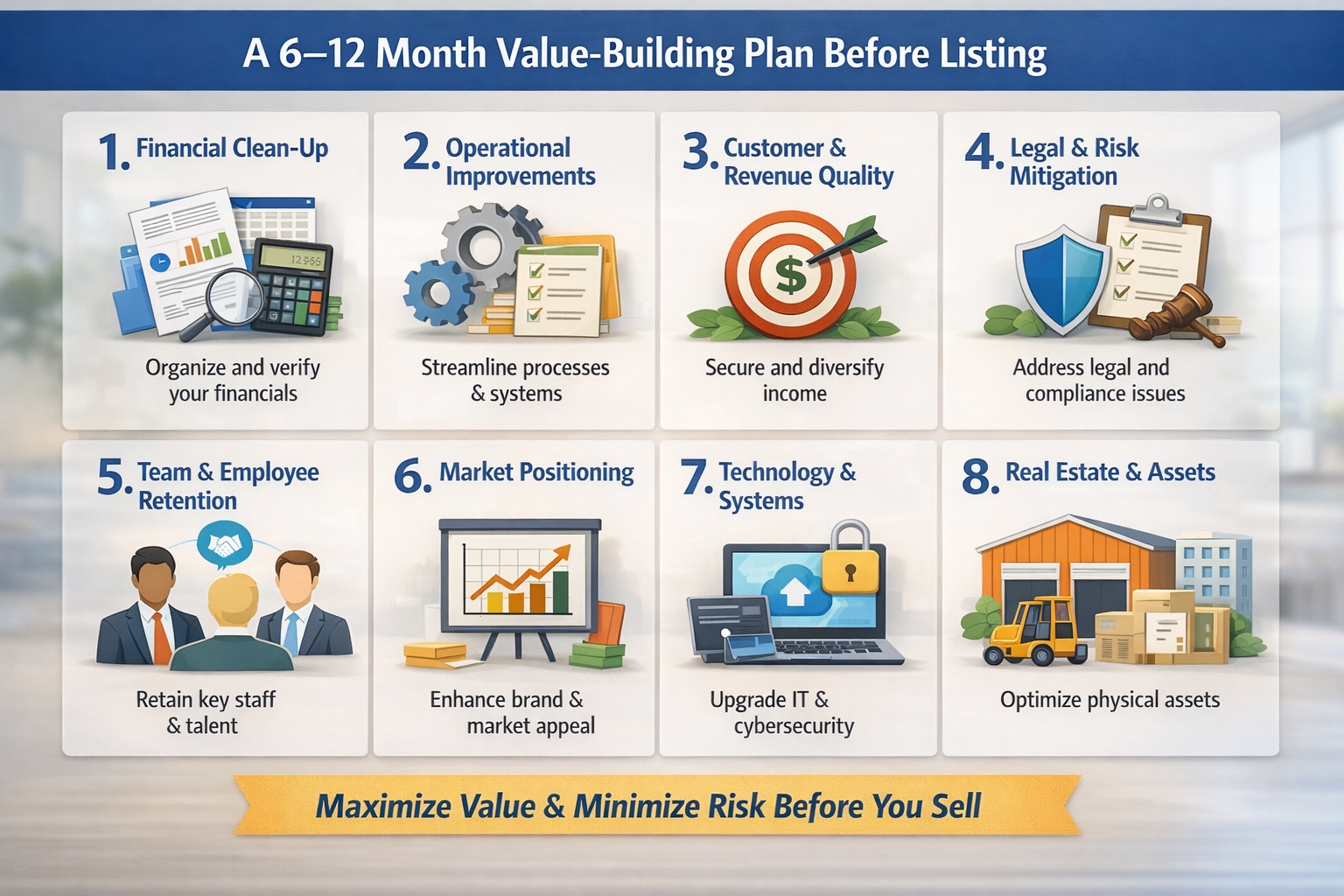
A 6–12 Month Value-Building Plan Before Listing

A 6–12 Month Value-Building Plan Before Listing

Preparing your business for sale is a sequence of targeted actions. The following eight steps will help maximize the value of your business, reduce deal risk, and position your company for a successful exit.

Step 1: Financial Clean-Up and Documentation

Before you list your business, your finances must be “in order”. Buyers and their advisors will scrutinize every line, looking for inconsistencies, hidden expenses, or red flags. For example, a business with three years of reconciled, CPA-reviewed statements will command more trust and a higher price than one with ad hoc spreadsheets and unexplained add-backs.

Document Type

What It Shows

Why It Matters

Profit & Loss (3 yrs)

Revenue, expenses, trends

Verifies earnings, growth

Balance Sheet

Assets, liabilities, equity

Reveals debt, working capital

Tax Returns

Official income, compliance

Confirms reported earnings

Aged Receivables

Customer payment patterns

Flags collection risks

Add-Back Schedule

Owner/non-recurring expenses

Supports higher valuation


A clean set of books also means removing personal or non-business expenses, documenting all owner add-backs, and resolving any outstanding tax or payroll issues. If you’re unsure where to start, having a CPA review your financials can reveal gaps and help you prepare for buyer due diligence.

Read Next: Want to Sell Your Business at Full Value? Start With Clean Financials

Step 2: Operational Improvements and Transferability

Buyers want businesses that can run smoothly without the owner’s daily involvement. “Operational maturity” means your company has documented processes, clear roles, and systems that make it easy to transfer ownership. This not only reassures buyers but also increases the likelihood of a smooth transition and sustained performance after the sale.

  • Document standard operating procedures (SOPs): Create comprehensive, step-by-step written guides for all key processes, including sales, fulfillment, customer service, and back-office functions.

  • Cross-train employees: Develop a training plan that ensures multiple team members can perform each critical task. This approach prevents business interruptions if someone leaves and demonstrates to buyers that the company is not reliant on any single individual, including yourself.

  • Implement workflow management tools: Adopt digital systems (such as project management or CRM platforms) to track projects, assign tasks, and monitor performance metrics. These tools provide transparency, accountability, and scalability, making it easier for a new owner to oversee operations.

  • Reduce owner dependence: Systematically delegate decision-making authority and customer relationship management to your team.

  • Establish key performance indicators (KPIs): Define, track, and regularly report on metrics that drive business performance, such as sales conversion rates, customer retention, and operational efficiency.

  • Review vendor and supplier agreements: Examine all contracts to ensure they are transferable and not tied to your personal relationships. If necessary, renegotiate terms to make agreements assignable, which reduces transition risk for buyers.

  • Prepare a transition plan: Develop a detailed outline of how you will support the new owner during the handover period, including training, introductions to key contacts, and ongoing support.

Step 3: Customer and Revenue Quality

Not all revenue is created equal. Buyers pay more for businesses with diversified, recurring, and contractually secured revenue streams. “Revenue quality” refers to the predictability, diversity, and sustainability of your income.

Revenue Attribute

High-Quality Example

Risky Example

Customer Concentration

No customer >10% of sales

One customer = 40% of sales

Recurring Revenue

Multi-year contracts

One-off projects

Churn Rate

<5% annual loss

20%+ annual loss

Contract Documentation

Signed, assignable agreements

Verbal or expired deals


To improve revenue quality, focus on diversifying your customer base, securing long-term contracts, and reducing churn. Document all agreements and ensure they are assignable. If you have a customer concentration issue, start building new relationships now—buyers will notice.

Read Next: Improve Customer Retention: A Guide to Increasing Your Business Value

Step 4: Legal, Compliance, and Risk Mitigation

Legal and compliance issues can derail a sale or lead to costly re-trades. Buyers will scrutinize your contracts, licenses, and risk exposures during due diligence, so addressing these areas in advance is essential for a successful transaction.

  • Update all contracts and agreements: Conduct a thorough review of customer, vendor, and employment contracts to ensure they are up to date, assignable, and compliant with current laws. Address any problematic clauses or missing signatures, and organize all agreements for easy access during due diligence.

  • Resolve outstanding disputes: Identify and settle any pending litigation, claims, or regulatory issues that could create uncertainty or delay the sale. Buyers are wary of unresolved legal matters, and clearing these up in advance demonstrates proactive risk management.

  • Ensure all licenses and permits are current: Verify that your business holds all necessary local, state, and federal licenses and permits, and that they are valid and transferable. Address any gaps or expirations immediately to avoid last-minute complications.

  • Review intellectual property (IP) protection: Audit your trademarks, patents, copyrights, and trade secrets to confirm they are properly registered and owned by the business. Take steps to secure any unprotected IP, as this can be a significant value driver for buyers.

  • Conduct a compliance audit: Assess your business’s adherence to HR, safety, environmental, and industry-specific regulations. Identify any areas of non-compliance and implement corrective actions to minimize risk and demonstrate good governance.

  • Document insurance coverage: Maintain up-to-date records of all insurance policies, including general liability, property, workers’ compensation, and key person insurance. Adequate coverage reassures buyers that risks are managed and can help facilitate financing.

  • Prepare a risk register: Create a comprehensive list of all known business risks, including operational, financial, legal, and market risks, along with your mitigation strategies. A well-documented risk register shows buyers that you understand and actively manage potential threats.

Read Next: Legal Agreements in a Business Sale: What Every Entrepreneur Must Know Before Signing

Step 5: Team and Key Employee Retention

A strong, stable team is one of the most important assets a business can offer a buyer. When evaluating a company, buyers look closely at whether key employees are likely to remain after the sale and whether the business can maintain its performance during and after the transition.

To build buyer confidence and protect your company’s value, start by identifying which employees are truly critical to your operations, customer relationships, or intellectual property. These are the individuals whose knowledge, skills, or client connections would be difficult to replace quickly.

Once you’ve identified these key team members, consider implementing retention agreements or stay bonuses that incentivize them to remain with the business through and after the sale. These agreements can be structured as financial bonuses, career advancement opportunities, or other benefits that align with their interests and the company’s needs.

Open communication is also vital. Trusted employees should be brought into your succession planning process early enough to reduce uncertainty and anxiety about the future. When employees understand the transition plan and their role in it, they are more likely to stay engaged and committed.

Documenting roles and responsibilities in clear job descriptions and organizational charts further strengthens your position. This documentation not only clarifies expectations for current staff but also makes it easier for a new owner to step in and manage the team effectively.

A business with a committed, well-documented team is more resilient and valuable.

Step 6: Market Positioning

Market positioning is about shaping how buyers perceive your business before they ever see your financials or tour your facility. The way you present your company’s story, strengths, and future potential can have a direct impact on both buyer interest and the final sale price.

To start, develop a clear, compelling narrative that highlights your business’s operational maturity, financial performance, and unique selling propositions. This narrative should be supported by data and documentation, not just anecdotes or aspirations.

A key tool in this process is the Confidential Information Memorandum (CIM). This document serves as the foundation for your buyer presentation, providing a comprehensive overview of your company’s history, operations, financials, and growth opportunities. The CIM should benchmark your business against relevant market comparables, using industry data and recent transaction multiples to justify your valuation and position your company competitively.

It’s also important to anticipate and address potential buyer objections within your positioning materials. Transparency about any weaknesses or risks, along with clear explanations of your mitigation strategies, builds trust and reduces the likelihood of renegotiation later in the process.

Finally, preparation extends beyond documentation. Practice your management presentation so you can confidently answer detailed questions from buyers and their advisors. Demonstrating a deep understanding of your business, its market, and its future prospects reassures buyers with confidence and can be a deciding factor in negotiations. Effective market positioning is not just about what you say, but how you prove and communicate your company’s value at every stage of the sale process.

Step 7: Technology, Systems, and Digital Readiness

In today’s market, buyers expect businesses to have up-to-date technology and secure, scalable systems. Digital maturity can be a differentiator and a risk mitigator. Consider the risk: a business running on outdated software or lacking cybersecurity protocols may face price reductions or even deal termination if a data breach is discovered during diligence.

To prepare:

  • Audit your IT infrastructure for outdated hardware, unsupported software, or security vulnerabilities.

  • Upgrade critical systems, such as accounting or CRM platforms, to cloud-based solutions.

  • Document all digital assets, including domain names and software licenses.

  • Implement cybersecurity best practices and ensure compliance with privacy laws.

A business with modern, secure systems is more attractive and easier to transition to new ownership.

Step 8: Real Estate, Equipment, and Physical Asset Optimization

Physical assets such as real estate, machinery, vehicles, and inventory represent a significant portion of a business’s value. Buyers will closely examine these assets for condition, documentation, and transferability. Any uncertainty about ownership, maintenance, or legal status can lead to price reductions or even derail a deal.

To maximize the value of your business and ensure a smooth transaction, owners must address several key areas before listing.

#1) Appraisals and Deferred Maintenance

Obtain current, third-party appraisals for all major real estate and equipment. Accurate valuations help justify your asking price and give buyers confidence in what they’re acquiring. Address any deferred maintenance or overdue repairs so assets present well during inspections. Well-maintained assets reduce negotiation friction and support a higher valuation.

#2) Asset Registers and Documentation

Maintain a detailed, up-to-date asset register listing all equipment, vehicles, and inventory. Include serial numbers, locations, and current condition. Support this register with maintenance and service records for major assets, demonstrating reliability and care. Comprehensive documentation reassures buyers and streamlines due diligence.

#3) Lease Agreements and Assignability

Review all real estate and equipment leases to ensure terms are assignable and competitive. If leases contain unfavorable clauses or cannot be transferred, address these issues before listing. Assignable, market-rate leases make your business more attractive and reduce closing complications.

Transition Planning for Closing

Develop a clear transition plan for inventory counts, equipment handover, and real estate transfers at closing. Anticipate buyer questions and outline how each asset will be transferred. A well-prepared transition plan reduces surprises and supports a smooth, confident closing process.

Common Mistakes That Destroy Value (and How to Avoid Them)

Even experienced owners fall into traps that reduce the sale price or kill deals. The table below summarizes the most common mistakes, their consequences, and how to fix them.

Mistake

Consequence

How to Fix

Overestimating value without evidence

Price reductions, failed deals

Get a formal valuation and benchmark against market data

Ignoring transferability issues

Buyer skepticism, lower offers

Document processes, cross-train staff, and reduce owner dependence

Neglecting compliance or legal gaps

Deal delays, re-trades, legal exposure

Conduct a compliance audit and resolve issues before selling a business

Failing to address customer concentration

Higher perceived risk, lower multiples

Diversify customer base and secure contracts

Not preparing for due diligence

Lost buyer trust, renegotiation

Organize all documents and anticipate buyer questions

Waiting until the last minute

Limited improvement options, rushed sale

Start value-building 6–12 months in advance


How to Prioritize Value-Building Actions (Decision Criteria & ROI)

With limited time and resources, focus on actions that deliver the highest return on investment before listing. Use an impact vs. effort matrix to prioritize:

  • High impact, low effort: Financial clean-up, contract updates, customer diversification.

  • High impact, high effort: Operational improvements, technology upgrades, team retention.

  • Low impact, low effort: Cosmetic fixes, minor process tweaks.

  • Low impact, high effort: Non-essential projects, new product or service launches.

Prioritize quick wins first, then allocate resources to longer-term improvements that will pay off at closing.

What a Pre-Sale Audit Covers (and How to Prepare)

What a Pre-Sale Audit Covers (and How to Prepare)

A pre-sale audit is a comprehensive review of your business’s financial, operational, legal, and market position. It identifies value gaps, risk factors, and actionable steps to maximize business value and reduce deal risk. Here’s how to prepare:

Preparation Checklist:

  • Gather three years of financial statements, tax returns, and supporting schedules.
  • Compile all customer, vendor, and employment contracts.
  • List all licenses, permits, and compliance documents.
  • Prepare organizational charts, SOPs, and transition plans.
  • Document all physical and digital assets.
  • Identify key employees and retention plans.
  • Outline growth opportunities and market positioning materials.

What to Expect:

  • A prioritized action plan with specific recommendations.
  • Identification of red flags and risk areas.
  • Documentation list for due diligence.
  • Timeline and resource estimates for each improvement.

Your Next Step to Maximize Value Before Listing

Maximizing your business’s value before listing is not about luck—it’s about taking the right actions, in the right order, at the right time. By following this 8-step plan, you can increase your sale price, reduce deal risk, and attract more qualified buyers. The most successful owners start early, focus on what matters, and seek expert guidance to avoid costly mistakes.

Key Takeaways:

  • Start value-building 6–12 months before listing for the best results.
  • Focus on financials, operations, customer/revenue quality, compliance, team, technology, and assets.
  • Avoid common mistakes by prioritizing high-impact actions and seeking expert guidance.

Request a pre-sale audit to get a personalized, actionable roadmap for your business. Sunbelt Atlanta’s experienced team will help you identify value gaps, prepare for due diligence, and position your company for a successful, confidential sale.

FAQs

What is the best way to maximize the value of a business before listing?

The best way to maximize value before listing is to start preparing 6–12 months in advance. Focus on cleaning and recasting your financials, standardizing operations, addressing legal and compliance gaps, and preparing for buyer due diligence. Prioritize improvements that have a direct impact on business valuation and buyer confidence.

How far in advance should I start preparing my business for sale?

Ideally, you should begin preparing your business for sale at least 6–12 months before you plan to list. This timeline allows you to address value-building opportunities, resolve any issues, and present your business in the best possible light to buyers.

What documents do I need to prepare before selling my business?

You should prepare three years of financial statements, tax returns, contracts, licenses, permits, operational manuals, legal records, and a complete inventory of physical assets. Organizing these documents in advance streamlines the due diligence process and builds buyer trust.

How do I know which improvements will have the biggest impact on value?

Improvements that directly affect financial performance, operational maturity, legal compliance, and customer/revenue quality typically have the greatest impact on value. Use a pre-sale audit to identify and prioritize these high-impact actions based on your business’s unique situation.

Why is a pre-sale audit important before listing my business?

A pre-sale audit provides an objective assessment of your business’s readiness for sale, identifies value gaps, and delivers a prioritized action plan. It helps you address issues before buyers discover them, reducing deal risk and supporting a higher valuation.

Thinking of Selling in 2026? A Step-by-Step Guide to Prepare Your Business for Sale

8 min read

Thinking of Selling in 2026? A Step-by-Step Guide to Prepare Your Business for Sale

If you're thinking of selling your business in 2026, you might feel like you have plenty of time. However, the owners who achieve the highest...

Read More
How to Build an Exit Timeline That Maximizes Your Business Sale

10 min read

How to Build an Exit Timeline That Maximizes Your Business Sale

Selling a business is a major decision with long-term consequences. If you're planning to exit within the next one to three years, the real question...

Read More
Accelerating the Sale of Your Manufacturing Business for Maximum Profit: A Step-by-Step Guide

10 min read

Accelerating the Sale of Your Manufacturing Business for Maximum Profit: A Step-by-Step Guide

Imagine this: You’ve spent years — decades, even — pouring into your business. You’ve labored and toiled day-in and day-out to create something truly...

Read More