


13 min read
11 Steps to Prepare a Utility Construction Business for Sale and Increase Its Value
Doreen Morgan is the owner and managing broker of Sunbelt Business Brokers – Atlanta, where she has spent two decades guiding Main Street and lower-middle-market business owners through successful sales valued from $750K to $75M. A proven dealmaker, Doreen has personally closed 300-plus transactions since 2005 across B2B services, heavy construction, healthcare, franchising, manufacturing, specialty distribution, and technology. Before acquiring Sunbelt Atlanta in 2015, she sharpened her M&A...
Doreen Morgan
Updated on August 5, 2026
Preparing a utility construction business for sale starts well before the company goes to market. Buyers evaluate much more than revenue or profitability. They also assess financial performance, management depth, customer relationships, workforce stability, equipment, and business operations to determine whether the company can continue generating reliable cash flow after the ownership transition.
Many construction business owners assume their company's value is determined when they decide to sell. In reality, much of a company's value is built during the years leading up to a transaction. Owners who prepare early have more time to strengthen operations, improve financial reporting, reduce buyer concerns, and address issues that could affect valuation during due diligence.
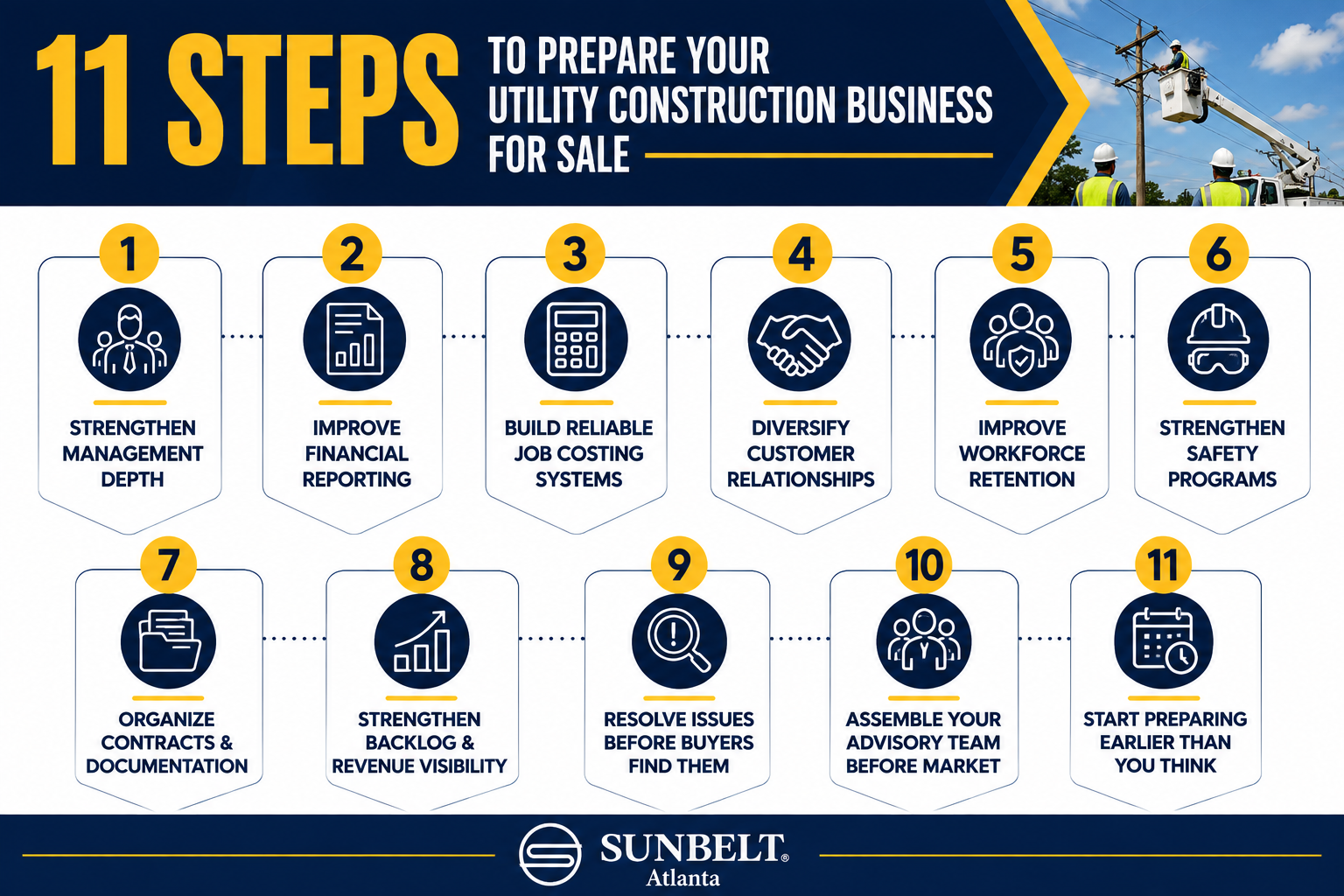
This guide outlines 11 practical steps to help you prepare a utility construction business for sale, improve transferability, and position the company for a smoother transaction and stronger buyer interest.
💡 TL;DR: Preparing Early Can Improve Value and Sale Readiness
-
Preparing a utility construction business for sale should begin years before the company enters the market. Early planning gives owners time to strengthen operations, improve financial reporting, and address issues that buyers commonly identify during due diligence.
-
Business value depends on more than financial performance. Buyers also evaluate management depth, customer relationships, workforce stability, backlog quality, equipment, safety programs, and operational efficiency when assessing a potential acquisition.
-
Reducing risk can improve buyer confidence. Organized financial records, documented business processes, and a transferable management team help buyers evaluate the company with greater confidence and may contribute to stronger valuation and deal terms.
-
Preparation creates opportunities to increase business value before negotiations begin. Addressing owner dependence, customer concentration, documentation gaps, and operational weaknesses before going to market can lead to a smoother sale process and fewer surprises during due diligence.
-
This guide outlines 11 practical steps to help utility construction business owners prepare for a successful sale. Whether you're planning to sell next year or several years from now, preparing early can strengthen your company's market position and preserve more options for the future.
Why Preparation Matters Before Selling a Utility Construction Business
Preparing a utility construction business for sale is about more than deciding when to enter the market. Buyers evaluate whether the business can continue performing under new ownership, and that assessment begins long before a Letter of Intent is signed. The stronger and more transferable the business is before the sale process begins, the more confidence buyers typically have in the opportunity.
Many owners focus on external factors such as market conditions, acquisition activity, or valuation multiples. While those considerations influence demand, they rarely compensate for weaknesses within the business itself. Companies with reliable financial reporting, experienced management, diversified customers, and well-documented operations are generally better positioned to attract qualified buyers regardless of market conditions.
Preparation also gives owners time to address issues before they become negotiating points during due diligence. Improving financial reporting, reducing owner dependence, strengthening workforce stability, and organizing documentation can help reduce uncertainty and keep negotiations focused on the company's long-term value rather than avoidable risks.
The value of early preparation becomes clearer once a transaction begins. In KPMG’s 2025 M&A Deal Market Study, featuring a survey of 300 U.S. M&A professionals, 44% identified reaching agreement on valuation as a leading obstacle to closing, while 41% cited completing due diligence and another 41% cited regulatory hurdles. Addressing financial, operational, and compliance concerns before going to market can reduce the likelihood that these issues disrupt negotiations later.
Read Next: How to Maximize Business Value Before Selling [2026 Guide]
Benefits of Preparing Before Going to Market
| Preparation Effort | How It Can Improve a Transaction |
|---|---|
| Stronger Financial Reporting | Builds buyer confidence and supports business valuation. |
| Reduced Owner Dependence | Improves transferability and lowers transition risk. |
| Better Documentation | Speeds up due diligence and reduces buyer uncertainty. |
| Workforce and Management Development | Demonstrates operational stability beyond the current owner. |
| Early Identification of Tasks | Provides time to resolve issues before negotiations begin. |
Owners cannot control every aspect of a transaction, but they can influence how prepared their business is when buyers begin their evaluation. Starting early provides greater flexibility, creates more opportunities to strengthen the business, and often leads to a smoother sale process.
A Step-by-Step Guide to Preparing Your Utility Construction Business for Sale
Preparing a utility construction business for sale is an ongoing process rather than a single event. Buyers evaluate every aspect of the company, from financial performance and management depth to customer relationships, workforce stability, equipment, and operational systems, to determine whether the business can continue performing successfully after the ownership transition.
The following 11 steps focus on the areas that typically have the greatest influence on buyer confidence, business valuation, and transaction readiness. While every company has different strengths and priorities, addressing these areas before going to market can help reduce uncertainty, improve transferability, and position the business for a smoother sale process.

Step 1: Strengthen Management Depth
One of the first questions buyers ask is whether the business can continue operating successfully without the current owner. If key decisions, customer relationships, estimating, or day-to-day operations depend heavily on one person, buyers may view the business as carrying greater transition risk. That uncertainty can affect valuation, financing, and deal terms.
Strong management depth gives buyers confidence that the company can continue performing after the ownership transition. Experienced managers, project supervisors, and department leaders help preserve customer relationships, maintain operational continuity, and reduce reliance on the seller.
Rather than focusing solely on titles or reporting structures, buyers evaluate how responsibilities are distributed across the organization and whether critical functions are supported by documented processes and capable employees.
| Key Business Function | What Buyers Want to Understand |
|---|---|
| Project Management | Who oversees active projects and keeps work on schedule? |
| Estimating | Who prepares bids, develops estimates, and manages proposals? |
| Operations | Who coordinates field crews, equipment, subcontractors, and daily execution? |
| Customer Relationships | Are key customer relationships shared across the organization or concentrated with the owner? |
| Business Development | Who is responsible for generating new work and maintaining the sales pipeline? |
Owners planning to sell their construction business should begin delegating responsibilities well before taking the company to market. Giving managers greater decision-making authority, documenting operating procedures, and involving key employees in customer relationships allows buyers to see that the business is built around a team rather than a single individual. That often strengthens buyer confidence and supports a smoother transition after closing.
Owners who are evaluating whether now is the right time to sell may also benefit from speaking with experienced Utility Construction Business Brokers early in the planning process. An initial conversation can help identify opportunities to improve transferability, understand current market conditions, and prioritize the changes that are likely to have the greatest impact before the business goes to market.
Step 2: Improve Financial Reporting
Financial reporting is often one of the first areas buyers evaluate because it helps them assess the company's financial health, cash flow, and earning potential. Buyers want confidence that the numbers accurately reflect how the business performs, not just during its strongest years but consistently over time.
For utility construction companies, reliable financial reporting goes beyond annual revenue. Buyers also review profit margins, job profitability, working capital, and whether financial statements are supported by organized records. When financial information is incomplete or inconsistent, buyers may spend more time verifying the numbers, which can slow due diligence and introduce unnecessary questions during negotiations.
Owners preparing to sell should ensure their financial statements are current, accurate, and supported by clear documentation. Separating personal expenses from business expenses, documenting discretionary add-backs, and maintaining organized financial records make it easier for buyers to understand the company's true earning power and move through the sale process with greater confidence.
A Confidential Business Valuation can help an owner understand how normalized earnings, backlog quality, customer concentration, equipment requirements, and other company-specific factors may affect market value before the sale process begins.
Read More: Want to Sell Your Business at Full Value? Start With Clean Financials
Step 3: Build Reliable Job Costing Systems
Accurate job costing helps buyers understand how a utility construction business generates profit. Buyers want to see that management can measure project performance consistently, not simply review financial results at year-end. Reliable job costing also demonstrates that leadership understands where margins are earned and where projects may be underperforming.
During due diligence, buyers often compare job costing reports with financial statements to evaluate whether reported profitability reflects actual project performance. A strong job costing system should help you:
-
Track labor, equipment, materials, and subcontractor costs by project.
-
Compare estimated costs with actual costs throughout a project's lifecycle.
-
Identify profitable and unprofitable work before projects are completed.
-
Improve estimating accuracy for future bids.
-
Support financial reporting with reliable project-level data.
This level of cost visibility is particularly important for Civil Infrastructure Contractors, where site conditions, subcontractor activity, equipment utilization, and schedule changes can materially affect project margins. Owners who can clearly demonstrate how they monitor project profitability often give buyers greater confidence in the company's financial performance and management discipline.
Read Next: Increase EBITDA Before Selling Your Business: 7-Step Playbook
Step 4: Diversify Customer Relationships
A loyal customer base is an asset, but buyers also consider how much revenue depends on a small number of clients. If one utility, municipality, telecommunications provider, or general contractor represents a significant share of annual revenue, buyers will evaluate how the loss of that customer could affect future cash flow.
Customer concentration alone rarely determines whether a transaction moves forward. Buyers look at the quality of those relationships, the history of repeat work, contract visibility, and whether new opportunities continue entering the pipeline. Buyers often evaluate questions like:
| Area | Why It Matters |
|---|---|
| Customer Concentration | How much revenue depends on one customer or contract? |
| Repeat Business | Do customers consistently return for future projects? |
| Relationship Ownership | Are client relationships tied to the business or primarily to the owner? |
| Backlog Quality | Does existing contracted work provide future revenue visibility? |
Owners preparing to sell should gradually introduce project managers, operations leaders, or account managers to key clients before going to market. Buyers gain confidence when they see that customer relationships are supported by the broader organization rather than relying on a single individual.
Read More: Improve Customer Retention: A Guide to Increasing Your Business Value
Step 5: Improve Workforce Retention
A skilled workforce is one of the most valuable assets a utility construction business can have. Buyers look beyond employee headcount to understand whether experienced project managers, supervisors, equipment operators, and field crews are likely to remain with the company after the sale.
That workforce can be difficult to rebuild. The 2025 Workforce Survey Analysis from the Associated General Contractors of America and NCCER found that 92% of construction firms that were hiring had difficulty finding qualified workers, while 45% reported project delays caused by shortages among their own employees or subcontractors. A stable, experienced team therefore carries practical value for both project execution and business continuity after a sale.
High employee turnover can raise concerns about operational stability, training costs, and the company's ability to deliver projects consistently. Buyers also evaluate whether institutional knowledge is shared across the organization or concentrated in a few long-tenured employees whose departure could disrupt operations.
Owners preparing to sell should focus on building a stable workforce supported by documented processes, cross-training, and clear leadership responsibilities. When buyers see that the business can continue operating without relying on a handful of individuals, they often have greater confidence in the company's long-term performance and transferability.
Read More: The Critical Role of Employee Retention in Business Valuation
What Could Your Utility Construction Business
Be Worth?
Step 6: Strengthen Safety Programs
Safety performance influences far more than regulatory compliance. Buyers review safety programs because they provide insight into how the business is managed, how risk is controlled, and whether future liabilities could affect the company's value after closing.
Utility construction companies often work around underground utilities, active roadways, energized infrastructure, and heavy equipment. For Electrical Utility Contractors, preparation should also address energized-work procedures, employee qualifications, incident documentation, and the continuity of licenses or credentials needed to perform power-distribution and utility-related electrical projects.
A well-documented safety program demonstrates that the business has established procedures to manage those risks consistently rather than reacting to incidents as they occur. Before going to market, review whether your business has:
-
Current safety manuals and written safety policies.
-
Regular employee safety training and documented attendance.
-
OSHA logs and incident records that are complete and organized.
-
Equipment inspection and maintenance records.
-
Procedures for investigating incidents and implementing corrective actions.
Buyers understand that no construction company is entirely free of incidents. What matters is whether the business has a consistent approach to safety, documentation, and continuous improvement. Strong safety practices can reduce uncertainty during due diligence and reinforce buyer confidence in the company's operations.
Step 7: Organize Contracts and Business Documentation
Well-organized documentation helps buyers evaluate a business more efficiently and reduces unnecessary delays during the sale process. Missing agreements, unsigned contracts, or inconsistent records can create additional questions during due diligence, even when the underlying business is performing well.
Before going to market, owners should review whether important business documents are complete, current, and easy to locate. Here are the documents worth reviewing before you sell:
| Document Category | Why It Matters |
|---|---|
| Customer Contracts | Confirms the scope of work, contract terms, and assignment rights after a sale. |
| Subcontractor and Supplier Agreements | Helps buyers understand vendor relationships and purchasing obligations. |
| Equipment Leasing and Financing Agreements | Identifies ongoing financial commitments and transfer requirements. |
| Licenses, Permits, and Insurance Policies | Demonstrates regulatory compliance and operational readiness. |
| Corporate and Legal Records | Verifies ownership, governance, and other legal obligations. |
Preparing these records in advance allows buyers to spend more time evaluating the business itself instead of tracking down missing information. It also helps maintain momentum once due diligence begins. Gas Utility Contractors should also organize operator-qualification records, customer-specific compliance documents, permits, insurance certificates, and agreements covering gas-line installation, replacement, repair, and maintenance work.
Step 8: Strengthen Contract Backlog and Revenue Visibility
Buyers want to understand not only how the business has performed, but also where future revenue is expected to come from. A healthy backlog provides visibility into upcoming work and helps buyers evaluate whether the company has a steady pipeline after closing.
For utility construction companies, backlog quality often matters more than backlog size. Buyers consider factors such as the types of projects under contract, customer mix, project duration, funding status, and the likelihood that scheduled work will move forward as planned. For Water and Sewer Contractors, buyers may distinguish between fully funded municipal projects, awarded work awaiting notice to proceed, and pipeline opportunities tied to future capital-improvement budgets.
A strong backlog typically demonstrates:
-
Signed contracts rather than verbal commitments.
-
A healthy mix of customers and project types.
-
Realistic project schedules and completion timelines.
-
Revenue that extends beyond the next few months.
-
Opportunities for repeat work from existing customers.
Owners should periodically review their backlog from a buyer's perspective rather than an operational one. A well-documented backlog supported by executed contracts and realistic project schedules provides greater confidence in the company's future revenue and long-term stability.
Step 9: Resolve Issues Before Buyers Find Them
Every utility construction business has areas that could raise questions during a sale. What matters is whether those issues are identified and addressed before buyers begin reviewing the company.
For example, unresolved contract disputes, incomplete project files, aging equipment scheduled for replacement, or inconsistent financial records may not prevent a sale. However, if buyers discover them unexpectedly, they often spend additional time understanding the issue and evaluating its potential impact on the business.
Before going to market, take a fresh look at the company as if you were acquiring it yourself. Here are the questions worth asking:
-
Are there unresolved legal, tax, or regulatory issues that should be addressed?
-
Do project files contain signed contracts, change orders, and supporting documentation?
-
Are equipment maintenance records complete and up to date?
-
Can financial records be explained without relying on the owner's personal knowledge?
-
Are there operational issues that would be easier to resolve now than during negotiations?
Preparing thoughtful answers to these questions allows owners to enter the sale process with fewer surprises and greater confidence.
Read More: Red Flags That Scare Off Buyers — 9 Deal Killers That Can Surface During Business Acquisition
Step 10: Assemble Your Advisory Team Before Going to Market
Many owners wait until they receive buyer interest before contacting a business broker, accountant, or attorney. By that point, financial records, contracts, tax questions, and transaction planning often need to be addressed within a much shorter timeframe.
Building an advisory team earlier gives owners more time to prepare. An experienced business broker can help evaluate market readiness, identify factors that may influence valuation, and develop a confidential sale strategy. An accountant can review financial reporting and normalize earnings, while an attorney can identify legal issues that are easier to resolve before negotiations begin.
Rather than working independently, these advisors should understand the owner's goals and communicate throughout the preparation process. That coordination often helps avoid unnecessary delays once buyers begin requesting information.
A business sale is usually one of the largest financial transactions an owner will complete. Having the right advisors in place before going to market allows more time to strengthen the business, organize documentation, and prepare for discussions with qualified buyers.
Read Next: Thinking of Selling? Here’s How Business Brokers Help Maximize Your Business Value
Step 11: Start Preparing Earlier Than You Think
One of the biggest advantages an owner can have is time. Improving financial reporting, developing managers, strengthening customer relationships, organizing contracts, and addressing operational issues rarely happen overnight. The earlier these efforts begin, the more flexibility owners have to make meaningful improvements before the business enters the market.
Preparing early also gives owners more control over the timing of a sale. Instead of reacting to unexpected circumstances, they can choose to go to market when the business is performing well, management responsibilities are shared, and financial records accurately reflect the company's performance.
Signs Your Business Is Moving in the Right Direction
-
Management can operate the business without relying on the owner for every major decision.
-
Financial reporting and job costing provide a clear picture of business performance.
-
Customer relationships extend beyond the owner's personal involvement.
-
Contracts, licenses, and business records are organized and readily available.
-
The company has a stable workforce, well-maintained equipment, and documented operating procedures.
No business is perfect before a sale, and buyers understand that. What they look for is a company that has been thoughtfully managed and prepared for the future. Owners who begin planning well in advance often have more opportunities to strengthen business value, improve transferability, and approach the sale process with confidence.
Preparing Early Creates More Options
Preparing a utility construction business for sale is a process that begins well before the company enters the market. Improving financial reporting, strengthening management, organizing documentation, and reducing owner dependence all take time. Starting early allows owners to make those improvements gradually rather than trying to address them after buyer interest begins.
No business is perfect before a sale, and buyers don't expect it to be. What they do expect is a company that has been thoughtfully managed, supported by reliable financial information, and positioned to operate successfully after the ownership transition. Those qualities often make negotiations more productive and help transactions move forward with fewer unexpected issues.
If you're preparing to sell a utility construction business, working with an experienced Utility Construction Business Broker before. Whether your timeline is one year or several years away, early planning gives you more flexibility and a clearer understanding of the steps that can improve your company's market readiness.
Preparing for a Future Sale?
Frequently Asked Questions
How far in advance should I start preparing my construction business for sale?
The best time to prepare a construction business for sale depends on its current condition, but many owners benefit from starting one to three years before going to market. That provides time to improve financial reporting, strengthen management, diversify customer relationships, and improve operational efficiency before buyers begin their evaluation. Early preparation also allows owners to position the business for a successful sale without disrupting day-to-day business operations.
How is a utility construction company's value determined?
Construction company valuation is based on more than revenue or equipment. Buyers evaluate cash flow, profitability, financial statements, backlog quality, management depth, customer relationships, fleet condition, and the company's ability to operate successfully under new ownership. A professional business valuation helps owners better understand the value of their construction business and identify opportunities to strengthen the company's value before entering the market.
When is the best time to sell a construction company?
The best time to sell a construction company is often when financial performance is strong, the company has a healthy backlog of profitable construction projects, and business operations are running without heavy dependence on the owner. Market conditions matter, but so does preparation. Selling from a position of strength generally gives owners more flexibility than waiting until circumstances force a decision.
Should I hire a business broker before putting my construction company on the market?
Many owners contact a business broker only after deciding to sell their construction business. However, involving an experienced business broker earlier in the planning process gives owners more time to prepare financials, organize documentation, and identify opportunities to improve business value before buyers begin their review. A broker can also work alongside your accountant and attorney to help position the business for a smoother sale process.
What's the difference between a business valuation and a professional business appraisal?
Although the terms are sometimes used interchangeably, they serve different purposes. A business valuation estimates the value of a construction company by analyzing cash flow, financial performance, assets, growth potential, and market conditions. A professional business appraisal is often prepared for legal, tax, or regulatory purposes and may follow formal valuation standards. Owners considering selling a business should work with qualified advisors to determine which approach best supports their goals.