
10 min read
Selling Your Medical Practice? Here Are Some Things to Consider
As a medical professional, you know the value of hard work. After those long years in medical school, passing your board exams, and finally becoming...
12 min read
Doreen Morgan
:
Mar 18, 2026 2:00:01 PM
Selling a business is often sparked by instinct; a quiet voice telling you it's the right time to sell. However, a nagging sense that “it might be time” isn’t the same as being truly ready to sell your company.
According to the 2025 Exit Planning Institute report, 75% of business owners intend to exit within the next decade. That growing wave of planned exits makes timing more competitive, and it raises an important question: are you preparing proactively, or reacting when circumstances force your hand? The right timing can mean the difference between a rewarding exit and a missed opportunity.
This guide covers:
P.S. Sunbelt Atlanta has spent over 25 years helping business owners navigate the complexities of selling. Their team of seasoned advisors and confidential process is designed to help you clarify your readiness, understand your options, and take the right next steps, whether you’re ready to exit now or just starting to explore.
If you find yourself relating to several signs in this guide, book a readiness call to get a clear, objective perspective on your business’s value and your next move.
|
Readiness Sign |
What It Means and What to Do Next |
|
Growth has plateaued or stalled |
If revenue and profits have leveled off despite your efforts, it may be time to consider a sale or new leadership. |
|
You’re experiencing burnout or loss of drive |
Persistent fatigue, lack of motivation, or dreading work are strong signals to assess your exit strategy. |
|
Industry consolidation or high buyer demand |
If competitors are being acquired or buyers are active, you may be in a seller’s market—timing is critical. |
|
Revenue/customer concentration is high |
Heavy reliance on a few clients increases risk; buyers notice this, so plan to address or disclose it. |
|
Most of your wealth is tied up in the business |
Concentrated wealth raises personal risk; selling can help diversify and secure your financial future. |
|
No successor or transition plan in place |
Lack of a clear successor can lower value; outline a basic transition plan to reassure buyers. |
|
Market conditions are favorable |
Strong buyer interest, low rates, and high multiples mean you could maximize value by selling now. |
|
Business performance is at its peak |
Selling when your business is thriving attracts premium offers and reduces negotiation risks. |
|
You’ve received unsolicited offers or interest |
If buyers are reaching out, your business is attractive—evaluate offers carefully and act before interest wanes. |
.png?width=1536&height=1024&name=9%20Signs%20You%E2%80%99re%20Ready%20to%20Sell%20Your%20Business%20(Beyond%20Just%20a%20Gut%20Feeling).png)
Deciding to sell isn’t just about the numbers. It’s about your energy, your market, and your long-term goals. This checklist helps you assess your readiness from every angle, with detailed explanations and actionable insights for each sign.
When your business’s growth levels off, even after reinvesting time and resources, it’s a clear signal to pause and reassess. Buyers are drawn to potential, and if you’ve exhausted your ideas or energy for expansion, it may be time to let someone else take the reins.
Plateaued revenue: Revenue has remained flat or only marginally increased over several quarters or years, even after you’ve invested in new marketing campaigns, hired additional staff, or upgraded technology. This persistent stagnation suggests the business may have reached its current growth ceiling under your leadership.
Diminished innovation: New product launches, service expansions, or geographic moves no longer generate meaningful results or excitement. If you find yourself recycling old strategies or lacking enthusiasm for innovation, it’s a sign your creative drive is waning, and the business may need new energy to break through.
Maintenance mode: The business feels like it’s in maintenance mode, with day-to-day operations running smoothly but no clear path to the next stage of growth. Buyers are drawn to businesses with untapped potential, so even if you’re not the one to pursue new markets or product lines, documenting these opportunities can help buyers see the upside.
Competitors outpacing you: You notice that competitors are outpacing you in growth or innovation, and your market share is holding steady or declining. This can be a signal that your business is ready for a new chapter under different leadership.
Burnout is a gradual process that can erode both your personal well-being and your business’s performance. If you find yourself waking up dreading the workday or feeling consistently drained by challenges that once energized you, it’s a strong indicator that your motivation is fading.
Owners who no longer celebrate achievements or feel pride in company milestones often become less engaged with their teams and less responsive to new opportunities.
This emotional fatigue affects your mood and can also lead to missed opportunities, a decline in company culture, and operational mistakes that erode value. Over time, burnout can cause you to overlook important details, delay key decisions, or lose touch with your market.
Buyers are adept at sensing when an owner is emotionally checked out, and they prefer to step in before burnout starts to impact performance. Recognizing and acting on these feelings early is essential for protecting your business’s value and ensuring a smoother transition.
Market timing can make or break your exit. If your industry is experiencing a wave of acquisitions or buyers are actively seeking businesses like yours, you may be in a prime position to sell.
| How to Spot Industry Trends | What to Watch For and Why It Matters |
|---|---|
| Competitors being acquired | If similar businesses are selling at high multiples, it signals buyers are active and willing to pay a premium. |
| Strategic buyers or private equity entering | New entrants or investment groups targeting your sector indicate a consolidating market and increased acquisition activity. |
| Increased inbound inquiries | More calls or emails from brokers, buyers, or industry contacts suggest strong demand and a competitive environment. |
| Industry news and trade publications | Frequent reports of M&A activity, consolidation, or record deal values in your sector point to a seller’s market. |
| Valuation multiples are trending upward | If recent deals are closing at higher EBITDA or revenue multiples than in previous years, timing may be optimal. |
| Peer networking and conference buzz | Conversations at industry events or among peers about exits, roll-ups, or buyouts can be an early indicator of a shift. |
| Buyers offering flexible terms | When buyers are willing to negotiate on deal structure, earnouts, or transition support, it reflects strong competition for quality businesses. |
Research recent deals in your sector, talk to industry peers, and consult with a broker to understand your business’s fit in the current landscape.
Businesses that depend heavily on a small number of customers or clients face additional scrutiny from buyers. If one client accounts for a significant portion of your revenue—typically 30% or more—or your top five clients make up over 70%, buyers will closely examine the stability and longevity of those relationships.
This level of concentration can make your business vulnerable to sudden revenue loss if a key client leaves, which is a major concern during due diligence. If your revenue concentration is this high and you’re beginning to consider selling, addressing these risks early can significantly strengthen your position and valuation.
To address these risks, it’s important to secure long-term contracts or agreements with your major clients whenever possible. Documenting the history and stability of these relationships, including how long clients have been with you and the nature of your interactions, can provide reassurance.
Outlining a clear plan for transitioning these relationships to a new owner further demonstrates that you’ve managed the risk thoughtfully. Being transparent about concentration risks and showing concrete steps you’ve taken to mitigate them helps maintain your business’s attractiveness and value during the sale process.
Many owners have the majority of their net worth locked in their company. This concentration brings personal financial risk, especially as you approach retirement or other life milestones.
Concentrated net worth: The majority of your net worth is concentrated in your business, leaving you financially exposed to industry downturns, unexpected disruptions, or changes in the competitive landscape. This lack of diversification can create significant stress, especially as you approach retirement or other major life transitions.
Limited personal liquidity: Personal savings and investments outside the business are minimal, making it difficult to weather personal emergencies or take advantage of starting a new venture without selling the company.
Lifestyle and retirement planning: You’ve started to consider your lifestyle goals, retirement needs, and family obligations, and realize that a sale could provide the liquidity and flexibility needed to secure your future.
Uncertainty about net proceeds: There is uncertainty about how much you would actually net from a sale after taxes, fees, and debt repayment, making it difficult to plan confidently for life after the exit.
Advisor consultation: Consulting with a financial advisor to model different post-sale scenarios can help you understand the impact of a sale on your long-term financial health and ensure you’re prepared for the next chapter.
Succession planning is a major challenge for business owners. According to a 2025 BBH survey, only 46% of owners have a formal succession plan, and 30% have none at all. Lack of a clear successor can lower your business’s value and make buyers wary.
Leadership uncertainty: When there is no clear successor in your family or management team, buyers may worry about the business losing direction or key relationships after the sale. This can lead to lower offers or requests for longer transition periods.
Transition planning: Outlining how you will help a new owner during the handover, such as introducing them to major clients and vendors or providing training on essential systems, can make buyers more comfortable and reduce perceived risk.
Process documentation: Creating step-by-step guides for daily operations, financial controls, and customer management helps a new owner maintain continuity and shows that your business is organized and ready for transition.
Identifying future leaders: Reviewing your team to find employees who could take on more responsibility, and gradually giving them key tasks, reassures buyers that the business can run smoothly without your constant involvement.
Having a clear succession and transition plan not only increases buyer confidence but also protects your business’s value. Even small steps toward planning can make your company more attractive and easier to sell.
The broader market environment can have a profound impact on your business sale outcome. When buyer demand is high and multiple parties are competing for businesses like yours, you gain leverage in negotiations and are more likely to achieve a favorable price and terms.
Low interest rates make financing more accessible for buyers, which can increase their willingness to pay a premium for the right opportunity.
It’s also important to research recent sales in your sector to determine if valuations are trending upward. If you see that deals are closing at higher EBITDA or revenue multiples than in previous years, it’s a strong indicator that the market is favoring sellers.
Industry news, trade publications, and conversations with peers can provide valuable context about current trends. Staying informed about these factors and consulting with a broker or advisor can help you identify the optimal window for your sale, ensuring you don’t miss out on a strong market.
Selling from a position of strength is always preferable. Buyers pay a premium for businesses that are thriving, with strong financials and growth potential.
| Key Performance Indicator | Why It Matters for Sale Readiness |
|---|---|
| Consistent revenue and profit growth | Demonstrates stability, strong fundamentals, and future upside, making your business more attractive to buyers. |
| High customer retention | Indicates loyal, recurring revenue streams that are likely to continue under new ownership, reducing perceived risk. |
| Efficient operations | Well-documented systems, streamlined processes, and a capable management team reduce transition risk and support a smooth handover. |
| Strong brand reputation | Attracts more buyers, justifies higher offers, and signals trust and credibility in your market. |
| Diversified product or service portfolio | Reduces reliance on any single revenue stream and shows adaptability to market changes. |
| History of successful innovation | Demonstrates the business’s ability to evolve and capture new opportunities, appealing to growth-oriented buyers. |
| Clear record of compliance | Minimizes legal or regulatory concerns, making the business easier to acquire and operate post-sale. |
Prepare detailed financial statements, highlight recent wins, and be ready to show how your business can continue to grow under new ownership.
If buyers are reaching out to you, even if you weren’t planning to sell, is a sign your business is attractive in the current market.
Inbound buyer interest: Receiving inbound inquiries or offers from buyers, brokers, or competitors is a strong indication that your business is viewed as valuable in the current market. This interest often arises when your company stands out for its performance, reputation, or strategic fit within the industry.
Evaluating offers: Evaluating unsolicited offers carefully is important, as sometimes the best deals come when you’re not actively looking to sell. Assess the seriousness and credibility of each inquiry, and consider how the terms align with your goals and expectations.
Acting while demand is high: Acting while demand is high can lead to better outcomes, but it’s crucial to move before market conditions shift or interest wanes. Delaying engagement can result in missed opportunities or less favorable terms if the market cools.
Broker or advisor support: Working with a broker or advisor to assess the quality of offers, negotiate terms, and manage the process ensures you maintain leverage and make informed decisions throughout the transaction.
Comparing multiple offers: If you receive multiple offers, compare not just the price but also the structure, contingencies, and cultural fit of each buyer to ensure the best long-term outcome for you and your business.
After reviewing the checklist, it’s time to take stock. The more signs you recognize in your own situation, the more likely it is that you’re ready (or nearly ready) to sell. If you’re on the fence, use the decision matrix below to clarify your next steps.
|
Number of Signs Checked |
What It Means for You |
Recommended Next Step |
|
0–2 |
You’re likely not ready yet, but keep monitoring. |
Focus on building your business's value and planning. |
|
3–5 |
You’re approaching readiness—start preparing now. |
Book a readiness call to discuss your options. |
|
6+ |
You’re likely ready to sell—timing is critical. |
Book a readiness call and a pre-sale audit. |
If you check several boxes:
If only a few signs apply:
Read Next: Business Valuation Trends for 2026: Get Ahead of What Buyers Want

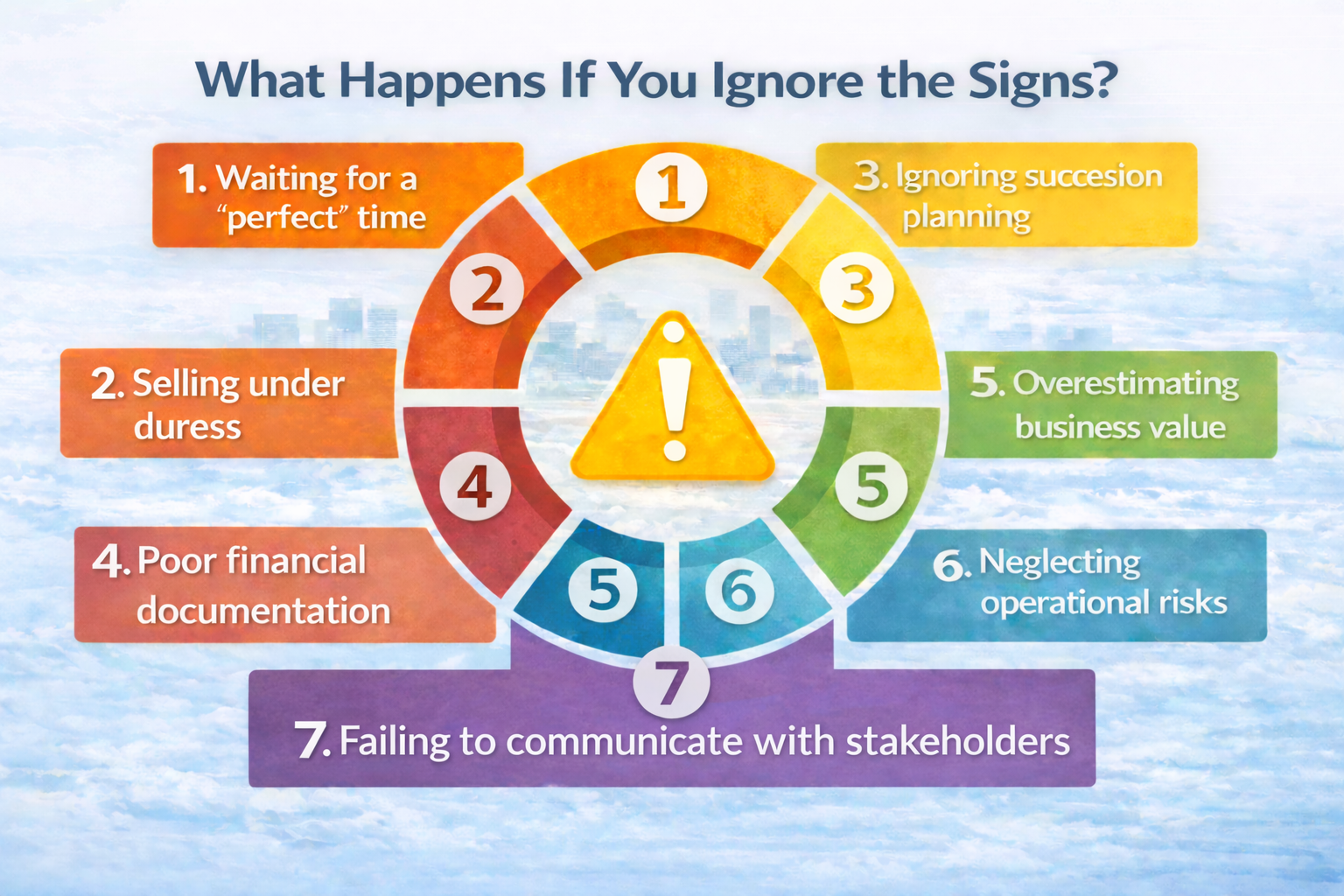
Ignoring the signals that you’re ready to sell can have serious consequences. Many owners wait too long, hoping for one more year of growth, only to face declining performance, market downturns, or personal burnout. Here’s what can go wrong, and how to avoid it.
| Pitfall | How to Avoid or Fix |
|---|---|
| Waiting for a “perfect” time | Set a decision deadline for yourself, review your readiness checklist quarterly, and consult with a broker to identify the next best window based on current market data. |
| Selling under duress | Prepare a written contingency plan that includes a list of trusted advisors, a summary of your key business documents, and a short list of potential buyers or brokers to contact if you must exit quickly. |
| Ignoring succession planning | Assign at least one team member to shadow your core responsibilities, document your daily/weekly tasks, and schedule quarterly leadership reviews to identify gaps. |
| Poor financial documentation | Schedule monthly reconciliations, create a digital folder for all supporting documents (tax returns, contracts, AR/AP reports), and have your CPA review your books annually for sale-readiness. |
| Overestimating business value | Request a formal business valuation from a qualified third party, compare your business to at least three recent local or industry sales, and adjust your expectations before listing. |
| Neglecting operational risks | Conduct a pre-sale audit using a checklist (legal, compliance, contracts, insurance), resolve any outstanding issues, and keep a summary of fixes for buyer review. |
| Failing to communicate with stakeholders | Draft a confidential communication plan in advance, including template emails for employees and key customers, and coordinate timing with your business broker to minimize disruption. |
Not every owner is ready to sell today, and that’s okay. The key is to use your self-assessment to build a stronger, more valuable business for the future. Here’s how to stay proactive and prepare for a successful exit down the road.
Focus on improving financial performance, diversifying your customer base, and strengthening your management team to increase value.
Create manuals, checklists, and transition guides to make your business more transferable and reduce buyer concerns.
Identify and develop potential leaders, even if you’re not planning to exit soon, to ensure continuity and reduce risk.
Stay informed about industry consolidation, buyer demand, and valuation multiples by monitoring market trends and networking with peers.
Set a calendar reminder to revisit your readiness checklist every 6–12 months, or after major business changes.
Read Next:
Deciding when to sell your business is never easy, but a structured self-assessment can bring clarity and confidence to your decision. By recognizing the signs of readiness, understanding the risks of waiting too long, and taking proactive steps, you can maximize your outcome and minimize regret.
Recognize and act on multiple readiness signals to time your exit for maximum value.
Avoid common pitfalls by planning ahead, documenting processes, and seeking expert input.
Book a readiness call to clarify your position and prepare for a successful, stress-free sale.
If you’re ready to take the next step, book a readiness call with Sunbelt Atlanta. With decades of experience, a confidential process, and a commitment to owner success, Sunbelt Atlanta is your trusted partner for every stage of the business sale journey. Whether you’re ready to exit now or just want to be prepared, our team can help you make the right move at the right time.
You know it’s time to sell your business when several key factors align: you feel emotionally ready, your business is performing strongly, favorable market conditions are in place, and you have clear personal or financial goals for the next chapter.
Additionally, if you’re experiencing burnout, receiving unsolicited offers, or see industry consolidation, these are strong signals to consider an exit.
The 30% rule in business typically refers to not having more than 30% of your revenue concentrated in a single customer or client. High concentration increases risk for buyers and can lower your business’s value. Diversifying your customer base makes your business more attractive and resilient, both for ongoing operations and for future sales.
A company getting ready to sell often shows signs like cleaning up financials, documenting processes, reducing owner dependence, and securing long-term contracts. Owners may also start delegating more, preparing transition plans, or engaging with brokers and advisors. Increased industry networking and responding to buyer inquiries are additional indicators.
Common mistakes include waiting too long to sell, failing to prepare financials, ignoring succession planning, overestimating business value, and not seeking professional advice. These errors can lead to lower offers, deal delays, or failed transactions. Proactive planning and expert guidance help avoid these pitfalls.
To increase your business’s value, focus on improving profitability, diversifying your customer base, strengthening your management team, and documenting key processes. Address any operational or financial weaknesses, secure long-term contracts, and reduce owner dependence. Regularly review your readiness and consult with advisors to maximize your sale outcome.
10 min read
As a medical professional, you know the value of hard work. After those long years in medical school, passing your board exams, and finally becoming...
17 min read
What causes most small business sales to fall apart after an offer is accepted? According to data from Axial, nearly 70% of failed transactions break...
10 min read
Imagine this: You’ve spent years — decades, even — pouring into your business. You’ve labored and toiled day-in and day-out to create something truly...